
Choosing between Upwork vs Fiverr can shape every freelancer’s daily workflow and earning potential. Whether you prefer the structure of fixed-price gigs on Fiverr or the opportunity for ongoing client relationships on Upwork, the core differences in hiring models and project management are more than just technical—they define how your work is found, priced, and valued. This guide helps you identify which platform best matches your freelance strengths so you can focus on growing your reputation and income efficiently.
Table of Contents
- Core Differences Between Upwork And Fiverr
- Hiring Models And Project Workflows
- Fee Structures And Earning Potential
- Best Project Types For Each Platform
- Common Challenges And Mistakes To Avoid
- Strategic Tips For Standing Out And Winning Jobs
Key Takeaways
| Point | Details |
|---|---|
| Platform Model | Upwork operates on a bidding system while Fiverr uses a gig-based marketplace, impacting job acquisition styles and freelancer types. |
| Communication Style | Upwork fosters ongoing, detailed communication with clients, while Fiverr interactions are typically brief and transactional. |
| Fee Structures | Fiverr has a flat 20% commission, whereas Upwork offers a tiered fee system that rewards long-term client relationships. |
| Project Suitability | Fiverr is best for quick, standard tasks; Upwork excels in complex, collaborative projects requiring deeper client engagement. |
Core differences between Upwork and Fiverr
Freelancers navigating online work platforms need to understand the fundamental distinctions between Upwork and Fiverr. These platforms might seem similar at first glance, but they operate with distinctly different models that can significantly impact a freelancer’s workflow and earning potential.
The most critical difference lies in their job acquisition approach. Gig-based versus bidding systems define how freelancers interact with potential clients:
- Fiverr: Uses a gig-based marketplace where:
- Freelancers create predefined service packages
- Clients browse and purchase standardized offerings
- Prices are typically fixed
- Ideal for quick, specific service deliverables
- Upwork: Employs a competitive bidding model where:
- Clients post detailed job descriptions
- Freelancers submit customized proposals
- Prices are negotiable
- Better for complex, long-term projects
These structural differences mean each platform attracts different types of freelancers and clients. Fiverr tends to suit specialists offering quick, repeatable services like logo design or basic writing, while Upwork caters to professionals seeking more comprehensive, collaborative project engagements.
The client relationship dynamics also vary significantly. On Fiverr, interactions are typically transactional and brief, with minimal ongoing communication. Upwork, conversely, encourages more in-depth client relationships, often leading to recurring work and potential long-term partnerships.
Here’s a summary of client-freelancer relationship dynamics by platform:
| Relationship Aspect | Upwork | Fiverr |
|---|---|---|
| Communication depth | Ongoing, detailed | Brief, transactional |
| Long-term opportunities | Common and encouraged | Rare, mostly one-off |
| Project customization | Highly flexible | Limited to gig packages |
| Repeat client potential | High, supports recurring work | Low, relies on gig sales |
Pro tip: Research both platforms thoroughly and create profiles that highlight your specific service strengths to maximize your chances of success.
Hiring models and project workflows
Freelance platforms like Upwork and Fiverr offer distinctly different approaches to project hiring and workflow management. Understanding these nuanced differences can help freelancers strategically choose the platform that best matches their work style and professional goals.
Flexible hiring models define the core operational distinctions between these platforms:
- Upwork Hiring Models:
- Hourly rate contracts
- Fixed-price project agreements
- Milestone-based payment structures
- Comprehensive project management tools
- Detailed time tracking capabilities
- Fiverr Hiring Models:
- Primarily fixed-price gigs
- Predefined service packages
- Standardized deliverable expectations
- Quick turnaround focus
- Limited customization options
The workflow variations significantly impact how freelancers interact with clients. On Upwork, professionals engage through detailed job postings, submit customized proposals, and negotiate specific project parameters. This approach allows for more nuanced collaboration and flexible project scoping.

In contrast, Fiverr streamlines the process by presenting predefined service packages. Clients browse standardized offerings and purchase directly, reducing negotiation time but potentially limiting the depth of client-freelancer interaction. This model works exceptionally well for straightforward, clearly defined tasks like graphic design, writing, or programming snippets.
Pro tip: Analyze your service type and typical client needs to determine which platform’s workflow will maximize your earning potential and professional satisfaction.
Fee structures and earning potential
Understanding the fee structures on Upwork and Fiverr is crucial for freelancers looking to maximize their earning potential. Each platform takes a different approach to commission and pricing that can significantly impact a freelancer’s take-home pay.
Platform fee models create distinct financial landscapes for freelancers:
- Fiverr Fee Structure:
- Flat 20% commission on all sales
- Consistent fee across all project values
- Predictable but potentially higher cost for freelancers
- No sliding scale for long-term clients
- Upwork Fee Structure:
- Tiered commission model
- 20% fee for first $500 earned with a client
- Reduces to 10% for earnings between $500.01-$10,000
- Further reduces to 5% for client earnings over $10,000
- Incentivizes long-term client relationships
The fee difference dramatically influences freelancers’ strategic choices. Fiverr’s uniform 20% commission works well for quick, low-maintenance gigs, making it attractive for service providers offering standardized offerings. Upwork’s sliding scale encourages deeper, ongoing client relationships by financially rewarding sustained engagement.
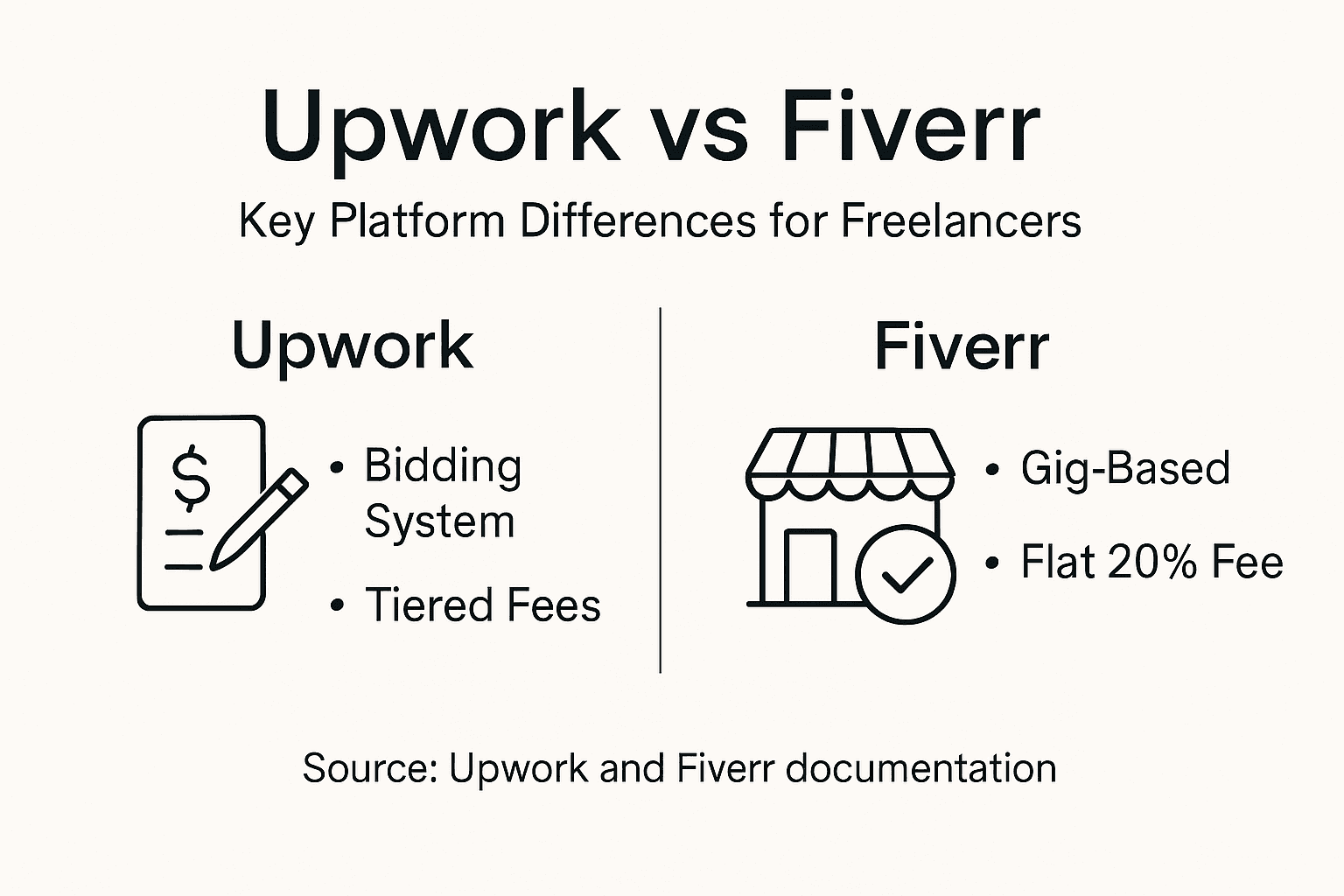
Freelancers must carefully calculate their pricing strategy, considering platform fees, project complexity, and long-term earning potential. While Fiverr offers simplicity, Upwork provides more nuanced financial opportunities for those willing to invest in building lasting client connections.
Pro tip: Calculate your effective hourly rate after platform fees to ensure you’re pricing services competitively across different freelancing platforms.
Best project types for each platform
Understanding which freelance platform suits specific project types can dramatically improve a freelancer’s success rate and overall earning potential. Each platform has unique strengths that align with different professional service categories.
Project type specializations reveal distinct platform characteristics:
- Fiverr Best Project Types:
- Graphic design
- Logo creation
- Video editing
- Short-form content writing
- Social media graphics
- Quick digital marketing tasks
- Translation services
- Music and audio editing
- Upwork Best Project Types:
- Software development
- Web programming
- Complex marketing strategies
- Long-term consulting projects
- Comprehensive content production
- Technical writing
- Business analysis
- Professional research projects
The fundamental difference lies in project complexity and client interaction requirements. Fiverr excels with standardized, quick-turnaround services that can be easily packaged into fixed-price offerings. These are typically creative or technical micro-tasks with clear, predefined deliverables.
Upwork, conversely, thrives on projects demanding deeper collaboration, specialized skills, and ongoing communication. Professional services requiring significant customization, strategic thinking, and extended engagement find a more suitable home on Upwork’s platform.
Pro tip: Analyze your specific service skills and create platform-specific portfolios that highlight the types of projects most likely to succeed on each marketplace.
Common challenges and mistakes to avoid
Freelancers often encounter significant hurdles when navigating Upwork and Fiverr, which can dramatically impact their success and earning potential. Understanding these potential pitfalls is crucial for maintaining a competitive edge in the online freelancing marketplace.
Platform-specific freelancing challenges create unique obstacles for professionals:
- Upwork Challenges:
- Complex proposal writing requirements
- Competitive bidding environment
- Strict profile verification processes
- High competition for quality projects
- Detailed client communication expectations
- Time-consuming application processes
- Fiverr Challenges:
- Limited client interaction options
- Fixed pricing constraints
- Rapid turnaround expectations
- High platform commission rates
- Less opportunity for negotiation
- Difficulty building long-term client relationships
Many freelancers make critical errors by not thoroughly understanding each platform’s unique ecosystem. On Upwork, underbidding or creating generic proposals can quickly lead to rejection, while on Fiverr, failing to create compelling, standardized service packages can result in minimal visibility and reduced job opportunities.
Successful freelancers must strategically approach platform selection, profile optimization, and client communication. This means tailoring your approach to each platform’s specific requirements, maintaining professional standards, and continuously adapting to platform-specific nuances.
This table consolidates top strategic mistakes to avoid on each platform:
| Platform | Common Mistake | Impact on Success |
|---|---|---|
| Upwork | Generic, unpersonalized proposals | Reduced project offers |
| Upwork | Underbidding for jobs | Lower earnings, project rejection |
| Fiverr | Vague or unclear service packages | Poor visibility in client searches |
| Fiverr | Ignoring rating management | Fewer new client transactions |
Pro tip: Invest time in creating platform-specific strategies, thoroughly read each platform’s guidelines, and continuously refine your approach based on performance metrics and client feedback.
Strategic tips for standing out and winning jobs
Succeeding on freelance platforms requires a strategic approach that goes beyond basic service offerings. Freelancers must develop a sophisticated understanding of platform-specific dynamics to truly differentiate themselves and attract high-quality clients.
Winning freelance strategies demand targeted approaches for each platform:
- Upwork Winning Strategies:
- Craft hyper-personalized proposals
- Build comprehensive professional profiles
- Highlight specialized skill sets
- Develop long-term client relationships
- Maintain consistently high-quality work
- Actively manage client communication
- Fiverr Winning Strategies:
- Create clear, attractive service packages
- Use competitive, strategic pricing
- Optimize gig descriptions for search
- Provide fast, consistent delivery
- Maintain exceptional customer ratings
- Use platform-specific visual branding
Successful freelancers understand that platform performance is about more than just technical skills. On Upwork, this means creating proposals that demonstrate deep understanding of client needs, while on Fiverr, it involves packaging services in ways that immediately communicate value and professionalism.
The most effective freelancers continuously refine their approach, studying platform algorithms, client feedback, and emerging trends. This means regularly updating portfolios, seeking client testimonials, and staying adaptable to changing market demands.
Pro tip: Invest in professional profile photos, craft compelling service descriptions, and treat each platform as a unique ecosystem requiring specialized strategies.
Boost Your Freelance Success on Upwork and Fiverr Today
Navigating the complex worlds of Upwork and Fiverr can be challenging when it comes to winning jobs, managing clients, and standing out from the competition. This article highlights key pain points like crafting personalized proposals, managing different hiring models, and handling platform fee structures. If you want to eliminate time-consuming tasks, generate winning proposals effortlessly, and streamline your freelance workflow in one place, Zenlance is designed exactly for those needs.
Discover how Zenlance can help you conquer the challenges discussed in this article by supporting personalized proposal creation and client management that fit both gig-based and bidding platforms. Don’t wait to level up your freelance game on Upwork and Fiverr. Visit Zenlance now and get started. For more insights on enhancing your freelancing strategy, check out our Uncategorized – Zenlance category and explore other tools at our main site. Your pathway to winning more jobs and growing your freelance business faster begins here.
Frequently Asked Questions
What are the main differences between Upwork and Fiverr?
Upwork uses a bidding system where freelancers submit customized proposals for client projects, while Fiverr operates on a gig-based marketplace where freelancers create predefined service packages that clients can purchase directly.
What types of projects are best suited for Fiverr?
Fiverr is ideal for quick, standardized services such as graphic design, video editing, short-form content writing, and social media graphics. These projects typically require clear and predefined deliverables.
How do the fee structures of Upwork and Fiverr compare?
Fiverr charges a flat 20% commission on all sales, regardless of project value. In contrast, Upwork employs a tiered commission model, with fees reducing from 20% to 5% based on cumulative earnings with a client, incentivizing long-term relationships.
What common mistakes should freelancers avoid on these platforms?
Freelancers should avoid generic proposals on Upwork, as well as underbidding for jobs, which can lead to reduced earnings. On Fiverr, vague service packages may result in poor visibility, and neglecting rating management can limit new client opportunities.