Freelancers often describe Upwork as unpredictable. Some weeks bring steady interviews and new contracts, while other weeks produce silence despite similar effort. This inconsistency leads many freelancers to assume that success on the platform is random or dependent on luck.
In reality, Upwork is governed by structured ranking and matching systems designed to maximize successful hiring outcomes. These systems are commonly referred to as the “Upwork algorithm.” While Upwork does not publish a technical specification, its behavior is observable through consistent patterns.
This guide provides a complete and practical Upwork algorithm explained framework. It is written for freelancers who want to understand not only what affects visibility, but why those factors exist and how to align with them sustainably. The goal is not short-term tricks, but long-term positioning that compounds over time.
Table of Contents
- What the Upwork Algorithm Is
- Why the Algorithm Exists
- Step 1: How Search Ranking Works
- Step 2: Profile Signals That Affect Visibility
- Step 3: Proposal Performance and Client Engagement
- Step 4: Job Success Score and Long-Term Trust
- Step 5: Behavioral Signals and Consistency
- Step 6: Workflow Optimization at Scale
- Advanced and Often Ignored Ranking Signals
- How the Invite System Works
- How New Freelancers Should Approach the Algorithm
- Common Myths About the Upwork Algorithm
- Zenlance Tie-In: Turning Knowledge Into Execution
- Frequently Asked Questions
Quick Summary
| Key Insight | Explanation |
|---|---|
| Upwork optimizes for outcomes | Freelancers are ranked based on likelihood of successful contract completion. |
| Relevance precedes reputation | A focused profile often outranks a generic profile with more history. |
| Engagement drives exposure | Replies, interviews, and hires influence future visibility. |
| Consistency compounds | Predictable activity and delivery build long-term trust. |
| Systems outperform effort | Structured workflows outperform inconsistent bursts of activity. |
What the Upwork Algorithm Is
The Upwork algorithm is not a single formula. It is a group of interconnected systems that determine which freelancers are shown to clients, in what order, and under which circumstances. These systems affect search results, proposal ordering, invite eligibility, and overall exposure, as outlined in Upwork’s official guidance on how freelancers are discovered by clients.
The algorithm does not exist to reward effort, loyalty, or seniority. It exists to protect the client experience. Every ranking decision is ultimately based on one question: how likely is this freelancer to deliver a successful outcome for the client?
To answer that question, Upwork evaluates three categories of signals. The first category is relevance, which measures how closely a freelancer matches a client’s immediate need. The second category is trust, which measures historical performance and reliability. The third category is behavior, which measures patterns of responsiveness and consistency.
Freelancers who understand these categories stop guessing. Instead of reacting emotionally to fluctuations, they begin optimizing intentionally.
Why the Algorithm Exists
Upwork serves millions of clients and freelancers across hundreds of categories. Without automated ranking systems, clients would be overwhelmed by choice and hiring would become inefficient.
The algorithm exists to reduce friction. It helps clients find suitable freelancers faster, reduces the likelihood of disputes, and increases the chance that clients return to the platform.
From a business perspective, Upwork benefits when contracts complete successfully, clients rehire, and freelancers remain active. The algorithm rewards behavior that supports those outcomes.
The algorithm is not designed to be fair to freelancers. It is designed to be safe for clients.
Step 1: How Search Ranking Works
Search ranking determines whether a client ever discovers your profile. Before reviews, ratings, or earnings are considered, the algorithm evaluates relevance.
Relevance is calculated using multiple signals. These include keyword alignment between a client’s search query and your profile title, the clarity of your specialization, your selected category and subcategory, and the similarity between your past contracts and the client’s job.
Many freelancers attempt to appear versatile by listing multiple services. While this may seem logical, it often reduces search visibility. The algorithm prefers clarity because clarity reduces uncertainty for clients.

A narrowly positioned profile sends a stronger signal than a broad one. A freelancer who clearly serves a specific type of client or problem is easier to match and easier to recommend.
Search ranking is not permanent. It changes based on recent relevance and performance. Freelancers who update their positioning without consistency often confuse the system.
Key takeaway: Your profile should clearly answer who you help, what you do, and what outcome you deliver within seconds.
Step 2: Profile Signals That Affect Visibility
Once relevance is established, the algorithm evaluates profile quality. This stage answers a different question: if a client clicks this profile, how likely is a successful engagement?
Profile completeness is critical. Incomplete or outdated profiles introduce doubt. Even small inconsistencies, such as irrelevant portfolio items or outdated skills, reduce engagement.
High-impact profile signals include a clear title, a focused overview, relevant portfolio samples, consistent work history, and logical pricing, all of which are covered in detail in our Upwork profile optimization guide.
Portfolios matter not because of aesthetics, but because they provide evidence. Clients want proof that you have solved similar problems before.
Profiles that attempt to appeal to everyone often appeal to no one. Focused positioning increases both client trust and algorithm confidence.
Step 3: Proposal Performance and Client Engagement
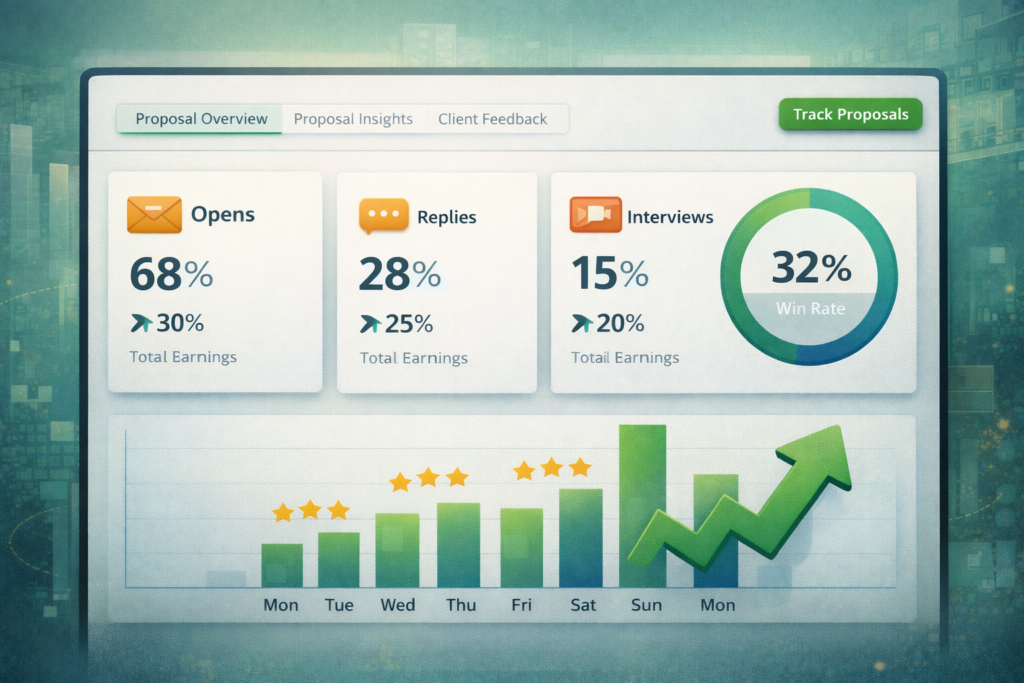
Proposals are not shown equally. Upwork tracks how clients interact with proposals and uses that data to inform future visibility, a concept also reinforced in marketplace optimization research published by HubSpot’s sales engagement studies.
Engagement signals include whether a proposal is opened, how long it is read, whether the client replies, whether an interview is created, and whether a hire occurs.
Proposals that fail to generate engagement gradually reduce a freelancer’s exposure. This is why mass-applying with generic proposals often leads to diminishing returns.
High-performing proposals focus on relevance, clarity, and ease of response, which is why freelancers benefit from following a structured approach like the one outlined in our Upwork proposal writing guide.
Long proposals filled with credentials often underperform because they create cognitive load. Clear and concise proposals outperform verbose ones.
The goal of a proposal is not to win the job. It is to start a conversation.
Step 4: Job Success Score and Long-Term Trust
Job Success Score represents long-term reliability rather than short-term performance. It reflects aggregated outcomes across multiple contracts.
Strong Job Success Scores are associated with completed contracts, positive private feedback, repeat clients, on-time delivery, and low dispute rates, which we break down further in our Job Success Score explained guide.
One poor contract rarely causes lasting damage. Patterns matter more than isolated incidents, which aligns with how long-term trust signals are evaluated across digital marketplaces according to Forbes’ analysis on digital platform trust.
Freelancers who panic after a single setback often make decisions that create further instability. Calm, consistent performance restores trust over time.
Closing contracts properly, managing scope changes, and communicating expectations clearly are critical to long-term trust.
Step 5: Behavioral Signals and Consistency
Behavioral signals measure reliability. These signals are subtle but powerful.
The algorithm observes login frequency, response times, proposal cadence, and availability accuracy. Freelancers who demonstrate predictable behavior are safer recommendations.
Extended inactivity or erratic bursts of activity introduce uncertainty. Even skilled freelancers can lose momentum if behavior appears inconsistent.
Consistency does not mean constant activity. It means stable patterns that the system can rely on.
Step 6: Workflow Optimization at Scale
As freelancers grow, execution becomes the bottleneck. Without systems, performance degrades under workload.
Optimized workflows rely on repeatable processes. These include clear criteria for job selection, reusable proposal frameworks, scheduled follow-ups, and regular performance reviews.
Freelancers who track their activity make better decisions. Data replaces emotion, and adjustments become strategic instead of reactive.
Systems allow freelancers to maintain quality and consistency without burnout.
Advanced and Often Ignored Ranking Signals
Beyond obvious metrics, the algorithm evaluates secondary signals. These include repeat client behavior, contract stability, communication efficiency, and scope management.
Repeat clients send one of the strongest trust signals. They indicate that the match was successful beyond initial expectations.
Stable contracts with clear scopes outperform large but chaotic engagements. Predictability reduces platform risk.
Freelancers who communicate clearly and require fewer follow-ups create smoother client experiences and stronger signals.
How the Invite System Works
Invites are distributed based on relevance, trust, recent activity, and availability.
Freelancers who ignore invites or decline excessively may see fewer invites over time. Responsiveness matters even when declining.
Invites are not a shortcut. They follow the same principles as search and proposals.
How New Freelancers Should Approach the Algorithm
New freelancers lack historical data. As a result, relevance and engagement are even more important.
New accounts should focus on narrow positioning, strong portfolio examples, and selective applications.
The goal early on is not maximum income. It is signal clarity.
Early positioning shapes long-term visibility.
Common Myths About the Upwork Algorithm
Many freelancers believe lower bids rank higher. This is false. Price affects client choice, not algorithm trust.
Others believe constant activity alone improves ranking. Activity without engagement often harms performance.
Another myth is that new accounts are suppressed. In reality, new accounts simply lack data.
Finally, many freelancers fear one bad review. Patterns matter more than single events.
Zenlance Tie-In: Turning Knowledge Into Execution
Understanding the Upwork algorithm explained in theory is useful. Executing consistently is where most freelancers struggle.
Zenlance helps freelancers systemize proposals, track engagement, manage follow-ups, and maintain consistency. Instead of guessing, freelancers operate with structure.
Structured execution naturally produces the signals the algorithm rewards.
Frequently Asked Questions
Is the Upwork algorithm publicly documented?
No, but its behavior is observable through platform patterns and official guidance.
How long does optimization take?
Relevance changes can impact visibility quickly. Trust improvements compound over weeks.
Is quality more important than volume?
Yes. Focused, high-engagement activity consistently outperforms mass applications.
Can freelancers recover from poor performance?
Yes. Consistent delivery and clear positioning restore trust over time.
Is the Upwork algorithm something to fear?
No. It is a predictable system that rewards professionalism, clarity, and consistency.