Fiverr Level System Explained: How to Become Top Rated Seller Faster (2026)
Understanding the Fiverr level system is not optional if you are serious about building a sustainable income on the platform. Your seller level determines how many gigs you can publish, how fast your earnings clear, what support tier you have access to, and — critically — how much trust buyers extend to you before placing an order. A Level 2 seller competing for the same buyer as a New Seller is operating from a fundamentally different position of advantage. And a Top Rated seller operates in an entirely different category of opportunity, trust, and visibility.
Most guides to the Fiverr level system stop at the requirements table: here are the numbers, hit them, move up. This one goes further. The Fiverr level system is a layered mechanism — six quantifiable metrics govern the automatic promotions through New Seller, Level 1, and Level 2, but Top Rated status requires something qualitative that no metric can fully capture. It requires a manual review by Fiverr’s evaluation team against four specific pillars. Understanding both the quantitative and qualitative dimensions of the Fiverr level system is what separates sellers who move through it efficiently from sellers who meet the numbers and still do not get promoted.
This guide covers the complete Fiverr level system in 2026: how every level works, what the six metrics mean and how to move them, what makes Top Rated different from every other level, how the manual review actually evaluates your account, and the specific strategies that consistently accelerate progression through every tier — from New Seller to the platform’s most prestigious designation.
Table of Contents
- What Is the Fiverr Level System and Why Does It Matter?
- Section 1: The Six Metrics That Power the Fiverr Level System
- Section 2: New Seller — Starting Point and Smart First Moves
- Section 3: Level 1 — Requirements, Benefits, and How to Get There Faster
- Section 4: Level 2 — The Most Underestimated Step in the Fiverr Level System
- Section 5: Top Rated Seller — The Manual Review Explained
- Section 6: The Four Pillars Fiverr Uses to Evaluate Top Rated Candidates
- Section 7: How to Accelerate Through the Fiverr Level System
- Section 8: The Success Score — The Hidden Engine of the Fiverr Level System
- Section 9: How to Protect Your Level and Avoid Demotion
- Common Mistakes That Slow Progress Through the Fiverr Level System
- Fiverr Level System Progression Checklist
- Frequently Asked Questions About the Fiverr Level System
What Is the Fiverr Level System and Why Does It Matter?
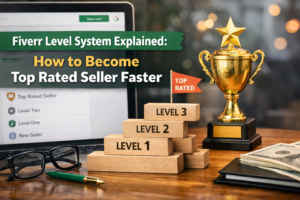
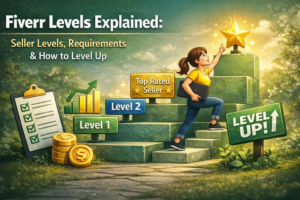
The Fiverr level system is a four-tier seller recognition framework — New Seller, Level 1, Level 2, and Top Rated — that classifies every seller on the platform based on their performance, consistency, and client satisfaction. Each tier unlocks a progressively larger set of capabilities and benefits: more active gig slots, additional gig extras, faster earnings clearance, higher-tier customer support, and greater algorithmic visibility in Fiverr’s search results.
According to Fiverr’s official level system documentation, your level is determined by your performance across six key metrics. The Fiverr level system was substantially updated in recent years — removing order completion rate and on-time delivery as direct level criteria and replacing them with the Success Score and a unique clients count. The current system evaluates your performance daily for Level 1 and Level 2 promotions, meaning you can advance any day you qualify — not just on a fixed monthly schedule.
The practical impact of the Fiverr level system extends far beyond the badge on your profile. Fiverr’s search algorithm weights seller level as a ranking signal, which means a higher level translates directly into more impressions on your gigs, more organic buyer visibility, and a stronger first impression for any buyer who reaches your profile page. A New Seller and a Level 2 seller with identical gig descriptions are not competing equally in Fiverr’s marketplace — the level creates a visibility gap that cannot be bridged by gig optimization alone.
The Fiverr level system is not just a recognition program — it is the infrastructure of your Fiverr business. Every level you advance multiplies your gig capacity, shortens your payment timeline, and expands the trust signal you present to every buyer who finds you. Understanding and deliberately moving through it is one of the most impactful actions any Fiverr seller can take.
Section 1: The Six Metrics That Power the Fiverr Level System
The Fiverr level system evaluates six specific metrics simultaneously. All six must meet the threshold for your target level at the same time — falling short on any single metric blocks promotion regardless of how strong your other numbers are. Understanding each one prevents the frustrating experience of approaching level-up day thinking you qualify, only to find one metric below threshold.
1. Success Score (Scale of 1–10)
The Success Score is the Fiverr level system’s most complex and most important metric. It is a composite evaluation of each of your gigs across six performance areas: client satisfaction, communication quality, cancellations, repeat business, buyer feedback, and overall order experience. Critically, the Success Score is relative — it benchmarks your performance against other sellers in the same price range, not against the entire platform. A seller charging $50 per gig is compared to other $50 sellers. This means you can have a 4.8-star rating and still carry a Success Score of 4 if sellers in your price tier are consistently outperforming you on private feedback, cancellation rates, or revision frequency.
The minimum Success Score required by the Fiverr level system is 5 for Level 1, 7 for Level 2, and 9 for Top Rated qualification.
2. Star Rating
Your star rating in the Fiverr level system reflects the rolling average of all client-submitted ratings over the past two years. The minimum for Level 1 is 4.7, dropping slightly to 4.6 for Level 2, then returning to 4.7 for Top Rated qualification. This non-linear pattern matters: a seller who dips to a 4.65 average might be stuck at Level 1 even after completing the orders and earnings required for Level 2.
3. Response Rate
Response rate measures how often you reply to new messages within 24 hours over the last 90 days. A 90% or higher response rate is required at every level in the Fiverr level system above New Seller. This is the most easily protected metric — it requires only a daily inbox habit, not exceptional skill. Installing the Fiverr app and enabling message notifications is the simplest way to ensure response rate never becomes your blocking metric.
4. Orders Completed
This is the total all-time count of orders you have completed on Fiverr. The Fiverr level system requires 10 completed orders for Level 1, 20 for Level 2, and 40 for Top Rated qualification.
5. Unique Clients
Unique clients counts the number of different buyers you have worked with — each buyer counts once regardless of how many repeat orders they place. This metric enters the Fiverr level system at Level 2 (requiring 10 unique clients) and scales to 20 for Top Rated. It specifically rewards breadth of client experience. A seller who has done 25 orders for three repeat buyers has not yet met the Level 2 unique client threshold, regardless of earnings or order count.
6. Earnings
Total Fiverr earnings is the cumulative revenue from all completed orders: $500 for Level 1, $2,000 for Level 2, and $10,000 for Top Rated qualification.
| Metric | Level 1 | Level 2 | Top Rated |
|---|---|---|---|
| Success Score | 5+ | 7+ | 9+ |
| Star Rating | 4.7+ | 4.6+ | 4.7+ |
| Response Rate | 90%+ | 90%+ | 90%+ |
| Orders Completed | 10+ | 20+ | 40+ |
| Unique Clients | — | 10+ | 20+ |
| Earnings | $500+ | $2,000+ | $10,000+ |
| Promotion Type | Automatic | Automatic | Manual review |

Section 2: New Seller — Starting Point and Smart First Moves
Every seller enters the Fiverr level system as a New Seller — the starting tier assigned automatically when you create your first gig. The New Seller phase is not a waiting room; it is the foundation phase where the inputs that drive every subsequent level promotion are built. How you approach your first 10 to 20 orders shapes not just your level progression but the Success Score baseline that follows you through the entire Fiverr level system.
Use All Available Gig Slots
New Sellers in the Fiverr level system can publish up to 7 active gigs. Using all 7 from the start — each targeting a distinct search query, buyer intent, or price point — creates 7x the surface area for buyer discovery. Every unfilled gig slot is a missed opportunity to appear in search results for a different buyer. The fastest way to accumulate the 10 orders needed for Level 1 is to maximize the number of pathways buyers can find you, and gig slot utilization is the most direct way to do this.
Prioritize Breadth of Buyers Early
Because unique clients becomes a requirement at Level 2 in the Fiverr level system, the habit of serving a diverse buyer base should begin in the New Seller phase. A seller who takes 10 orders from a single returning buyer reaches Level 1’s order count but is building a narrow client base that will constrain Level 2 progression. Prioritize orders from new buyers, even at modestly lower margins, to build the client diversity that the Level 2 threshold requires.
Treat Early Orders as Success Score Investments
Your Success Score benchmark is established by your early order performance. Over-delivering on the first five to ten orders — faster than promised, with proactive communication, with a deliverable that genuinely exceeds expectations — creates a Success Score foundation that is much easier to maintain than it is to rebuild after a difficult early engagement. The Fiverr level system’s Success Score is easier to protect from a strong position than to recover from a weak one.
Section 3: Level 1 — Requirements, Benefits, and How to Get There Faster
Level 1 is the first promoted tier in the Fiverr level system and the first visible trust signal a buyer sees on your profile beyond the New Seller default. The promotion is automatic — no application required. When all six metrics meet the Level 1 thresholds simultaneously, Fiverr promotes you, typically by the next day under the current daily evaluation system.
What Changes at Level 1
At Level 1, the Fiverr level system grants: 10 active gig slots (up from 7), up to 4 gig extras per gig priced up to $40, priority customer support, and eligibility for Seller Plus Standard ($29/month), which unlocks advanced analytics, early payout features, and promotional tools. The earnings clearance period remains at 14 days.
The most significant practical shift at Level 1 is not the extra gig slots — it is the buyer perception shift. A Level 1 badge tells every buyer who visits your profile that you have completed real orders, generated real earnings, and maintained a 4.7+ rating doing it. In a search result comparison between a New Seller and a Level 1 seller with otherwise equal gigs, the Level 1 badge converts browsers into buyers at a meaningfully higher rate.
The Fastest Path to Level 1
To move through the Fiverr level system to Level 1 quickly: set competitive introductory pricing to attract your first buyers, respond to every message within the hour to build and protect your response rate, deliver every order at or before the agreed deadline, and after each delivery send a brief, warm message confirming the client is satisfied and asking if there is anything else you can do. This combination consistently produces the 4.7+ ratings and 5+ Success Score needed while accumulating orders and earnings at the fastest organic pace.
Section 4: Level 2 — The Most Underestimated Step in the Fiverr Level System
Level 2 is the most strategically important promotion in the Fiverr level system for most sellers because it unlocks Seller Plus Premium — the tier that includes a dedicated Success Manager — and doubles your gig capacity. It is also the level where most sellers hit an unexpected wall because of the unique clients requirement.
The Unique Clients Trap
Many sellers approaching Level 2 in the Fiverr level system discover that they have reached the $2,000 earnings threshold and the 20-order count but fall short of the 10 unique clients requirement. This happens when a seller has delivered excellent work to a small group of highly satisfied repeat buyers — a genuinely good outcome in terms of service quality, but one that leaves the unique client count below threshold.
If unique clients is your bottleneck for Level 2, the solution is deliberate new buyer acquisition: pricing competitively enough to attract first-time buyers rather than relying on repeat orders, actively diversifying your gig portfolio to surface in front of different buyer segments, and promoting your gigs externally through LinkedIn or direct outreach to bring fresh buyers into your pipeline.
Level 2 Benefits Worth Knowing
At Level 2, the Fiverr level system grants: 20 active gig slots, up to 5 gig extras per gig priced up to $50, continued priority support, and Seller Plus Premium eligibility. The dedicated Success Manager available at Seller Plus Premium level is one of the most underused assets in the Fiverr level system — they provide personalized guidance specifically on the path to Top Rated, including advice on which metrics to prioritize, which gig categories to develop, and how to present your profile for the manual review process.

Section 5: Top Rated Seller — The Manual Review Explained
Top Rated is where the Fiverr level system changes fundamentally. Every promotion below Top Rated is fully automatic — the system checks your metrics and promotes you when all thresholds are met. Top Rated status requires something the algorithm cannot evaluate: a human judgment of your quality, professionalism, and client experience, conducted by Fiverr’s dedicated evaluation team.
The Trigger and Timeline
According to Fiverr’s official Top Rated documentation, the system checks your eligibility for Top Rated review daily. As soon as you meet all six metric thresholds, a banner appears on your dashboard indicating you are under review. The evaluation team then performs the holistic review. Fiverr’s team prioritizes reviews for high-demand categories where more Top Rated sellers are needed — if your gig category is not currently on the high-demand list, Fiverr cannot provide a timeline estimate for your review.
If You Are Approved or Rejected
If approved, your Top Rated status appears on your dashboard immediately. If not approved, you receive an email with the primary reason for the decision, remain at Level 2, and become eligible for re-evaluation after six months if your metrics still qualify. The rejection is not permanent — it is a specific, documented reason that tells you what to improve before the next review cycle.
Priority Queue for Seller Plus Premium
Sellers enrolled in Seller Plus Premium receive priority placement in the Top Rated review queue. Given that the review timeline is otherwise category-dependent and potentially indeterminate, this queue priority is one of the most direct ways to accelerate your Top Rated promotion within the Fiverr level system. If you are approaching Top Rated eligibility, investing in Seller Plus Premium for the queue priority alone may be worth the $49/month.
Section 6: The Four Pillars Fiverr Uses to Evaluate Top Rated Candidates
The Top Rated evaluation goes far beyond metrics. Fiverr’s team evaluates your account across four qualitative pillars that together assess whether you represent the kind of seller that deserves the platform’s highest public endorsement.
Pillar 1: Proficiency and Quality
This pillar measures whether your delivered work genuinely matches your advertised services and meets client expectations at the level of quality your price point implies. The evaluation looks at whether your deliverables demonstrate the professional skills your gig descriptions claim, whether the quality is consistent across different orders and clients, and whether your work complexity is appropriate to the scope and price of what you offered. Sellers who over-promise and under-deliver on deliverables — even if they receive polite public reviews — often fail this pillar because Fiverr’s team can review actual deliverables and private feedback patterns.
Pillar 2: Client Experience
This pillar evaluates how effectively you manage client interactions from initial message to final delivery. Fiverr’s reviewers assess your responsiveness to client inquiries, your skill in setting clear expectations about timelines and scope before work begins, and the overall smoothness of the client journey. A client who felt well-informed and professionally served throughout the process — even if the project had complications — represents a strong client experience signal. A client who felt confused, surprised by outcomes, or frustrated by communication gaps represents a weak one, regardless of what the public review says.
Pillar 3: Professional Presentation
This pillar examines how you present yourself and your services on the platform. It covers the clarity and completeness of your gig descriptions, the quality and professionalism of your gig images and videos, the structure and accuracy of your seller profile, and whether your overall presentation makes you easy to find, understand, and trust. A seller with a Top Rated-worthy track record but disorganized gig pages, thin descriptions, and low-quality gig images will fail this pillar. Professional presentation is not cosmetic — it is a direct signal of how seriously you take your Fiverr business.
Pillar 4: Compliance
This is a non-negotiable pillar. Your account must have a clean Terms of Service history — no active warnings, no history of behavior that violates Fiverr’s community standards, no attempts to conduct business off-platform, and no manipulation of the review system. A single Terms of Service warning in the 30 days prior to evaluation creates an automatic disqualification from the Top Rated review regardless of how strong your other pillars are.
| Pillar | What Fiverr Evaluates | Key Signal |
|---|---|---|
| Proficiency & Quality | Deliverable quality vs. advertised scope | Consistent, high-standard output across all orders |
| Client Experience | Communication, expectation setting, delivery smoothness | Clients feel informed and well-served end-to-end |
| Professional Presentation | Profile, gig pages, images, descriptions | Clear, complete, trustworthy presence on the platform |
| Compliance | Terms of Service adherence, community standards | Zero warnings; all activity on-platform and compliant |
Section 7: How to Accelerate Through the Fiverr Level System
Understanding the Fiverr level system’s mechanics is necessary — but the sellers who move through it fastest combine metric knowledge with deliberate execution habits that compound over time.
Fill Every Gig Slot at Every Level
The Fiverr level system grants increasing gig capacity at each tier: 7 → 10 → 20 → 30. Sellers who fill every slot create proportionally more search visibility, more buyer entry points, and more order opportunities. A seller at Level 2 with 8 active gigs out of 20 available is operating at 40% of their visibility potential within the Fiverr level system. Each new gig targets a different search term and reaches a different buyer segment — unused slots are unused revenue potential.
Protect Response Rate as a Non-Negotiable
The 90% response rate required throughout the Fiverr level system above New Seller is a metric that almost never needs to be an obstacle — yet it regularly becomes one for sellers who let their inbox go unchecked during busy periods. Set Fiverr mobile notifications and commit to a once-daily minimum inbox review. A response rate that drops from 95% to 85% takes weeks to recover because the metric looks back 90 days. The habit cost of maintaining it is a daily 5-minute check; the recovery cost of losing it is weeks of potential level-blocking.
Build Toward Unique Clients Proactively
Because unique clients is the most commonly missed metric at Level 2 in the Fiverr level system, treat new-buyer acquisition as a deliberate strategic goal from the start. Set competitive introductory pricing, create gigs that target different buyer segments, promote your Fiverr profile externally, and actively respond to buyer requests. Repeat business is valuable but cannot substitute for unique client diversity in the Fiverr level system’s counting logic.
Target Your Success Score Directly
Since the Success Score is the most complex and most impactful metric in the Fiverr level system, improving it requires targeting its specific inputs: reduce cancellations through clear scope definitions before order acceptance, improve communication quality by sending proactive updates at key project milestones, and generate repeat business by delivering experiences that make clients want to return. Review your Level Overview page monthly to track your Success Score trend and identify which gig is pulling the overall score down.

Section 8: The Success Score — The Hidden Engine of the Fiverr Level System
The Success Score is the least understood component of the Fiverr level system and the one with the highest leverage. Because it is only visible to you — buyers see your level, not your score — most sellers treat it as a secondary metric. That is a strategic mistake. The Success Score is the single metric with the highest threshold escalation across the Fiverr level system (from 5 to 7 to 9), and it is the one most closely correlated with Fiverr’s search visibility algorithm.
Why the Relative Scoring Model Matters
Because the Success Score benchmarks you against sellers in the same price range rather than against an absolute standard, improving your score is partly about your own performance and partly about the competitive landscape you operate in. A seller who charges $50 per gig and is in a highly competitive category with many well-performing peers may need to be significantly above average to maintain a high score. Pricing your gigs at a level where your performance genuinely stands out from your comparison group — rather than competing at a price point where you are mediocre by the category’s standards — is one of the most effective Success Score positioning strategies.
The Six Input Areas
Fiverr calculates the Success Score across six key areas within the Fiverr level system. Client satisfaction covers public and private review patterns. Communication quality evaluates how effectively you exchange information with buyers before and during orders. Cancellations measure both the frequency and circumstances of cancelled orders. Repeat business rewards clients who return, signaling sustained satisfaction. Buyer feedback encompasses both the public rating and the private score buyers submit separately. Order experience quality wraps these inputs into an overall assessment of how smooth and satisfying each engagement was.
The Highest-Impact Action: Eliminate Cancellations
Cancellations are the single most negative input in the Success Score model within the Fiverr level system. An order that is cancelled after work has begun — regardless of whose fault the cancellation is — generates a stronger negative signal than almost any other event in the system. The prevention strategy is specific: never accept an order without confirming you understand the full scope, use the requirements gathering phase to clarify ambiguities before work begins, and when a clearly mismatched order arrives, address it immediately through messaging rather than accepting and then cancelling.
Section 9: How to Protect Your Level and Avoid Demotion
The Fiverr level system can move in both directions. A level earned can be lost if metrics fall below the threshold for your current tier, and the business impact of a demotion is immediate — fewer gig slots, lower search visibility, and a trust signal downgrade that buyers notice.
The 30-Day Grace Period
When a metric in the Fiverr level system drops below your current level’s threshold, you enter a 30-day grace period before any demotion takes effect. This window gives you time to recover the lagging metric before a level change is applied. The grace period is one of the most seller-friendly features of the current Fiverr level system — but it only works if you notice the metric drop quickly enough to act on it.
Weekly Level Overview Checks
The Level Overview page in your seller dashboard (accessible via Growth & Marketing → Level Overview) shows your current standing against every metric threshold in real time. Building a weekly habit of checking this page gives you early warning when any metric is trending toward a threshold — well before the grace period is triggered. Identifying a declining metric in week 1 is very different from discovering it in week 3 of a 4-week grace period.
TOS Compliance Is Non-Negotiable
Throughout the Fiverr level system, Terms of Service compliance is a continuous prerequisite for level participation. A warning places your progression on hold — you can still receive and complete orders, but you cannot advance through the Fiverr level system while the hold is active. For Top Rated sellers, a single warning in the preceding 30 days creates an automatic review risk. Never conduct business off-platform, never attempt to manipulate the review system, and never engage in behavior that Fiverr’s community standards prohibit. The consequences at every level are disproportionate to any short-term gain a violation might seem to offer.
Common Mistakes That Slow Progress Through the Fiverr Level System
These errors consistently delay level progression and are entirely preventable with the right awareness.
1. Treating the Fiverr level system as time-based rather than performance-based. The most common misconception about the Fiverr level system is that levels come automatically with tenure. They do not. A seller who has been on Fiverr for two years with poor metrics stays at New Seller. A seller who completes 10 high-quality orders in 60 days reaches Level 1. The system rewards performance, not time on platform. Every seller who is waiting to level up should be asking which of the six metrics is below threshold — not how many more months they need to wait.
2. Ignoring the unique clients count until it is a problem. The unique clients metric in the Fiverr level system catches many Level 1 sellers by surprise when they approach Level 2. A seller with strong earnings and high order counts who has been serving a small group of repeat buyers can find themselves $1,000 short of the $2,000 earnings threshold — or technically over it — but with only six unique clients against the required ten. Check your unique client count on your Level Overview page monthly and adjust your acquisition strategy if it is trending below the next threshold.
3. Letting the Success Score drift without intervention. The Fiverr level system’s Success Score does not decline due to inactivity — but it does decline due to subtle performance patterns that accumulate over time: a slightly higher revision rate, a few more cancellations than usual, a private feedback pattern that differs from the public ratings. Most sellers only discover a declining Success Score when it blocks a promotion or triggers a grace period. Weekly Level Overview checks prevent this by surfacing score trends before they reach threshold impact.
4. Not preparing for the Top Rated review while working toward the metrics. The biggest mistake sellers make in the Fiverr level system’s Top Rated phase is waiting until all six metrics are met before thinking about the four qualitative pillars. The review evaluates your gig presentation, profile completeness, and communication patterns across your entire history — not just your most recent orders. Start optimizing your gig descriptions, gig images, and profile for the review long before your metrics reach the Top Rated thresholds.
5. Accepting orders outside your genuine skill scope. Every order accepted outside your actual capability is a cancellation risk, a revision-frequency risk, and a Success Score risk — all of which directly impact your position in the Fiverr level system. The short-term income of an out-of-scope order is rarely worth the metric damage it creates. Defining your service boundaries clearly in your gig descriptions and declining orders that do not fit is not limiting — it is protecting your level progression and your Success Score trajectory.
6. Not using Seller Plus Premium to accelerate Top Rated review. Seller Plus Premium members receive priority placement in Fiverr’s Top Rated review queue. According to Fiverr’s community guide on becoming Top Rated, joining Seller Plus Premium and working with a dedicated Success Manager is one of the most direct paths to navigating the review process successfully. For a seller who has met all six Top Rated metric thresholds and is waiting for a review, this queue priority can meaningfully shorten the timeline to Top Rated status. The $49/month cost of Seller Plus Premium is a small investment relative to the income impact of reaching Top Rated — the level that unlocks 7-day earnings clearance, VIP support, and the platform’s most powerful trust signal.
7. Responding to metrics drops with panic rather than diagnosis. When a metric in the Fiverr level system drops, the productive response is identifying which specific input caused the drop and addressing it precisely. Cutting prices, accepting any order available, or over-communicating with buyers out of anxiety are responses that often create new metric problems while failing to address the original one. Use the Level Overview page, the Success Score breakdown, and your recent order history to diagnose the actual cause, then act on that diagnosis specifically.
8. Never asking for reviews from satisfied buyers. Your star rating is a direct input to your standing in the Fiverr level system, and many satisfied buyers do not leave reviews unless prompted. After delivering each completed order, include a brief note: “If you are happy with the work, a short review makes a real difference as I grow on Fiverr — I genuinely appreciate it.” This single habit consistently produces higher review rates from satisfied buyers and strengthens the rating metric that the Fiverr level system tracks continuously.

Fiverr Level System Progression Checklist
- ☐ Level Overview page reviewed weekly (Growth & Marketing → Level Overview)
- ☐ All available gig slots filled at current level
- ☐ Response rate is 90%+ — Fiverr mobile app installed with notifications enabled
- ☐ Success Score is at or above threshold for target level (5 / 7 / 9)
- ☐ Star rating is at or above threshold for target level (4.7 / 4.6 / 4.7)
- ☐ Unique clients count tracked — new buyer acquisition active if below next threshold
- ☐ Cancellations actively prevented: scope confirmed before accepting every order
- ☐ Proactive milestone updates sent on every active order
- ☐ Review request included in every order delivery message
- ☐ No active Terms of Service warnings or account holds
- ☐ If approaching Level 2: unique clients is above 10
- ☐ If approaching Top Rated: all gig descriptions are complete, specific, and professionally written
- ☐ If approaching Top Rated: gig images are high-quality and professionally presented
- ☐ If approaching Top Rated: seller profile is 100% complete and accurately represents your skills
- ☐ If approaching Top Rated: Seller Plus Premium considered for priority review queue access
- ☐ If in grace period: bottleneck metric identified and improvement plan in place
Frequently Asked Questions About the Fiverr Level System
How often does Fiverr evaluate your level in the fiverr level system?
For Level 1 and Level 2, Fiverr evaluates your eligibility daily — meaning you can be promoted any day you meet all six metric thresholds simultaneously. For Top Rated, the system checks eligibility daily and triggers a manual review queue entry as soon as you qualify, but the actual evaluation is conducted by Fiverr’s team on a timeline that depends on your category’s demand for Top Rated sellers. There is no fixed monthly evaluation date in the current Fiverr level system — the old 15th-of-the-month schedule applied to a previous version.
Can I be demoted in the Fiverr level system?
Yes. If any metric falls below the threshold for your current level, you enter a 30-day grace period. If the metric is not recovered within 30 days, a demotion is applied. For Top Rated sellers, a Terms of Service warning within the preceding 30 days creates an immediate review risk without the standard grace period protection. The level demotion has a direct impact on search visibility — Fiverr’s algorithm uses level as a ranking signal, so a demotion translates to fewer gig impressions until your level is recovered.
Why is Top Rated different from the other levels in the Fiverr level system?
Level 1 and Level 2 are fully automated — the system promotes you the day your six metrics all hit the required thresholds. Top Rated is the only level in the Fiverr level system that requires a human review. Fiverr’s evaluation team assesses your account across four qualitative pillars — proficiency and quality, client experience, professional presentation, and compliance — that no algorithm can fully measure. This manual dimension ensures Top Rated status is a genuine marker of quality, not just a metrics milestone that any high-volume seller can hit.
What is the Success Score and why does it matter so much?
The Success Score is a 1–10 composite metric Fiverr calculates for each of your gigs based on six performance areas: client satisfaction, communication quality, cancellations, repeat business, buyer feedback, and overall order experience. Its most important and most misunderstood characteristic is that it is relative — your score is benchmarked against other sellers in the same price range, not against the entire platform. This means a 4.8-star rating does not guarantee a high Success Score if your competitive set consistently outperforms you on private feedback, revision rates, or cancellation patterns. The Success Score is the metric that most directly reflects the holistic quality of your Fiverr operation.
How do I know if my gig category is eligible for Top Rated review?
Fiverr’s evaluation team prioritizes reviews for high-demand categories where more Top Rated sellers are needed. According to Fiverr’s official Top Rated documentation, if your gigs are not in one of the currently prioritized categories, Fiverr cannot provide a timeline estimate for your review. You can check the eligible category list in the Top Rated help article. If your category is not listed, continue building your metrics and profile quality — the category list updates over time as Fiverr’s demand patterns change, and Seller Plus Premium members receive priority queue access regardless of category.
Does inactivity hurt your position in the Fiverr level system?
Your Success Score does not decrease due to inactivity alone — it reflects your historical performance record rather than current order volume. However, your response rate is measured over the last 90 days, so extended inactivity where messages go unanswered will pull that metric below threshold. The practical approach for periods of reduced availability is to use Fiverr’s Out of Office mode, which pauses incoming orders and new inquiries without affecting your response rate or Success Score during the period it is active. Returning from Out of Office mode with a clean metric slate is significantly easier than recovering a damaged response rate from an unmanaged absence.
How Zenlance Helps You Move Through the Fiverr Level System Faster
Progressing through the Fiverr level system is fundamentally a consistency challenge — not a knowledge challenge. You know what the metrics require. The difficulty is maintaining all six metrics simultaneously across dozens of active orders, client conversations, and delivery deadlines without any single one slipping below threshold. The sellers who level up fastest are not the most talented — they are the most organized.
Zenlance is a free AI-powered CRM built specifically for Upwork and Fiverr freelancers. It gives you a centralized dashboard to track every active order, log client communications, set delivery reminders, and manage follow-ups — so the response rate, cancellation rate, and client satisfaction metrics that power the Fiverr level system stay consistently above threshold even when your order queue is full. Start free at zenlance.net.
Recommended Reading
- Fiverr Seller Levels Explained: Requirements & How to Level Up (2026)
- How to Write a Fiverr Gig Description That Converts Buyers (2026)
- How to Price Your Fiverr Gigs Without Undercharging (2026 Guide)
- How to Create a Fiverr Seller Profile That Gets Clicks in 2026
- How to Get Your First Fiverr Order Fast (Even as a Beginner) in 2026
- Fiverr vs Upwork: Which Platform Is Better for Freelancers in 2026?
- Free AI CRM for Freelancers: Manage Clients, Tasks, and Projects in 2026