How to Win Freelancing Jobs: A Step-by-Step System
This guide gives you a practical, repeatable system to win freelancing jobs. You will learn how to choose a winnable niche, position your profile, build proof fast, write proposals that convert, price confidently, and run a client workflow that leads to repeat work and referrals.
Table of Contents
- Step 1: Choose a winnable niche and offer
- Step 2: Build a profile that answers client questions
- Step 3: Create a portfolio that proves results
- Step 4: Find high-intent opportunities consistently
- Step 5: Write proposals that get replies
- Step 6: Price and scope for profit, not stress
- Step 7: Close projects and turn them into repeat work
Quick Summary
| Key Insight | Explanation |
|---|---|
| Clients buy clarity | They choose the freelancer who explains the plan, timeline, risks, and next steps in plain language. |
| Proof beats promises | Small case studies, samples, and before/after examples reduce perceived risk and increase reply rates. |
| Proposals are not resumes | Winning proposals focus on the client’s outcome, then match your experience to that outcome. |
| Scope is a sales tool | A clear scope, assumptions, and exclusions prevents misunderstandings and protects your time. |
| Follow-up multiplies wins | Most freelancers do not follow up. A professional follow-up often triggers replies and closes. |
| Systems create consistency | Templates for discovery questions, proposals, and delivery make quality repeatable and scalable. |
Step 1: Choose a winnable niche and offer
To win freelancing jobs consistently, you need a simple positioning statement that makes a client think, “This person does exactly what I need.” A niche is not limiting yourself forever. It is choosing a focused starting point where you can build proof faster and compete on expertise rather than price.
Start by combining (1) a specific client type, (2) a specific problem, and (3) a specific deliverable. For example: “Email sequences for Shopify skincare brands” or “Webflow landing pages for B2B SaaS lead gen.” This format helps clients self-qualify and helps you write sharper proposals.
- Pick one primary service you can deliver repeatedly with high quality.
- Define your target buyer (industry, size, stage, or role).
- Choose one measurable outcome (leads, conversions, speed, retention, clarity).
- Package your work into a clear deliverable (audit, landing page, dashboard, logo system, script, etc.).
- Create a short list of “ideal project types” you will actively pursue.
Pro tip: If you are unsure what to niche into, choose the work you can explain best. The ability to explain the work clearly is often what clients interpret as “expertise,” especially during early conversations.
A simple niche selection checklist
| Question | If “Yes,” it is a good sign | If “No,” what to do |
|---|---|---|
| Can I produce a strong result in 7–14 days? | Faster proof and testimonials | Package a smaller version (audit, MVP, first draft) |
| Can the client measure success? | Easier to sell outcomes | Define proxy metrics (time saved, reduced errors, clarity) |
| Do I enjoy repeating this work? | Higher consistency and less burnout | Adjust the offer or audience until it fits |
| Are clients already paying for it? | Proven demand | Refine to a more common pain point |
| Can I show proof without NDA issues? | Stronger portfolio | Use anonymized case studies or sample projects |
Step 2: Build a profile that answers client questions
Your profile is a sales page. Clients scan it to answer four questions: What do you do? Who do you do it for? Can you prove it? What happens if I hire you?
Marketplaces provide their own guidance on building and improving freelancer profiles. If you work on Upwork, review Upwork’s recommendations for building and enhancing your freelancer profile and use them as a quality baseline for completeness and credibility. Upwork profile essentials and Upwork profile enhancements are useful references for what to include and why. On Fiverr, follow platform guidance on gig structure and best practices. Fiverr gig best practices is a good starting point.
- Headline: “Role + niche + outcome” (not a long list of skills).
- Overview: 5–8 short paragraphs: who you help, the problem, your process, proof, and next steps.
- Specialized services: 3–5 bullet services that match client language.
- Portfolio: Lead with your best, most relevant examples.
- Credibility: Certifications, tools, or methods only if they support your offer.
- Professional details: A consistent name, photo, location/timezone, and response expectations.
The fastest way to lose a client’s attention is to make them decode what you do. Make the first two lines of your profile so clear that a client can repeat your value back to you.
Profile overview structure you can reuse
- Line 1: “I help [client type] achieve [outcome] with [service].”
- Line 2: “If you are dealing with [pain point], I can help.”
- Process: 3–5 steps you follow (audit → plan → build → review → deliver).
- Proof: 1–2 mini case study bullets (problem → action → result).
- Fit: “Best for” and “Not a fit for” statements (reduces bad leads).
- CTA: Invite a short call or ask 2–3 screening questions.
Pro tip: If you are on Upwork, consider setting a custom profile URL for easier sharing and cleaner outreach. Upwork documents how to update a custom profile URL in profile settings. Upwork custom profile URL help
Step 3: Create a portfolio that proves results
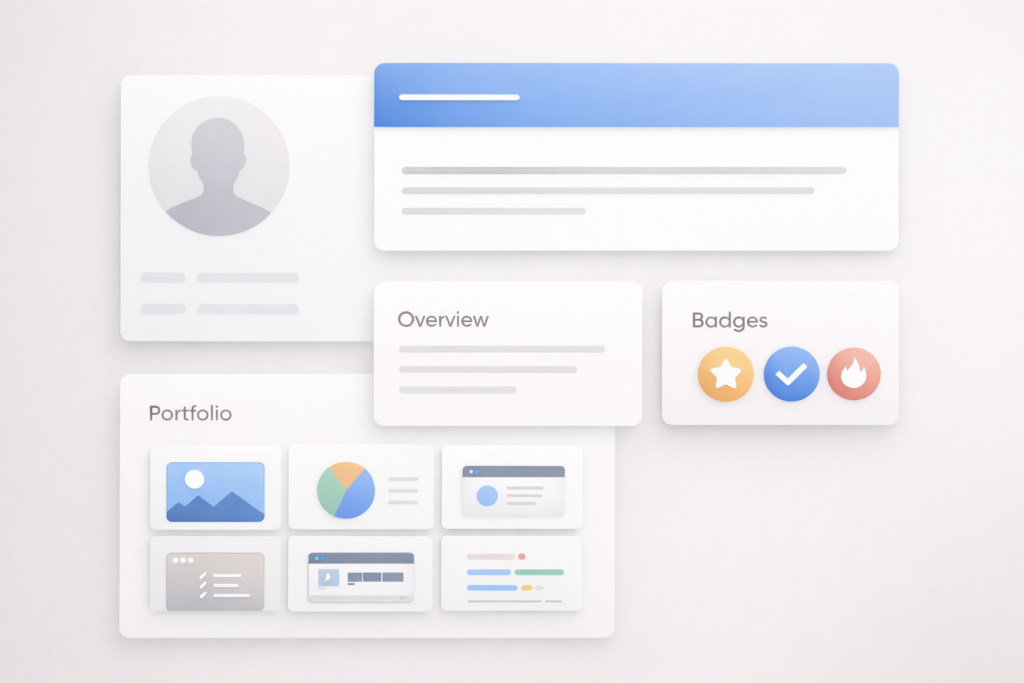
Clients do not need a large portfolio. They need a believable one. A small set of strong, relevant samples beats a long gallery of unrelated work. Your goal is to reduce risk: show that you have solved similar problems and that you have a reliable delivery process.
If you lack client work, create “proof projects.” These are realistic samples built around common client scenarios in your niche. For example, if you sell landing pages, create a landing page for a hypothetical product and document the choices you made and why. If you sell automation, build an automation for a common workflow and explain the inputs, outputs, and constraints.
- Include 3–6 portfolio items that match the projects you want next.
- For each item, add a 5–7 line case summary: goal, constraints, approach, deliverables, result.
- Show artifacts clients recognize: wireframes, dashboards, before/after screenshots, snippets, short Looms.
- Use anonymized data if needed; focus on process and decision-making.
- Create one “flagship case study” that is deeper than the rest.
A portfolio is not a museum. It is evidence. If an item does not help a client decide to hire you, remove it or rewrite it.
Case study template (copy and reuse)
- Client / context: Industry, size, and situation (anonymized if needed).
- Problem: What was not working, and what it cost them (time, money, risk).
- Goal: What success looked like within a timeframe.
- Approach: Your method and why you chose it.
- Deliverables: Concrete outputs (files, pages, reports, automations).
- Outcome: Quantified results when possible; otherwise clear qualitative wins.
Pro tip: Borrow language clients already use. Read job posts and extract the phrases they repeat (for example: “optimize,” “fix tracking,” “improve conversion,” “clean design,” “fast turnaround”). Then mirror those phrases in your portfolio captions and proposals.
Step 4: Find high-intent opportunities consistently
Opportunity quality matters more than volume. High-intent opportunities are those where the client has a clear need, a defined timeline, and signals they will make a decision soon. Low-intent opportunities are vague, under-scoped, or written as brainstorming prompts.
On marketplaces, you can improve your results by focusing on posts that describe a specific deliverable, include relevant context (industry, tools, access), and show that the client understands what “good” looks like. For Upwork proposals specifically, Upwork provides platform guidance on submitting proposals and writing cover letters that describe what you can do, ask questions, and suggest next steps. How to submit a proposal on Upwork is a practical reference for the flow and expectations. Upwork also shares proposal guidance designed to help freelancers tailor proposals and highlight relevant skills. How to create a proposal that wins jobs
- Set a daily input goal: for example, 30 minutes of searching and 3–5 targeted proposals.
- Prioritize fit signals: clear scope, reasonable budget, relevant tools, realistic timeline.
- De-prioritize red flags: vague requirements, unrealistic turnaround, “expert needed for cheap,” no decision timeline.
- Track what converts: project type, niche, client role, and your approach angle.
- Use multiple channels: marketplace feed + inbound content + referrals + direct outreach.
Pro tip: Keep a simple pipeline spreadsheet: Lead → Contacted → Replied → Call booked → Proposal sent → Won/Lost. This turns “random luck” into measurable conversion rates you can improve.
High-intent vs. low-intent job post comparison
| Signal | High-intent post | Low-intent post |
|---|---|---|
| Deliverable | Specific output and acceptance criteria | General desire, unclear output |
| Context | Background, tools, access, constraints | Minimal details |
| Timeline | Clear deadline or milestone dates | “ASAP” with no plan |
| Budget logic | Budget matches complexity | Budget disconnected from scope |
| Decision readiness | Asks for next steps, interview availability | No mention of selection process |
Step 5: Write proposals that get replies

Proposals are where most freelancers lose. Many proposals read like autobiographies: skills lists, generic promises, and long histories. Clients want a plan for their project: what you will do, how you will do it, what you need from them, and what happens next.
Use platform guidance as a baseline, then differentiate with specificity. Upwork emphasizes tailoring your approach, understanding client needs, and highlighting relevant skills. Upwork proposal guidance and Upwork’s advice on what to include and how to structure proposals can help you avoid common mistakes. Upwork: write a successful proposal For longer-form proposals (outside marketplaces), structured proposal components like problem, solution, timeline, and pricing are widely recommended. HubSpot’s proposal guidance is a useful reference for what a complete proposal often contains. HubSpot: how to write a business proposal
- Open with relevance: Repeat the client’s goal in your words and confirm you understand the context.
- Diagnose before prescribing: Mention the likely root cause or risk based on the details provided.
- Provide a short plan: 3–6 bullets with deliverables, timeline, and checkpoints.
- Include proof: One relevant sample, case study, or a short “similar project” summary.
- Ask smart questions: 2–4 questions that show you think like a partner.
- Close with next step: Offer a short call or propose a first milestone.
Your proposal should feel like the first page of the project plan, not a job application.
A proposal framework you can reuse
1) Hook (2–3 lines)
“You want [outcome] and you are currently dealing with [constraint]. I can help by [service] using [approach].”
2) Plan (5–8 lines)
Outline steps, each with a deliverable. Keep it scannable.
3) Proof (2–4 lines)
One relevant example: “For a similar [client], I did [action] and achieved [result].”
4) Questions (bullets)
Ask the questions that determine scope and timeline.
5) Next step (1–2 lines)
Suggest a call or propose a first milestone with a concrete deliverable.
Pro tip: Avoid attachments and long walls of text when possible. If you want to include a deeper breakdown, offer it as a follow-up: “If helpful, I can share a 1-page plan after you answer two quick questions.”
Follow-up system (the unfair advantage)
Many clients post a job, get overwhelmed by responses, and delay decisions. A calm, professional follow-up can bring you back to the top of their inbox without being pushy.
- Follow-up #1 (24–48 hours): reiterate the goal, restate your plan in one line, ask one question.
- Follow-up #2 (4–5 days): offer two options (call times or milestone choices).
- Follow-up #3 (7–10 days): close the loop politely and invite them to return when ready.
Step 6: Price and scope for profit, not stress
Pricing is not only a number. It is a structure that sets expectations. Most pricing problems come from vague scope: unclear deliverables, assumptions, and revision rules. When scope is clear, pricing becomes easier to defend because it is attached to outcomes and work units.
Start with a baseline rate or package that covers your time, overhead, and a profit margin. Then present pricing in a way that makes the client feel in control: options and trade-offs rather than a single take-it-or-leave-it number.
- Use milestones: break projects into logical phases with review points.
- Define deliverables: specify what files, formats, and access are included.
- Set revision rules: number of revision rounds and what counts as a “revision.”
- List assumptions: what you expect from the client (assets, approvals, access).
- Clarify exclusions: what is not included (prevents scope creep).
Clients rarely argue with a price when they understand exactly what they are buying and how it reduces their risk.
Pricing options table (example structure)
| Option | Best for | Includes | Trade-off |
|---|---|---|---|
| Starter (fixed) | Clear, small deliverable | Single output + 1 revision + handoff | Limited flexibility |
| Standard (milestones) | Most projects | Discovery + build + review + 2 revisions | More client involvement |
| Premium (retainer) | Ongoing optimization | Monthly deliverables + reporting + priority | Higher commitment |
Pro tip: If a client is price-sensitive, reduce scope, not quality. Offer a smaller first milestone that proves value quickly, then expand once trust is established.
Step 7: Close projects and turn them into repeat work
Winning a project is only the start. The freelancers who grow fastest do two things well: they set expectations early and they make the client’s life easier during delivery. That leads to great reviews, repeat work, and referrals.
Create a simple onboarding flow: confirm scope, collect access/assets, share a timeline, and define how communication will work. Then use a consistent delivery checklist to prevent mistakes and reduce stress.
- Kickoff message: recap goals, deliverables, timeline, and what you need first.
- Communication plan: response time, meeting cadence, where updates live.
- Progress updates: short updates at predictable times (e.g., every 2–3 days).
- Delivery package: final files + documentation + next-step recommendations.
- Project closeout: ask for feedback, request a testimonial/review, propose a follow-on.
A “smooth process” is a product. Clients pay for results, but they stay for reliability and communication.
Closeout script (professional and simple)
- Confirm what was delivered and where it is located.
- Explain how to use it (short checklist or 3–5 bullets).
- Share one improvement idea for the next phase.
- Ask: “Is there anything you want adjusted before we close?”
- Request a review/testimonial if they are satisfied.
Pro tip: Keep a “next engagement” menu ready (audit, monthly maintenance, new feature). The best time to sell the next project is right after a successful delivery.
Zenlance tie-in: Turn proposals and follow-ups into a system
Most freelancers lose jobs for preventable reasons: slow responses, inconsistent proposal quality, unclear scope, and missing follow-ups. Even strong freelancers can struggle when every proposal is written from scratch and every client conversation lives in scattered notes.
Zenlance helps you standardize how you win freelancing jobs by turning your best-performing proposal patterns into a repeatable workflow. Instead of reinventing your pitch each time, you can generate tailored proposals faster, keep client details organized, track follow-ups, and maintain a consistent delivery process that leads to better reviews and repeat work.
- Create structured proposals that emphasize scope, milestones, and outcomes.
- Store reusable service packages, case study snippets, and qualification questions.
- Track leads and follow-ups so opportunities do not disappear in your inbox.
- Keep a clear client timeline from kickoff to delivery to review requests.
Frequently Asked Questions
How long does it take to win freelancing jobs consistently?
It depends on your niche, proof, and daily outreach volume. Many freelancers see improvement within 2–4 weeks after tightening their offer, updating their portfolio, and sending targeted proposals consistently. The key is measuring conversion rates (views → replies → calls → wins) and improving one step at a time.
What should I include in the first two lines of a proposal?
Restate the client’s goal and show you understand the context. Then give a one-sentence plan or outcome. This signals relevance quickly and increases the chance the client reads the rest.
Do I need a niche to win freelancing jobs?
You can get work as a generalist, but a niche usually helps you win faster because clients can immediately see fit. If you are early, choose a focused niche for 30–60 days to build proof, then broaden carefully.
How do I win freelancing jobs if I have no reviews yet?
Create proof projects and package a small, low-risk first milestone. Your goal is to reduce client risk with clear deliverables and visible competence. You can also offer an audit or diagnostic as an entry service to build trust quickly.
How many proposals should I send per day?
A practical starting point is 3–5 highly targeted proposals per day. Quality matters more than volume, but consistency matters more than bursts. Track results weekly and adjust based on reply rate.
Should I follow up after sending a proposal?
Yes, professionally. Many clients miss messages or delay decisions. A short follow-up within 24–48 hours and one additional follow-up later can increase replies without being pushy.
What is the most common reason freelancers lose jobs?
The most common reason is unclear value: proposals that talk about the freelancer instead of the client’s outcome. The fix is to lead with a plan, add relevant proof, ask smart questions, and make the next step easy.
External Resources
Backlink Outreach Opportunities
- Freelancing communities and newsletters: They can reference the step-based framework and templates as a practical resource for their audiences.
- Creator education platforms: Sites that teach freelancing can link to the proposal and portfolio sections as a structured guide.
- Productivity and workflow blogs: They can cite the pipeline, follow-up system, and client delivery checklists as workflow best practices.