
How to Improve Job Success Score on Upwork (Without Getting More Clients) — 2026
Understanding how to improve job success score on Upwork is one of the most searched topics among freelancers — and one of the most misunderstood. Most guides tell you to complete more jobs and get more five-star reviews. That advice is not wrong, but it misses the point for the freelancer whose score is already suffering. If your JSS has dropped to 75%, you do not need more clients right now. You need to understand exactly why it fell, which existing contracts are dragging it down, and what specific actions taken within your current account will move the number back up — before you send another proposal.
The Job Success Score is not a simple average of your star ratings. It is a weighted composite of public feedback, private feedback, contract closure reasons, long-term relationship signals, and earnings-adjusted contract weights. A client who gave you four public stars and privately answered “4 out of 10” on the likelihood-to-recommend question has damaged your score more than the public rating suggests. A contract you left open three months ago with no activity is quietly counting against you. A high-value project that ended badly is weighted at 1.5× the impact of a small job. Knowing how to improve job success score means understanding all of these levers — not just chasing new five-star reviews.
This guide covers every factor Upwork uses to calculate your JSS, the specific strategies that move the score without requiring you to win new contracts, and the organizational habits that protect your score once it recovers. You will also find the exact thresholds Upwork uses to weight contracts, why private feedback is often the hidden culprit behind unexplained score drops, and how to use the Job Success Insights tool in your profile to diagnose problems accurately. Whether your score is stuck at 85% or has dropped below 80%, this is the practical, mechanics-first breakdown of how to improve job success score on Upwork in 2026.
Table of Contents
- What Is the Job Success Score and How Is It Calculated?
- Section 1: Why Your JSS Dropped (and How to Diagnose It)
- Section 2: How to Improve Job Success Score Through Private Feedback
- Section 3: How to Improve Job Success Score by Closing Contracts Cleanly
- Section 4: Long-Term Relationships and How They Boost Your Score
- Section 5: How Earnings Weighting Affects Your Score
- Section 6: How to Improve Job Success Score by Managing Open Contracts
- Section 7: How to Improve Job Success Score Through Delivery and Communication
- Section 8: Using the Job Success Insights Tool
- Section 9: Protecting Your Score Once It Recovers
- Common Mistakes That Damage Your Job Success Score
- Job Success Score Recovery Checklist
- Frequently Asked Questions
What Is the Job Success Score and How Is It Calculated?
Before you can know how to improve job success score, you need to understand what it actually measures. Upwork describes the JSS as a metric that reflects your clients’ overall satisfaction with your work on the platform. It appears on your profile once you have completed two or more projects with two or more different clients within a 24-month window. After that, it updates daily — a significant change from the old biweekly update cycle that made it harder to see the real-time impact of closed contracts.
Upwork calculates JSS based on your 6-month, 12-month, and 24-month history simultaneously and displays whichever of the three scores is highest on your profile. This means a freelancer who had a rough stretch six months ago but has since improved will show their best rolling window — protecting your visible score while the bad period ages out. Understanding this three-window system is important context for how to improve job success score: actions you take today start showing up in your 6-month window first, which is usually the fastest path to recovery.
The Four Factors Upwork Uses to Calculate JSS
According to Upwork’s official Job Success Insights documentation, four key factors determine your score:
| Factor | What It Measures | Impact Direction |
|---|---|---|
| Client Satisfaction | Public feedback, private feedback (0–10 NPS), and contract closure reason | Positive or negative based on all three components |
| Long-Term Relationships | Contracts active for 90+ days with payment are treated as automatically successful | Always positive — rewards retention |
| Higher Earnings | Jobs over $250 and over $1,000 are weighted more heavily | Amplifies both positive and negative outcomes |
| Contract Length | Every 90 days with payment counts as an additional “job” toward your JSS, up to 8× | Positive — long-running paid contracts multiply your score impact |
A score of 90% or above is considered excellent by Upwork and puts you on track for Top Rated status. Scores in the 80s indicate solid performance with some room for improvement. Below 79%, your visibility in search results drops and winning new projects becomes significantly harder. Knowing exactly how to improve job success score requires addressing whichever of these four factors is currently working against you — and that diagnosis starts with the Job Success Insights page in your profile.
Section 1: Why Your JSS Dropped (and How to Diagnose It)
The first step in knowing how to improve job success score is understanding why it dropped in the first place. Upwork identifies several specific causes, and the right recovery strategy depends on which one applies to your situation.
The most common reason for an unexpected score drop — one that surprises many freelancers — is negative private feedback. A client who gave you four or five public stars may have privately scored you 4 out of 10 on the likelihood-to-recommend question. That private score is factored into your JSS in ways that are invisible to you at the time of closing. You see the public review, feel good about it, and then watch your score slide without understanding why. According to Upwork’s support documentation on JSS drops, even if public feedback looks positive, negative private feedback can produce a less favorable JSS outcome on that contract.
Other Common Causes of JSS Drops
- Contracts closed without payment: If a contract ends with no earnings, it can still receive negative private feedback from the client — and that feedback counts against your score while positive feedback on zero-earnings contracts is excluded from the calculation entirely.
- Loss of a long-term client: A client you worked with for 90+ days was positively contributing to your JSS as long as the relationship continued. Losing them removes that positive weight and can cause the score to decline even without new negative feedback.
- A high-value contract ending badly: Jobs with earnings over $1,000 are weighted at 1.5× in the JSS calculation. A poor outcome on a large project hits harder than the same outcome on a small one — understanding this weighting is crucial for how to improve job success score in the context of higher-rate freelancing.
- Stale data rolling into view: Upwork uses 6-, 12-, and 24-month windows. Sometimes a score drops because old positive contracts aged out of the 12-month window and are no longer counted, leaving fewer positive signals to anchor the score.
- Disputed or cancelled contracts: Any contract that ends in a dispute or is cancelled without successful completion carries a negative signal that directly reduces your JSS.
To diagnose your specific situation, navigate to your Job Success Insights page: Profile → Stats/Trends → Job Success Insights. You will see which contracts are eligible, which are ineligible, and which specific factors — client satisfaction, long-term relationships, earnings, contract length — are showing positive or negative indicators. This is the starting point for any serious plan to how to improve job success score with precision rather than guesswork.

Section 2: How to Improve Job Success Score Through Private Feedback
Private feedback is the most underestimated factor in how to improve job success score. Most freelancers focus entirely on public star ratings — but the private component, which consists of the contract closure reason and the 0–10 likelihood-to-recommend score, often has an equal or greater impact on the JSS calculation. You never see the private score directly, but it is factored into your JSS before it is displayed on your profile.
The likelihood-to-recommend question is scored on a standard NPS scale: 0–6 is a detractor, 7–8 is neutral, and 9–10 is a promoter. A client who genuinely enjoyed working with you might give 4–5 public stars out of politeness but answer 6 on the private question — because they felt unclear about your process, were not fully satisfied with a specific deliverable, or simply did not feel the relationship was strong enough to confidently recommend you. On Upwork, a 4-star public rating combined with a private score of 6 can damage your JSS more than you would expect from looking at the stars alone.
How to Influence Private Feedback Without Asking for It
Upwork prohibits directly requesting positive feedback or coaching clients on how to rate you. But you can influence how a client feels at the point of closure — and that feeling determines what they score privately. The best approach to how to improve job success score through the private channel is to make every contract closure feel professionally complete, warm, and clear.
Specifically, in the 48 hours before a contract closes, deliver a structured handoff: a recap of everything completed, any documentation or files organized clearly, answers to likely next-step questions, and a short note expressing genuine appreciation for the collaboration. Clients who feel the project ended cleanly — with no ambiguity, no loose ends, and no sense of abandonment — are significantly more likely to score the relationship positively in private. The technical work matters. The closure experience matters equally.
Addressing Miscommunication Before It Becomes Private Feedback
If you sense during a project that a client is unhappy — slower replies, shorter messages, reduced engagement — address it proactively before the contract closes. Send a check-in message asking if the work is meeting expectations and whether there is anything they would like adjusted. Resolving tension mid-contract is far more effective for how to improve job success score than hoping the client’s frustration does not surface in private feedback at the end.
Section 3: How to Improve Job Success Score by Closing Contracts Cleanly
Contract closure reasons are one of the three components Upwork uses to measure client satisfaction — alongside public and private feedback — and they have a direct, documented impact on your JSS. The closure reason reflects whether Upwork classifies the end of the contract as successful, neutral, or problematic. Understanding this is essential for how to improve job success score without needing to complete additional work.
What Counts as a Clean Closure
A clean closure — where the client marks the job as completed successfully — is the strongest possible contract outcome for your JSS. It signals full client satisfaction to the algorithm, regardless of the star rating. By contrast, a contract closed by the client with a reason that implies incompletion, dissatisfaction, or dispute carries a negative signal even if no formal dispute was filed. Freelancers who proactively close idle contracts often make this mistake: closing a contract yourself triggers the client to leave feedback within 14 days, and if they are ambivalent about the project, their closure reason may reflect that ambivalence.
How to Engineer Clean Closures
The most reliable strategy for how to improve job success score through closures is to let the client initiate contract closure whenever possible — and to make that moment feel natural and positive. Before the project ends, deliver a formal wrap-up: summarize all deliverables, confirm the client’s satisfaction with a direct but relaxed question (“Is there anything else you need before we close this out?”), and give them the context they need to feel confident clicking “Job Completed Successfully.” This is not about manipulation — it is about ensuring the client has everything they need to feel good about the work when they go to close the contract.
For contracts where you need to close the account yourself — for example, projects abandoned by the client mid-way — do so carefully. If the client provided no payment and you close the contract, any negative private feedback they choose to leave will still count against you. If there is risk of negative feedback, it is sometimes better to leave the contract open until it ages naturally rather than forcing closure that could produce a negative JSS impact.
Even if public feedback looks positive, negative private feedback or a specific contract closure reason can lead to a less favorable JSS outcome. The closure experience is as important as the work itself. — Upwork Help Center
Section 4: How to Improve Job Success Score Through Long-Term Relationships
One of the most powerful but least-discussed mechanisms in how to improve job success score is the long-term relationship signal. According to Upwork’s official JSS documentation, contracts with clients you have worked with for longer than 90 days are automatically treated as successful outcomes — even if the contract eventually ends without client feedback. This means that every day a long-term client continues paying you, they are contributing a positive signal to your JSS without any additional action required.
The implication for how to improve job success score is significant: retaining even one or two clients in long-running engagements creates a steady positive foundation that partially offsets the impact of mixed feedback elsewhere. A freelancer with three active clients of 90+ days and one poor contract closure is in a fundamentally better JSS position than a freelancer running purely short-term projects where every closure depends on client feedback.
How to Cultivate Long-Term Relationships on Upwork
- Deliver small wins early. On every new contract, complete a meaningful piece of work within the first 10 days. Clients who see early evidence of competence and responsiveness are significantly more likely to extend the engagement.
- Send consistent, brief updates. A weekly message confirming progress — even two or three sentences — keeps clients engaged and reduces the “out of sight, out of mind” dynamic that leads to contracts going idle.
- Propose follow-on work proactively. At the end of a successful project, if there is a natural next step — a phase two, an optimization pass, an ongoing maintenance arrangement — mention it. Many freelancers leave long-term relationships on the table by treating each contract as a complete and separate engagement rather than the beginning of a relationship.
- Decline jobs you cannot sustain. Accepting a client you cannot serve consistently for three months is worse for your JSS than not accepting them at all. One of the most overlooked aspects of how to improve job success score is selectivity at the proposal stage — choosing clients where a long-term relationship is genuinely possible.
Section 5: How to Improve Job Success Score Using Earnings Weighting
Understanding the earnings weighting system is one of the most concrete mechanics in how to improve job success score, because it explains why two contracts with identical public feedback can have very different effects on your JSS. According to Upwork’s JSS insights documentation, contracts are weighted based on earnings as follows:
| Contract Earnings | JSS Weight | What This Means |
|---|---|---|
| $1 – $250 | 1.0× (base) | Counts as one standard job in the JSS calculation |
| $251 – $1,000 | 1.25× (elevated) | Has 25% more impact than a small job, positive or negative |
| Over $1,000 | 1.5× (high impact) | Has 50% more impact — a strong result amplifies your score significantly; a poor result hits harder |
| Contract length: every 90 days with payment | +1× per quarter (up to 8×) | Long-running paid contracts are treated as multiple successful jobs |
The practical lesson for how to improve job success score is twofold. First, a high-value project that ends badly does disproportionate damage. If you have a $2,000 contract at risk of poor feedback, the stakes of managing that client relationship carefully are much higher than they would be for a $150 project. Second, long-running contracts with regular payments are extraordinarily valuable to your JSS — not just because they create positive client satisfaction signals, but because each 90-day payment cycle counts as an additional successful job, multiplying the positive effect of a good relationship up to eight times.

Section 6: How to Improve Job Success Score by Managing Open Contracts
Open contracts with no recent activity are a quiet but real risk for your JSS. Freelancers often leave contracts open indefinitely — because the client has gone quiet, because both parties moved on without formally closing, or because the freelancer is uncertain whether closure will trigger unwanted feedback. Understanding how to handle these situations properly is a practical element of how to improve job success score that most guides skip.
Do Idle Open Contracts Hurt Your JSS?
An idle open contract — one with no recent payment or activity — does not directly damage your JSS while it remains open. The negative impact occurs only when it is closed and the client leaves negative private feedback. However, open contracts do affect your profile visibility and can create a misleading picture of your current workload for potential clients. More importantly, they represent a latent JSS risk: at any point the client can close the contract, and whatever they felt about the engagement — even if weeks or months have passed — can surface as private feedback.
How to Handle Stale Open Contracts
The strategic approach to how to improve job success score through open contract management is to proactively reach out to clients with idle contracts. Send a brief, professional message: confirm whether the project is complete, offer to close the contract cleanly, and give the client an opportunity to raise any unresolved concerns before closure. Most idle contracts end neutrally when you handle the outreach professionally. The goal is to control the closure process rather than waiting for the client to act unilaterally.
If you close the contract yourself, the client has 14 days to leave feedback. If they do not leave feedback within that window, the contract has no impact on your JSS — it simply becomes ineligible. According to Upwork’s community documentation, a contract closed with no payment and no feedback is excluded from the JSS calculation entirely. So for contracts where no money changed hands and where the client is unlikely to leave any feedback at all, proactive closure often has no JSS downside and removes the ambient risk of the contract sitting open indefinitely.
Section 7: How to Improve Job Success Score Through Delivery and Communication
The highest-leverage strategies for how to improve job success score over the long term are not tricks or workarounds — they are the delivery and communication habits that prevent score damage from occurring in the first place. Every point your JSS needs to recover is a point you did not lose — and given how weighted high-value contracts are, preventing one bad outcome is worth more than completing five small positive ones.
Set Clear Scope and Expectations Before Starting
Scope mismatches are the root cause of most client dissatisfaction on Upwork. When a client expects one thing and receives another — even if what you delivered is technically excellent — the private feedback often reflects that mismatch. Before accepting any contract, confirm in writing: the specific deliverables, the number of revisions included, the timeline, and what “done” looks like. Clients who have clearly agreed to the scope before work begins are far less likely to feel disappointed at the end — and far more likely to close the contract successfully.
Deliver Progress Updates Without Being Asked
One of the most reliable insights from experienced Upwork freelancers on how to improve job success score is that proactive communication consistently outperforms reactive communication in client satisfaction. Clients who receive unprompted progress updates — a quick message confirming you have started, a mid-project note with a preview, a heads-up before final delivery — consistently report higher satisfaction than clients who had to chase for updates, even when the actual work quality was identical. A weekly update on any contract longer than two weeks should be a non-negotiable part of your workflow.
Manage Scope Creep with a Calm, Professional Response
Scope creep — clients gradually adding requirements beyond the original agreement — is a common source of JSS risk. Freelancers who absorb scope creep silently often end up resentful, under-compensated, and unable to meet the original timeline, which then produces poor feedback. The better response is to acknowledge the request genuinely, clarify that it is outside the original scope, and propose a clear path forward: either a revised contract or an additional milestone. Clients handled this way rarely escalate — and they often respect the professionalism of a freelancer who manages expectations clearly.
Section 8: Using the Job Success Insights Tool to Know How to Improve Job Success Score
Upwork introduced the Job Success Insights tool in late 2024, and it is now the most direct resource available for understanding how to improve job success score in your specific account. It replaces guesswork with actual visibility into which contracts are positively or negatively impacting your score, and which factors — client satisfaction, long-term relationships, earnings, contract length — are working for or against you.
How to Access Job Success Insights
Navigate to your profile icon in the top right corner of Upwork and select your profile. From there, go to Stats/Trends and select Job Success Insights. If you have already earned a JSS, you will see a full breakdown of your score — including a list of eligible contracts with indicators showing whether each one is helping or hurting your score, and which specific factor is driving that outcome.
What to Look For in the Insights Dashboard
- Eligible vs. ineligible contracts: Contracts become ineligible when they age past 24 months, when a higher-value contract outweighs them, when they had no payment and no feedback, or when the client had a history of poor collaboration flagged by Upwork. Ineligible contracts do not affect your score — focus your energy only on eligible ones.
- Negative indicators on eligible contracts: Each eligible contract displays indicators for the four JSS factors. If client satisfaction shows a negative indicator, that contract’s private feedback or closure reason is dragging your score. If you see multiple contracts with negative client satisfaction signals, the issue is systemic — likely a scope, communication, or client selection problem — rather than a one-off event.
- Long-term relationship contributions: Check how many of your eligible contracts are contributing positively through the long-term relationship factor. If this column is thin or empty, building longer client engagements should be a priority in your plan for how to improve job success score.
- Contracts aging out soon: Some contracts will become ineligible as they approach the 24-month cutoff. If those contracts are positive, their removal from the calculation could lower your score unless you replace them with new positive signals. Time your outreach to existing clients and project completions around this window.
Section 9: Protecting Your Score Once It Recovers
Knowing how to improve job success score is only half the challenge. The other half is keeping it stable once it recovers — and understanding how to improve job success score sustainably means building habits that prevent the drop from recurring.
Be Selective About Which Jobs You Accept
Every job you accept is a potential JSS event. Low-budget, vague, or scope-ambiguous projects are disproportionately likely to produce poor outcomes — and on Upwork, one bad outcome on a high-value contract can undo the positive signal of five smaller successful jobs. The most durable freelancers on the platform treat job selection as their most important JSS protection habit. Ask three qualifying questions before accepting any contract: Is the scope clear enough to execute reliably? Does the budget reflect the actual complexity of the work? Does this client’s history suggest someone who closes projects positively?
Audit Your Open Contracts Monthly
Set a recurring monthly reminder to review all open contracts. Identify any that have had no payment in the past 30 days, where communication has gone quiet, or where the project seems to have stalled on the client’s side. Each of these is a latent JSS risk. Reaching out proactively — either to restart the engagement or to manage a clean closure — is the habit that keeps these risks contained before they become score damage.
Track Feedback Patterns, Not Just Individual Scores
A single 4-star review is not necessarily meaningful. A pattern of 4-star reviews across multiple clients is a signal that something in your delivery, communication, or expectation-setting is consistently creating moderate rather than strong satisfaction. Identifying that pattern early — through your Job Success Insights page and your public feedback history — is how you course-correct before the pattern compounds into a JSS problem. Systematic tracking is one of the most underused strategies in how to improve job success score sustainably over time.
Protect High-Value Contracts Above All Others
Given the earnings weighting system, a single contract over $1,000 that ends poorly can wipe out the positive contribution of several smaller projects. High-value contracts deserve proportionally more attention: more frequent check-ins, more thorough documentation, more careful scope management, and more proactive communication when anything feels uncertain. Anyone serious about how to improve job success score and keep it above 90% long-term should identify their highest-earning active contracts and treat them as the highest-priority client relationships they manage.

Common Mistakes That Prevent Freelancers From Learning How to Improve Job Success Score
Most JSS problems are avoidable. These are the mistakes that consistently appear in accounts where freelancers are struggling with how to improve job success score.
1. Assuming public feedback tells the full story. The most common misconception about how to improve job success score is that a good public rating means a good JSS outcome. Private feedback — specifically the 0–10 likelihood-to-recommend score — is factored separately and can differ dramatically from the stars. A client who gave you 4.5 public stars but privately scored you 5 out of 10 produced a net negative outcome for that contract. Always treat the private dimension as its own challenge, separate from the stars you see on your profile.
2. Leaving zero-earning contracts open. If a contract was opened but no payment was ever made, closing it yourself carries almost no JSS risk — but leaving it open indefinitely keeps it as a live vulnerability. If the client eventually closes it and leaves negative private feedback, that feedback counts against your score even though no work and no payment were exchanged. Close unpaid contracts proactively after reaching out to confirm nothing further is needed.
3. Accepting bad-fit clients in volume. A common response to a dropping JSS is to send more proposals and win more contracts, hoping new positive feedback will outweigh the damage. This can work — but only if the new contracts produce genuinely positive outcomes. Accepting a rush of low-budget, unclear, or difficult projects to recover your JSS often makes the problem worse. Selectivity is more powerful for how to improve job success score than volume.
4. Closing contracts yourself without checking client sentiment first. When you initiate contract closure, the client has 14 days to leave feedback. If they are unhappy with anything — even if they have not said so — the closure prompt gives them a structured opportunity to express that unhappiness. Before closing any contract yourself, send a brief check-in message to confirm satisfaction and give them a chance to raise any issues privately with you first.
5. Ignoring the Job Success Insights tool. Upwork now provides direct visibility into which specific contracts and factors are impacting your JSS. Freelancers who work on how to improve job success score without using this tool are working blindly. Log in, check the insights, and let the data — not guesswork — dictate your recovery strategy.
6. Accepting scope creep without documentation. Every time a client asks for something beyond the original agreement and you deliver it without updating the contract or milestone, you create an expectation gap. The client assumes that expanded scope was part of the original deal. When it affects timelines or quality, their disappointment surfaces in private feedback that damages your JSS. Document every scope change, even informally in a message, so both parties have aligned expectations at project close.
7. Neglecting existing clients while chasing new ones. Long-term client relationships are one of the four direct factors in Upwork’s JSS calculation. The moment you shift focus entirely to new proposal activity, your existing relationships receive less attention, communication quality drops, and the long-term relationship signal that was boosting your score starts to weaken. Retention and acquisition need to be balanced simultaneously for a healthy JSS over time.
How to Improve Job Success Score: Recovery Checklist
- ☐ Open Job Success Insights and identify every eligible contract with a negative indicator
- ☐ Check which contracts are showing negative client satisfaction signals — review closure reasons and probable private feedback patterns
- ☐ Identify all open contracts with no payment in the past 30 days and reach out to each client
- ☐ Confirm whether each idle contract should be closed — and if so, send a satisfaction check-in before closing
- ☐ List all active contracts earning $1,000+ and treat each as a high-priority relationship
- ☐ Review which active contracts have been running 60+ days — create a plan to extend each to 90 days for the long-term relationship bonus
- ☐ For any ongoing contracts, send an unprompted progress update this week
- ☐ Review your last five closed contracts for scope ambiguity that may have caused private feedback mismatches
- ☐ Update your contract kickoff template to include explicit scope, revision count, timeline, and “done” criteria
- ☐ Check which contracts are approaching the 24-month eligibility cutoff and are currently positive — plan new positive outcomes to replace that weight
- ☐ Set a recurring monthly calendar reminder for JSS audit (open contracts, active relationships, insights review)
- ☐ Review profile to confirm your specialization matches the types of projects where your JSS feedback has been strongest
Frequently Asked Questions: How to Improve Job Success Score on Upwork
How long does it take to improve job success score after taking corrective action?
Your JSS updates daily, so you can see improvements relatively quickly once positive signals enter the system. However, because Upwork uses 6-, 12-, and 24-month rolling windows, the speed of recovery depends on how many eligible contracts exist in your account. If you have a small number of contracts, each new positive closure has a larger proportional impact. If you have a large contract history, meaningful movement may take several weeks of consistent positive outcomes. The fastest path to how to improve job success score is to generate positive closures in your most recent 6-month window, since that window is calculated independently and displays if it is your highest score.
Does closing a contract myself hurt my job success score?
Not automatically. When you close a contract, the client has 14 days to leave feedback. If they do not leave feedback, the contract has no impact on your JSS. If they do leave feedback, that feedback — both public and private — counts as it normally would. The risk of self-closing is that it prompts the client to review the engagement. For contracts where you are confident the client is satisfied, self-closing is fine. For contracts where there may be lingering dissatisfaction, it is safer to reach out first and address any concerns before initiating closure.
Can I remove negative feedback from my job success score?
Upwork removed the ability for Top Rated freelancers to remove negative feedback as of September 2024. All feedback — positive and negative — now remains visible on your profile unless it violates Upwork’s Terms of Service. The only organic way to reduce the impact of negative feedback is to let time pass until those contracts age out of your 24-month window, while adding new positive outcomes to dilute the effect. This is why working on how to improve job success score proactively — before a major drop — is far more effective than trying to recover after one.
Does a full refund prevent negative private feedback from affecting my JSS?
No. According to Upwork’s official JSS documentation, giving a client a full refund does not prevent them from leaving private feedback, and that feedback still counts toward your JSS. The refund resolves the financial transaction, but the client’s private experience of the engagement — and their likelihood-to-recommend score — is captured separately.
How does a dispute affect my job success score?
Disputes carry a negative JSS signal. A contract that ends in a formal dispute — particularly one where the outcome is unfavorable to you — directly reduces your score. This is one of the strongest arguments for resolving client disagreements proactively through direct communication before they escalate to formal dispute processes. Even a resolution that is not fully in your favor but avoids formal dispute typically produces a less damaging JSS outcome than one that goes through Upwork’s dispute resolution system.
What is the fastest way to improve job success score without getting new clients?
The fastest actions available within your current account are: first, audit and proactively close idle contracts with satisfied clients to capture their positive feedback before the engagement fades from memory; second, reach out to existing long-term clients and strengthen those relationships — every 90-day payment cycle from a retained client adds another positive JSS signal without requiring a new contract.
Third, review your Job Success Insights page to identify any eligible contracts with negative indicators and use the context to understand whether there are patterns in your delivery or communication that are systematically producing lower private scores. These three actions — closing cleanly, retaining long-term clients, and diagnosing your data — are the core of how to improve job success score without the need for new client acquisition.
How Zenlance Supports Your Job Success Score Strategy
The gap between understanding how to improve job success score and actually executing on it consistently comes down to organization. Most freelancers know they should follow up with idle clients, close contracts proactively, and track which projects are approaching the 90-day long-term relationship threshold — but without a structured system, these tasks get crowded out by active project work. The organizational discipline needed to protect and recover your JSS is exactly the kind of consistency that freelance management tools are built to support.
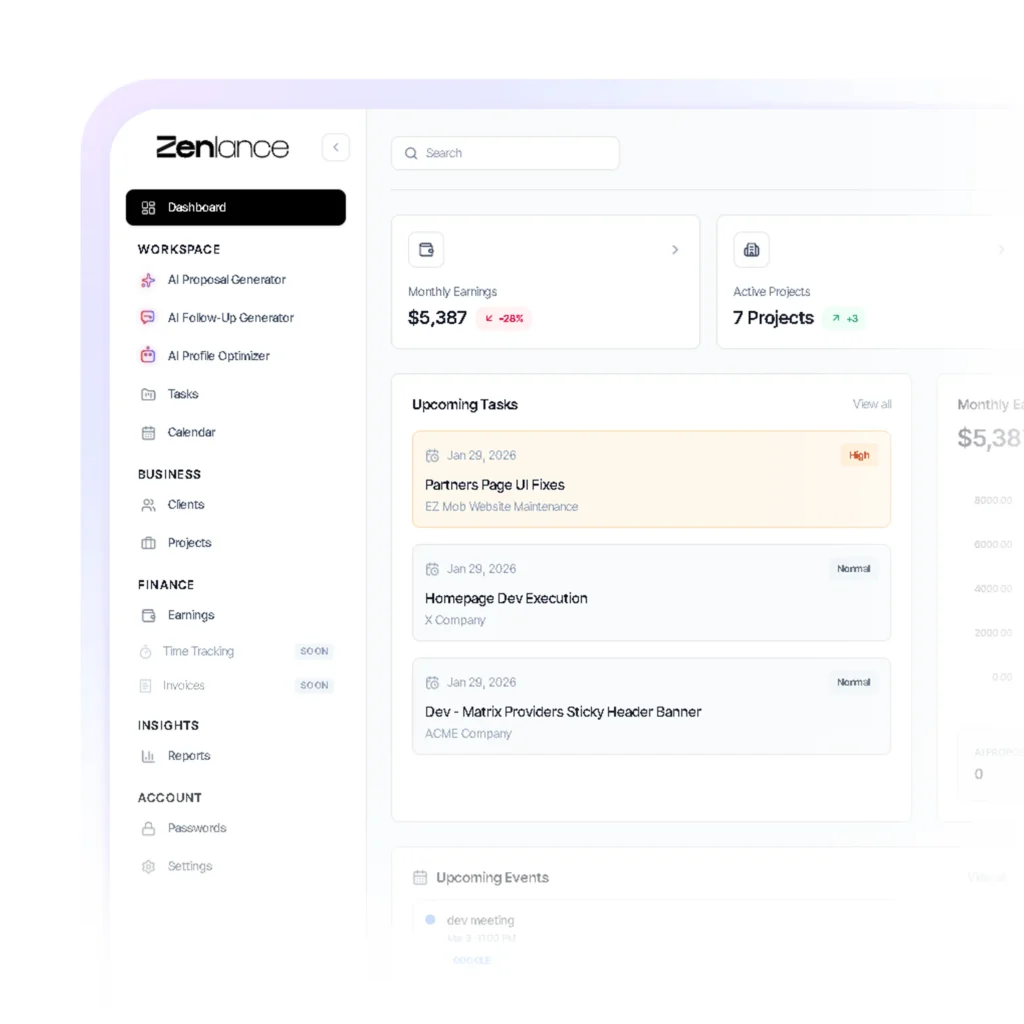
Zenlance is a free AI-powered CRM built specifically for freelancers on Upwork, Fiverr, and other platforms. It gives you a single dashboard where every client, project, and active contract is visible — so identifying which contracts have been idle for 30 days, which clients are approaching long-term status, and which active projects need a proactive communication touch is something you can see at a glance rather than reconstruct from memory.
The same system handles your proposals, task management, and earnings tracking in one place, meaning the organizational overhead of running a disciplined JSS recovery strategy does not add work — it replaces the scattered spreadsheets and mental overhead that make follow-through difficult. Start free at zenlance.net and build the structure that keeps your how to improve job success score strategy consistent rather than reactive.
Recommended Reading
- Upwork Job Success Score: How It Works and How to Improve It in 2026
- Upwork Profile Optimization: The Complete Guide to Winning More Clients in 2026
- How to Become Top Rated on Upwork: Step-by-Step Guide (2026)
- Upwork Proposal Examples That Win Jobs: Free AI + Manual Templates (2026)
- Free AI CRM for Freelancers: Manage Clients, Tasks, and Projects in 2026
- Best AI Tools for Freelancers to Win More Clients in 2026
- How to Get Your First Client on Upwork: A Step-by-Step Guide for 2026