
Fiverr vs Upwork: Which Platform Is Better for Freelancers in 2026?
The Fiverr vs Upwork debate is one of the most common questions new and experienced freelancers ask — and the answer is almost never a simple one. Both platforms are legitimate, both are used by millions of freelancers, and both can generate serious income. But the way they are structured, the types of clients they attract, the fees they charge, and the kind of freelance career they support are fundamentally different. Choosing the wrong platform for your skill set and work style does not just cost you time — it costs you income, momentum, and the confidence that comes from early wins.
Most fiverr vs upwork comparisons reduce the decision to a fee chart or a surface-level summary of how each platform works. That is not enough. The real question is not “which platform is better” in the abstract — it is which platform is better for you, specifically: your niche, your experience level, your income goals, and whether you want to build a business around inbound orders or outbound pitching. A graphic designer who wants passive income from package-based gigs will have a very different experience on each platform than a software developer pursuing long-term retainer clients.
This guide breaks down the fiverr vs upwork comparison across every dimension that matters for freelancers in 2026: how each platform works, the fee structures, the types of clients on each, earning potential, what it takes to get started, and when it makes sense to use both. By the end, you will have a clear, honest picture of which platform — or which combination — belongs in your freelance strategy this year.
Table of Contents
- Fiverr vs Upwork: How Each Platform Works
- Section 1: Fiverr vs Upwork Fee Structures Compared
- Section 2: Client Quality and Project Types on Fiverr vs Upwork
- Section 3: Fiverr vs Upwork — Getting Started and Getting Your First Client
- Section 4: Earning Potential — Fiverr vs Upwork for Income Growth
- Section 5: Fiverr vs Upwork for Specific Skill Categories
- Section 6: Payment Protection, Contracts, and Security
- Section 7: Profile, Reputation, and Ranking on Fiverr vs Upwork
- Section 8: Fiverr vs Upwork — Competition and Market Saturation
- Section 9: Should You Use Both Fiverr and Upwork?
- Common Fiverr vs Upwork Mistakes to Avoid
- Fiverr vs Upwork Decision Checklist
- Frequently Asked Questions About Fiverr vs Upwork
Fiverr vs Upwork: How Each Platform Works
Understanding the fiverr vs upwork distinction starts with the fundamental business model of each platform — because the model shapes everything else: who finds you, how you get paid, and what kind of work you end up doing.
Fiverr is a gig-based marketplace. As a freelancer, you create service listings called “Gigs” — pre-packaged offerings with a fixed title, description, delivery time, and price tier (Basic, Standard, Premium). Clients browse Fiverr’s marketplace, search for the service they need, find your Gig, and purchase it directly. The workflow is essentially inbound: you build a storefront, optimize it for Fiverr’s internal search, and wait for buyers to come to you. Fiverr was founded in 2010, originally built around $5 services, and now hosts over 4 million active sellers serving 5.5 million active buyers across hundreds of service categories.
Upwork is a proposal-based marketplace. Clients post job listings describing what they need, and freelancers submit proposals — customized pitches that explain why they are the right person for that specific job. You review job posts, choose the ones that match your skills, spend Connects (Upwork’s virtual currency) to apply, and compete with other freelancers for the contract. The workflow is outbound: you actively hunt for opportunities and pitch for each one. Founded in 2015 through the merger of Elance and oDesk, Upwork now hosts over 18 million registered freelancers serving more than 740,000 active clients, with annual gross services volume exceeding $2.3 billion, according to Upwork’s own platform comparison guide.
The core fiverr vs upwork difference is not just about how you find clients — it is about what kind of freelance career you are building. Fiverr rewards systematization: build great gigs, optimize them once, and let search drive orders to you. Upwork rewards relationship skills: write compelling proposals, communicate clearly, and build long-term client partnerships that grow in value over time. Neither is better. They are different businesses that happen to be called freelancing.
This structural difference in fiverr vs upwork has downstream effects on everything from what kind of client you attract to how stable your income is month to month. On Fiverr, your income depends on search visibility and gig rankings — a good month can be great, but an algorithm change can cut your orders in half overnight. On Upwork, your income is more within your control — you can always submit more proposals — but it requires more time and active effort to maintain.
Section 1: Fiverr vs Upwork Fee Structures Compared
Fees are one of the most practically important dimensions of the fiverr vs upwork comparison, because they directly determine how much of every dollar you earn you actually keep. The two platforms have significantly different structures, and the impact compounds meaningfully over a full year of freelancing.
Fiverr Fees
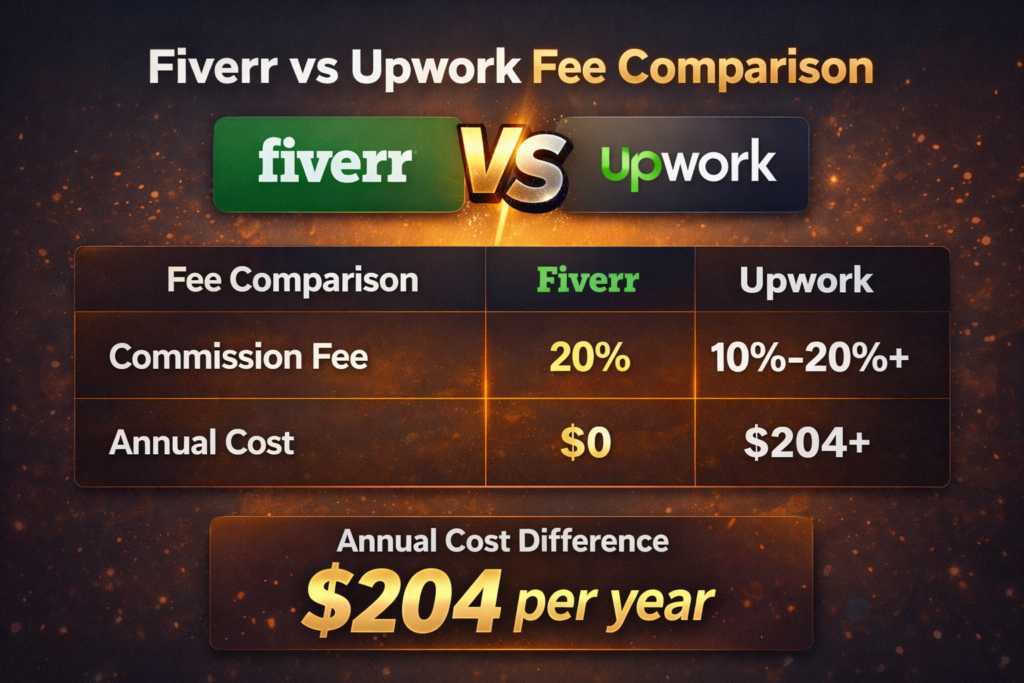
According to Fiverr’s official fee structure documentation, Fiverr charges freelancers a flat 20% commission on every order, regardless of order size or how long you have worked with a client. There are no tiered rates, no loyalty discounts for repeat work, and no way to reduce this commission through any platform feature. If you charge $500 for a logo design, you keep $400. If the same client orders five more logos over a year, you still pay 20% on every single transaction.
Buyers on Fiverr also pay fees: a 5.5% service fee on every order, plus an additional $3.50 on orders under $100. This buyer-side cost is worth understanding in the fiverr vs upwork context, because it affects how clients perceive pricing and why some buyers gravitate toward one platform over the other when comparing total cost.
Upwork Fees
Upwork moved to a variable fee structure in May 2025, as detailed in Upwork’s official freelancer service fee documentation. Freelancers now pay a service fee between 0% and 15% on earnings, with the specific rate determined at the time of contract based on factors including skill demand, market conditions, and contract type. The fee is shown when you submit a proposal and locked in for that contract’s duration. For most freelancers in competitive categories, the effective rate is typically in the 10–12% range based on 2025 user surveys — meaningfully lower than Fiverr’s flat 20%.
Clients on Upwork pay a one-time contract initiation fee ($0.99 to $14.99 depending on contract size) plus a service fee of up to 10% on payments, depending on their plan type.
Fee Comparison Table
| Fee Type | Fiverr | Upwork |
|---|---|---|
| Freelancer commission | 20% flat on all orders | 0–15% variable (typically 10–12%) |
| Buyer service fee | 5.5% + $3.50 on orders under $100 | Up to 10% + contract initiation fee ($0.99–$14.99) |
| Long-term client rate reduction | None — always 20% | Possible reduction based on market dynamics |
| Minimum payout threshold | $1 (PayPal/bank); varies by method | $0 (earnings balance); varies by withdrawal method |
| Cost to apply for jobs | Free (Gigs are inbound) | Connects required ($0.15 each, 1–24 per proposal) |
The fiverr vs upwork fee gap is real and meaningful. On a $50,000 annual income, a 20% Fiverr fee costs $10,000 per year vs. approximately $5,000–$6,000 on Upwork at a 10–12% effective rate. That difference alone — $4,000–$5,000 annually — is a significant factor in the fiverr vs upwork decision for any freelancer treating this as a primary income source.
Section 2: Client Quality and Project Types on Fiverr vs Upwork
In the fiverr vs upwork debate, client quality is often where freelancers feel the difference most viscerally. The two platforms attract meaningfully different buyer profiles, and understanding those profiles helps you set the right expectations for the type of work and relationships you will experience on each.
Clients on Fiverr
Fiverr buyers tend to skew toward smaller businesses, entrepreneurs, and individuals with well-defined, scope-specific needs. They already know what they want — a logo, a 500-word blog post, a social media banner — and they are looking for the fastest, most affordable way to get it done. The average Fiverr order is transactional: the buyer arrives, purchases, receives the deliverable, and often moves on without any long-term relationship. This is ideal for freelancers who want clean, fast, repeatable work with minimal negotiation — but it limits the earning ceiling on any single order.
Fiverr does have a Pro tier that attracts larger businesses and more sophisticated buyers, but Pro seller status requires an application process and is not accessible to all freelancers. For most sellers, the bulk of fiverr vs upwork client quality differences come down to Fiverr attracting more budget-conscious buyers looking for known deliverables at competitive prices.
Clients on Upwork
Upwork’s client base includes a higher proportion of mid-size businesses, agencies, and established companies seeking ongoing or complex work. Clients post detailed briefs, typically have a specific budget in mind, and are often open to hourly contracts that run for weeks or months. The fiverr vs upwork difference here is that Upwork clients tend to invest more per engagement — the average hourly rate for Upwork freelancers is $30–50, compared to Fiverr’s $15–25 average — and are more likely to become long-term relationships that grow in contract value over time.
Upwork also filters its client quality somewhat through the payment verification requirement: clients must have a verified payment method on file for a proposal to be eligible for Connects spend, which reduces the proportion of uncommitted or fraudulent job posts compared to entirely open platforms.
Project Types: Where Each Platform Wins
| Project Type | Better on Fiverr | Better on Upwork |
|---|---|---|
| One-off creative tasks (logo, banner, flyer) | ✅ | |
| Short content pieces (blog post, product description) | ✅ | |
| Long-term development projects | ✅ | |
| Ongoing retainer / consulting arrangements | ✅ | |
| Fast-turnaround video editing / voiceover | ✅ | |
| Complex software or app development | ✅ | |
| Standardized SEO or digital marketing packages | ✅ | ✅ (both viable) |
| Business strategy, consulting, financial analysis | ✅ |
Section 3: Fiverr vs Upwork — Getting Started and Getting Your First Client
The path to your first paying client on each platform is very different, and in the fiverr vs upwork comparison this difference often determines which platform new freelancers should start with.
Getting Started on Fiverr
Fiverr has no application review or approval process for most service categories. You create an account, build your seller profile, publish your first Gig, and you are live on the marketplace. The barrier to entry is low. However, getting your first order is not automatic — new Gigs start with zero reviews and low algorithmic visibility. Fiverr’s search algorithm favors Gigs with reviews, high click-through rates, and good conversion metrics, which means a brand-new Gig faces a cold-start problem: it needs orders to rank, but it needs to rank to get orders.
The standard strategies for breaking the cold start on Fiverr include pricing competitively at launch, optimizing your Gig title and tags for searchable keywords, building a compelling thumbnail and Gig description, and sharing your Gig externally to generate early traffic. New sellers also receive a one-time placement boost in Fiverr’s “New Arrivals” category, which provides some early visibility before the algorithm begins ranking you against established sellers.
Getting Started on Upwork
Upwork requires an application and profile review before you can submit proposals. Upwork may decline applications if the platform already has high supply in your category or if your profile does not meet quality standards. Once approved, you can begin submitting proposals immediately using your initial free Connects allocation (new accounts receive 50 Connects upon registration). The fiverr vs upwork difference here is that Upwork’s gatekeeping creates a slightly higher bar to entry, but once you are in, you can actively pitch for work from day one rather than waiting for inbound discovery.
For new Upwork freelancers, the fastest path to a first contract typically involves applying to Entry Level jobs specifically, submitting fully personalized proposals, charging a competitive rate to build early reviews, and targeting newer job posts to reduce competition. Unlike Fiverr, your profile outside the platform — a portfolio website, LinkedIn, GitHub — can be referenced in proposals to compensate for having no Upwork-specific review history yet.
Section 4: Earning Potential — Fiverr vs Upwork for Income Growth
Fiverr vs Upwork earning potential diverges most clearly over time. In the short term, both platforms can generate early income. Over months and years, the structural differences in fee rates, client relationships, and project scope create meaningfully different income trajectories.
On Fiverr, your earning ceiling is primarily set by your Gig pricing, your order volume, and your ability to upsell through premium packages and add-ons. Top-performing Fiverr sellers earn six figures annually, but this typically requires a high volume of orders, excellent reviews, and either Top Rated Seller or Fiverr Pro status to command premium pricing. The 20% fee is a fixed drag on every dollar — there is no mechanism to reduce it by working with a client long-term or growing your account earnings.
On Upwork, the ceiling is higher for freelancers willing to invest in building long-term client relationships. The typical Upwork hourly rate of $30–50 on average extends to $100+ for specialized skills in development, legal, finance, and strategy. Long-term contracts that run for months or years on Upwork generate substantial cumulative income with lower time spent on proposals per dollar earned. The fiverr vs upwork income growth picture heavily favors Upwork for freelancers who can deliver high-value, relationship-dependent work — but Fiverr wins for those building scalable, systematized service offerings where volume and efficiency are the competitive advantage.
Annual Income Comparison: A Realistic Scenario
| Scenario | Fiverr | Upwork |
|---|---|---|
| Gross annual earnings | $50,000 | $50,000 |
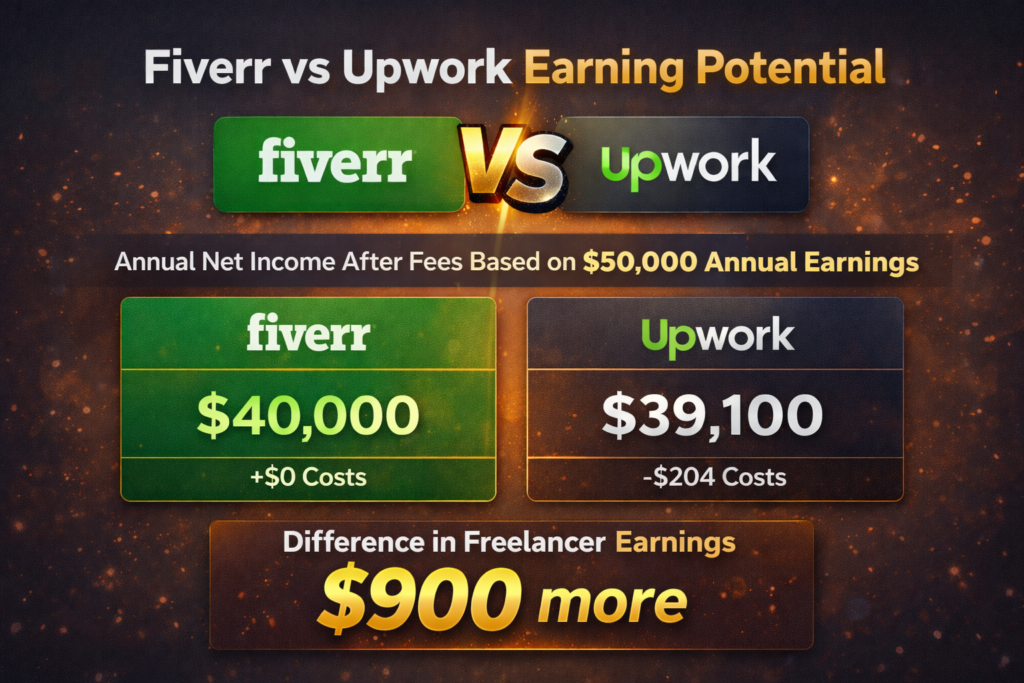
| Platform fee (est.) | $10,000 (20%) | $5,500 (11% average) |
| Net take-home | $40,000 | $44,500 |
| Connect spend (Upwork only) | N/A | ~$200–$500/year |
| Realistic net income | $40,000 | ~$44,000–$44,300 |
The fiverr vs upwork income gap at $50,000 gross is approximately $4,000 per year in the freelancer’s pocket — before considering that Upwork’s higher average project values mean reaching $50,000 often requires fewer total projects, less management overhead, and more time to do the work rather than find the next order.
Section 5: Fiverr vs Upwork for Specific Skill Categories
The fiverr vs upwork winner changes significantly depending on your skill category. Neither platform is universally better — the right answer depends on what you do and how clients in your field prefer to buy services.
Design and Creative Services
This is the category where fiverr vs upwork is most evenly contested. Fiverr dominates for logo design, social media graphics, illustrations, and brand identity packages — the gig model maps perfectly to well-defined, visual deliverables with clear scope. Buyers on Fiverr understand what they are getting before they purchase, which reduces negotiation and revision disputes. Upwork is more competitive for UX/UI design, complex branding projects, and design work embedded within larger development or marketing contracts where an ongoing relationship adds value.
Writing and Content
Fiverr works well for short-form content: product descriptions, social media copy, blog posts, and email sequences packaged as fixed deliverables. Upwork dominates for ongoing content strategy, long-form ghostwriting, editorial roles, and content marketing engagements where the client wants a consistent voice over months or years. In the fiverr vs upwork comparison for writers, Upwork’s higher average rates and long-term contract structure make it significantly more lucrative for experienced content professionals — but Fiverr can be a faster path to early reviews and income for new writers.
Web and Software Development
Upwork wins this fiverr vs upwork matchup decisively for development work. Development projects involve complex scopes, iterative delivery, technical communication, and ongoing support requirements that do not compress well into a fixed-price Gig format. Upwork’s hourly contracts, milestone payment structures, time tracking tools, and communication features are purpose-built for the developer-client relationship. Development is also one of the highest-earning categories on Upwork, with top-tier developers earning $80–120+ per hour on the platform.
Digital Marketing and SEO
Both platforms serve digital marketers, but in different ways. Fiverr works well for packaged SEO deliverables — audit reports, backlink packages, keyword research documents — where the scope is defined and the deliverable is tangible. Upwork is better for ongoing SEO retainers, paid advertising management, and full-service digital marketing engagements where the client needs a strategic partner rather than a task-for-hire. In the fiverr vs upwork calculation for marketers, those offering repeatable deliverables should have a Fiverr presence; those offering strategy and ongoing management should prioritize Upwork.
Virtual Assistance and Administrative Work
Upwork dominates the fiverr vs upwork comparison for VA and admin work. This category is almost entirely relationship-dependent — clients want a reliable, communicative person they can work with over weeks and months, not a transactional order from a storefront. Upwork’s hourly contracts and direct client communication features make it far better suited for VA work than Fiverr’s order-based model.
Section 6: Payment Protection, Contracts, and Security
Payment security is a critical dimension of the fiverr vs upwork comparison — especially for freelancers who have been burned by non-paying clients on other platforms.
Both Fiverr and Upwork hold client payments in escrow before work begins, which means the money is secured before you deliver. On Fiverr, buyers pay at the time of purchase, and funds are held until the order is marked complete. On Upwork, fixed-price contracts use milestone funding (client deposits each milestone amount upfront), and hourly contracts are backed by Upwork’s Hourly Protection — as long as you log hours using the Work Diary with adequate screenshots, your pay is guaranteed even if the client disputes the bill.
The fiverr vs upwork security comparison generally favors Upwork for high-value or long-term work. Upwork’s hourly billing protection is particularly powerful for freelancers doing ongoing work — it removes the risk of “we decided not to continue” non-payment that can catch hourly workers off guard. Fiverr’s escrow system works well for transactional orders but becomes more complex to navigate when scope creep or quality disputes arise on larger projects.
On Fiverr, client disputes handled through the Resolution Center can result in partial or full refunds being issued to buyers — sometimes without adequate consideration of whether the work was legitimately completed to the agreed scope. On Upwork, the dispute resolution process is more structured, with a clearer review process before funds are released or clawed back. For high-ticket work, Upwork’s dispute system is meaningfully more protective of the freelancer’s interests than Fiverr’s.
Section 7: Profile, Reputation, and Ranking on Fiverr vs Upwork
Your reputation is your most valuable long-term asset on both platforms, but how reputation is built and how it translates to visibility works very differently in the fiverr vs upwork ecosystem.
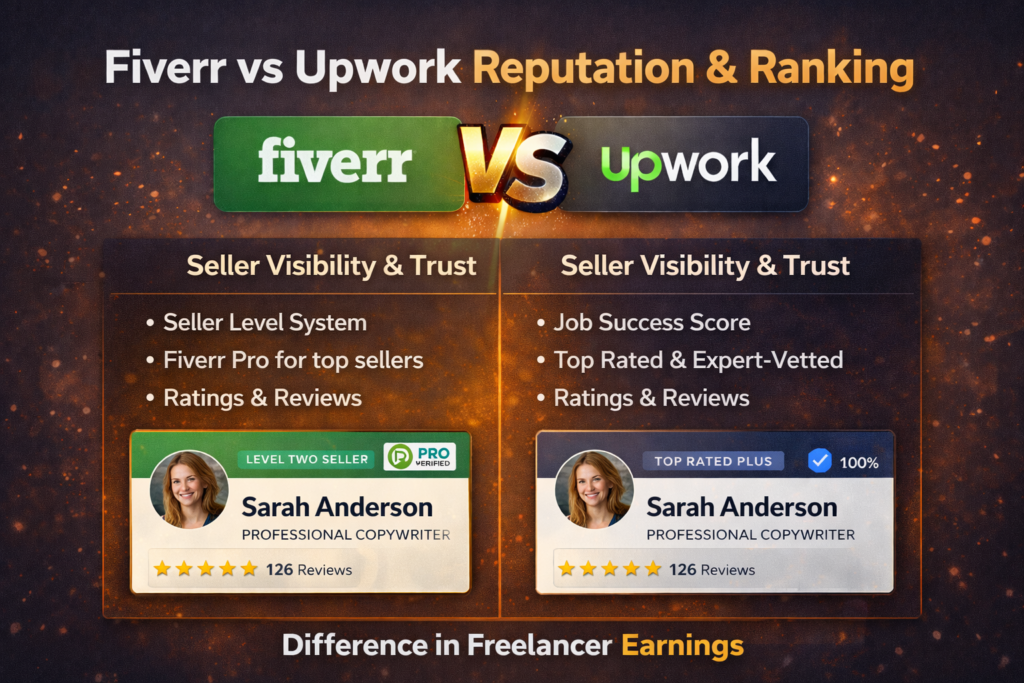
On Fiverr, your reputation lives primarily at the Gig level. Each Gig accumulates its own reviews and ranking signals independently. A seller with ten Gigs essentially has ten separate reputation stacks to build. Your seller profile also has a level — New Seller, Level 1, Level 2, or Top Rated Seller — that affects how prominently your Gigs appear in search. Fiverr’s algorithm rewards Gigs with high click-through rates, high conversion rates, fast response times, on-time delivery, and strong review scores. Algorithmic ranking is the primary lever for visibility on Fiverr, which means optimization — keywords, thumbnails, package structure — is as important as quality.
On Upwork, your reputation is more consolidated. Your Job Success Score (JSS), overall star rating, and client feedback live on your single seller profile rather than spread across multiple listings. A strong JSS (90%+) and consistent five-star reviews directly boost your profile’s ranking in search results, your eligibility for Top Rated status, and your attractiveness to clients browsing proposals. In the fiverr vs upwork reputation-building comparison, Upwork’s system rewards relationship depth — long-term clients, clean contract closures, and private feedback that reflects genuine satisfaction.
For new freelancers, getting that first review is the critical milestone on both platforms. On Fiverr, the first review unlocks the algorithm’s willingness to rank your Gig more competitively. On Upwork, it transforms your profile from “unproven” to “verified” in a client’s eyes. Both platforms have mechanisms to accelerate this first review — but both also require patience before organic traction kicks in.
Section 8: Fiverr vs Upwork — Competition and Market Saturation
Competition is a genuine concern in the fiverr vs upwork analysis for 2026. Both platforms have grown substantially, and some categories are heavily saturated with sellers — which affects how quickly new freelancers can break through.
On Fiverr, the most saturated categories include logo design, generic content writing, social media management, and basic video editing. In these niches, hundreds of sellers offer nearly identical Gigs at rock-bottom prices, and differentiation requires a very specific niche angle, exceptional portfolio work, or a pricing strategy that undercuts the market early before building reviews. The fiverr vs upwork competition dynamic on Fiverr is largely about Gig SEO and visual differentiation — the algorithm surfaces Gigs, and buyers make fast decisions based on thumbnail, title, and price.
On Upwork, competition plays out at the proposal level. For any given job post, anywhere from 5 to 50+ freelancers may submit proposals. The competition is often less about price and more about fit, communication quality, and profile strength. A well-written proposal from a freelancer with directly relevant experience will typically beat a cheaper proposal from someone with a weaker portfolio — even in competitive categories. The fiverr vs upwork competition advantage on Upwork goes to freelancers who can write strong proposals and have the patience to apply consistently while building their initial track record.
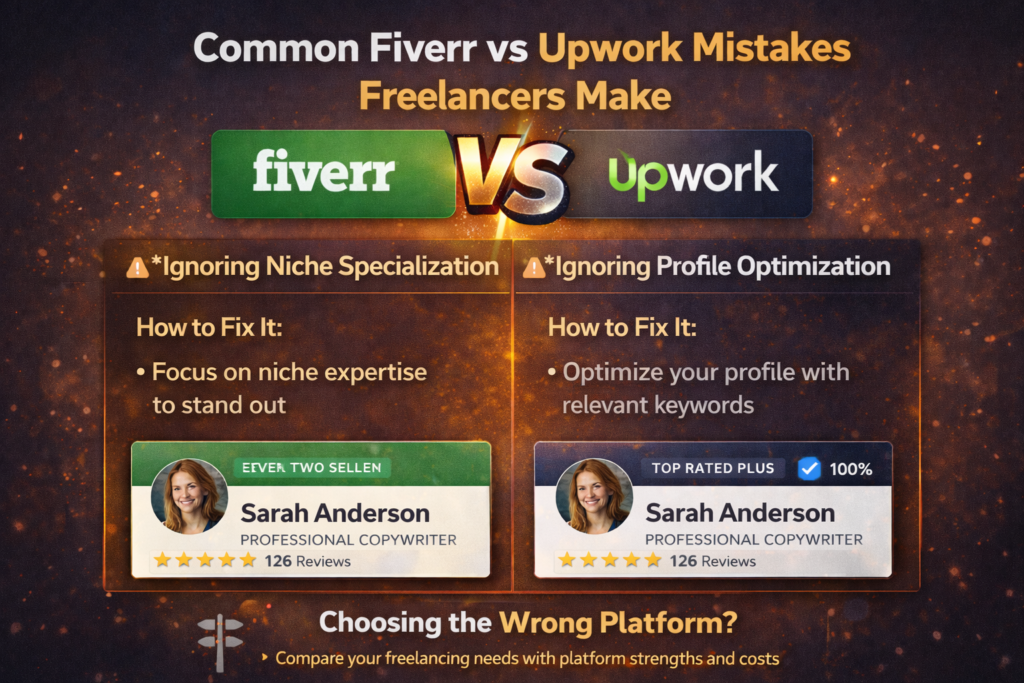
In both cases, the answer to saturation is the same: niche down. A “logo designer” faces brutal competition on Fiverr. A “minimalist logo designer for sustainable brands” finds a far less crowded corner of the same marketplace. A “web developer” on Upwork competes against tens of thousands. A “React developer specializing in SaaS dashboards” competes against a much smaller, more targeted pool.
Section 9: Should You Use Both Fiverr and Upwork?
After walking through the full fiverr vs upwork comparison, many freelancers arrive at the same question: why choose one? The platforms serve different client types and different work styles — running both simultaneously is a legitimate strategy, and one that many experienced freelancers use deliberately.
The case for using both fiverr and upwork is strongest when your skill set includes both standardized deliverables and relationship-based services. A copywriter might run Fiverr Gigs for blog posts and social media packages while using Upwork for long-term content strategy clients. A developer might use Fiverr for quick bug-fix or theme-customization Gigs while pursing complex application development on Upwork. The platforms complement each other: Fiverr provides a passive income stream and a visible portfolio of completed work; Upwork provides higher-value, longer-lasting client relationships.
The main risk of running both platforms simultaneously is spreading your attention too thin early on. When you are new to freelancing, building traction on one platform requires consistent effort — optimizing profiles, responding quickly, delivering excellent work, accumulating reviews. Splitting that effort between fiverr and upwork before you have strong momentum on either can slow your growth on both. The typical recommended approach is to start on one platform, reach a stable level of consistent incoming work or reviews, then expand to the second. Which platform you start with depends on your skill category and work style preference — using the fiverr vs upwork framework from this guide.
Signs You Should Start with Fiverr
- Your service is a clearly defined, packaged deliverable with a known scope
- You want a passive, inbound model where orders come to you
- You are new to freelancing and want to build a review base without cold pitching
- Your niche is creative: design, writing, video, audio, or marketing packages
- You prefer fixed-price work with clear deliverables over open-ended hourly projects
Signs You Should Start with Upwork
- Your service is relationship-dependent, complex, or involves ongoing collaboration
- You want to build long-term client relationships rather than one-off transactions
- You have portfolio work or credentials from outside the platform to reference in proposals
- Your niche is development, consulting, strategy, VA, or technical work
- You are willing to write customized proposals and actively pitch for work
Common Fiverr vs Upwork Mistakes to Avoid
These are the errors freelancers consistently make when navigating the fiverr vs upwork decision — and the corrections that save time, money, and momentum.
1. Choosing a platform based on what others say rather than what fits your skill category. The fiverr vs upwork answer is category-specific. A developer choosing Fiverr because a content writer raved about it is making a decision based on irrelevant data. Map the platform’s strengths to your specific niche before committing. Use the project type table in Section 2 as your starting point.
2. Ignoring the fee difference in your pricing calculations. Fiverr’s 20% commission and Upwork’s 0–15% variable fee are not abstract numbers — they directly reduce your effective hourly rate. A freelancer charging $50 per hour on Fiverr keeps $40. On Upwork at 11%, they keep $44.50. Set your rates on each platform with the fee difference factored in — and revisit your pricing when you calculate what you are actually earning per hour of work.
3. Treating fiverr and upwork as identical platforms that just look different. The fiverr vs upwork difference is not cosmetic — it is structural. Applying the same strategy to both (same bio copy, same pitch approach, same pricing logic) underperforms on both. Each platform rewards different skills: Fiverr rewards Gig optimization and visual presentation; Upwork rewards proposal quality and profile depth. Tailor your approach to each platform’s specific ranking and conversion mechanics.
4. Starting on both platforms at once before getting traction on either. Running parallel campaigns on fiverr and upwork without momentum on either is one of the most common early mistakes. You are not yet building a reputation stack on either platform, responding fast enough on either to meet algorithm requirements, or learning quickly enough from feedback to improve. Pick one, build to consistent reviews or contract history, then expand.
5. Underpricing on Fiverr in hopes of volume at the expense of sustainability. On Fiverr, the temptation to price low for early reviews is real — and often necessary to a point. But freelancers who build their entire Fiverr business on low prices struggle to raise rates later because clients anchor to the original price and leave negative feedback at any increase. Build a floor early that is sustainable, even if it is lower than your long-term target, and raise incrementally as reviews accumulate.
6. Not building toward client invitations on Upwork. The fiverr vs upwork economics on Upwork favor freelancers who attract client invitations — which cost zero Connects to respond to. Every proposal submitted is a Connect spent. A profile strong enough to generate invitations is essentially a way to access Upwork opportunities for free. Building toward invitation-based work through a strong JSS, complete profile, and Top Rated status is a long-term strategy that changes the economics of fiverr vs upwork in Upwork’s favor significantly.
7. Neglecting profile optimization on Fiverr after the initial setup. The fiverr vs upwork dynamic on Fiverr is heavily algorithm-driven, and algorithms change. Gig thumbnails that performed well six months ago may be outclassed by newer design trends. Keywords that ranked well may have increased competition. Treating your Fiverr Gigs as static once published — rather than testing and refining based on click and conversion data — leaves performance gains on the table.
8. Making the fiverr vs upwork decision permanent. Freelancing platforms evolve, fee structures change, and your skill set and income goals will shift over time. The platform that is right for you now may not be right for you in two years. Revisit the fiverr vs upwork question annually and be willing to shift your primary focus based on where you are getting the best results relative to time invested.
Fiverr vs Upwork Decision Checklist
- ☐ Identified which platform better matches my primary service category (use the project type table in Section 2)
- ☐ Compared the fee impact on my effective hourly rate at my current pricing on fiverr vs upwork
- ☐ Decided whether I prefer an inbound (Fiverr gig model) or outbound (Upwork proposal model) workflow
- ☐ Assessed whether my service involves standardized deliverables (Fiverr advantage) or ongoing relationships (Upwork advantage)
- ☐ Chosen one platform to start on and build traction before expanding to the second
- ☐ Set prices that account for platform fees — not just market rate — on whichever platform I start with
- ☐ Researched the competition in my specific niche on both platforms before committing
- ☐ Built a complete profile on my chosen platform before spending time on applications or gig creation
- ☐ Set a milestone to revisit the fiverr vs upwork question (e.g., after 10 completed orders or 3 months)
- ☐ Identified which platform I will expand to second, and what metrics need to be in place before I do
Frequently Asked Questions About Fiverr vs Upwork
Which is better for beginners — Fiverr or Upwork?
For most beginners, fiverr vs upwork breaks down by skill category. Fiverr is easier to start on — no application process, no Connects spend, and the gig model does not require writing personalized proposals from day one. But getting your first order on Fiverr requires patience while your Gig builds visibility. Upwork is slightly harder to get onto (the profile requires approval) but lets you actively pursue jobs from day one, which means faster first contracts if your proposals are well-written and targeted. Beginners with creative or design skills often find Fiverr easier; those with technical or consulting backgrounds often find Upwork more responsive to early efforts.
Are Upwork fees lower than Fiverr fees?
Yes, in most cases. Fiverr charges a flat 20% commission on every transaction regardless of size or client history. Upwork charges a variable fee of 0–15%, with most freelancers in 2025 paying an effective rate of 10–12%. On a $50,000 annual income, the fiverr vs upwork fee difference could result in $4,000–$5,000 more in take-home pay on Upwork. However, Upwork also requires spending Connects ($0.15 each) to apply for jobs — a cost that does not exist on Fiverr’s inbound model.
Can I use both Fiverr and Upwork at the same time?
Yes — many experienced freelancers run active profiles on both platforms simultaneously and treat them as complementary income streams. The fiverr vs upwork dual approach works best when your skills map to different service formats: use Fiverr for packaged, inbound deliverables and Upwork for proposal-based, longer-term work. The risk of running both simultaneously is split focus early on — most freelancers get better results building one platform to a stable, review-backed state before launching on the second.
Which platform pays better — Fiverr or Upwork?
In the fiverr vs upwork earning comparison, Upwork generally produces higher average earnings per freelancer. The average Upwork hourly rate of $30–50 exceeds Fiverr’s $15–25 average, Upwork’s lower fees mean a higher percentage of each dollar is kept, and Upwork’s long-term contracts create compound value that a series of one-off Fiverr gigs cannot replicate. However, top Fiverr sellers with high-volume, efficient gig operations absolutely earn six figures — the ceiling is real on both platforms. The fiverr vs upwork earnings comparison is most meaningful over a one-to-two-year horizon, not in the first few weeks.
Is Fiverr or Upwork better for long-term client relationships?
Upwork is significantly better for long-term client relationships in the fiverr vs upwork comparison. Upwork’s hourly contract model, direct messaging, time tracking, and milestone payment structure are all designed to support ongoing engagements that span months or years. Fiverr’s order-based model creates transactional relationships by design — clients complete an order, leave a review, and often move on. Fiverr does offer subscription Gigs and repeat-order features, but these are secondary features on a platform built for transactional purchasing, not the primary relationship model the way Upwork’s contracts are.
Does Fiverr or Upwork have better payment protection?
Both platforms use escrow to hold client payments before work is delivered, which provides a baseline level of security on both sides of the fiverr vs upwork comparison. For hourly work specifically, Upwork’s Hourly Protection program — which guarantees payment for logged hours with adequate Work Diary documentation — is one of the strongest payment security features available on any freelance platform. For high-value fixed-price work, both platforms offer milestone funding, but Upwork’s dispute resolution process is generally considered more structured and more protective of freelancers than Fiverr’s Resolution Center.
How Zenlance Helps You Manage Work Across Fiverr and Upwork
Whether you land on one side of the fiverr vs upwork debate or decide to run both platforms simultaneously, the operational challenge is the same: managing multiple clients, tracking active projects, following up on proposals, and keeping your delivery consistent across every engagement. Most freelancers who scale on fiverr or upwork hit the same wall — the work comes in faster than any spreadsheet or inbox can organize it, and something always slips.
Zenlance is a free AI-powered CRM built specifically for freelancers on Fiverr, Upwork, and other platforms. It gives you a single dashboard to track every active client, proposal, project deadline, and follow-up across both platforms — so the fiverr vs upwork question stops being a logistical problem and starts being a pure strategy question. The platform’s AI proposal generator also helps you craft faster, more personalized proposals for Upwork, and the client management tools keep your Fiverr order history and buyer communication organized in one place. Start free at zenlance.net and run your fiverr vs upwork strategy with the operational backbone serious freelancers use.
Recommended Reading
- Upwork Profile Optimization: The Complete Guide to Winning More Clients in 2026
- Fiverr Gig Optimization: The Complete Guide to Ranking Higher and Selling More in 2026
- How to Create a Fiverr Seller Profile That Gets Clicks in 2026
- Upwork Connects: How Many Do You Need and How to Save Them (2026)
- How to Write a Winning Upwork Cover Letter in 2026
- Upwork Job Success Score: How It Works and How to Improve It in 2026
- Free AI CRM for Freelancers: Manage Clients, Tasks, and Projects in 2026