How to Follow Up With Freelance Clients Without Being Annoying (2026)
The freelance client follow up is one of the most anxiety-inducing tasks in a freelancer’s workflow — and one of the most financially important. Whether you sent a proposal three days ago and heard nothing, delivered a project and the client has gone quiet, or have an invoice that is now two weeks past due, knowing how and when to follow up is the difference between money in your account and a relationship you quietly let go cold. Most freelancers avoid it too long, then overdo it when they finally reach out, and wonder why neither approach seems to work.
The uncomfortable truth about freelance client follow up is that most clients who do not respond are not ignoring you out of disinterest — they are busy, their inbox is full, and your message got buried. Research by Woodpecker found that sending just one follow-up email can increase your response rate by 22% — yet the majority of freelancers send only one outreach and then go silent. Clients who would have hired you, paid your invoice, or given you another contract simply never heard from you again — not because they made a deliberate decision to pass, but because no one reminded them you existed.
This guide gives you the complete freelance client follow up system for 2026: the right timing for every follow-up scenario, the exact language that gets responses without creating resentment, ready-to-use message templates for proposals, active projects, invoices, and past clients, and the mindset framework that makes follow-up feel natural instead of pushy. Whether you are following up on Upwork, via email, or through any other channel, these principles apply.
Table of Contents
- Why Freelance Client Follow Up Feels Awkward — And Why You Must Do It Anyway
- Section 1: The Freelance Client Follow Up Mindset
- Section 2: When to Follow Up — Timing Rules for Every Scenario
- Section 3: How to Follow Up After Sending a Proposal
- Section 4: How to Follow Up During an Active Project
- Section 5: How to Follow Up on an Unpaid Invoice
- Section 6: How to Follow Up With a Ghosted Client
- Section 7: How to Follow Up for Repeat Business and Referrals
- Section 8: Freelance Client Follow Up Templates You Can Use Today
- Section 9: Building a Freelance Client Follow Up System
- Common Freelance Client Follow Up Mistakes to Avoid
- Freelance Client Follow Up Checklist
- Frequently Asked Questions About Freelance Client Follow Up
Why Freelance Client Follow Up Feels Awkward — And Why You Must Do It Anyway
The reason freelance client follow up feels uncomfortable for most freelancers is not a lack of skill or confidence — it is a misdiagnosis of what following up signals. Many freelancers have internalized the belief that sending a follow-up message communicates desperation, that a confident professional waits to be called back, and that following up too soon is a sign that you need the work more than the client needs you. None of these beliefs are accurate, and all of them are costing you money.
What a well-timed, well-worded freelance client follow up actually communicates is the opposite of desperation: it signals professionalism, organization, and genuine investment in the client’s project. Clients — especially business owners and managers who deal with dozens of vendors and contractors — expect to be followed up with. A freelancer who submits a proposal and never follows up is often perceived not as confident but as disorganized or uninterested. The follow-up is part of the professional process, not an intrusion into it.
The practical case for freelance client follow up is equally compelling. Studies indicate that almost 80% of sales leads require at least five follow-ups after the initial meeting — yet nearly half of all salespeople and freelancers give up after just one. The clients who eventually say yes are disproportionately the ones who needed a second or third reminder — not because they were uninterested in the first message, but because they were busy when they received it and intended to respond later. A consistent, respectful freelance client follow up process recovers a meaningful percentage of those otherwise-lost opportunities.
Most clients who do not respond to a proposal or message are not saying no — they are saying “not yet” or “I forgot” or “I am buried this week.” A professional freelance client follow up does not push them toward a decision they have already made. It invites them back into a conversation they genuinely intended to have.
Section 1: The Freelance Client Follow Up Mindset
Before getting into specific timing and templates, the most important thing to establish is the mental frame from which you approach every freelance client follow up interaction. The frame determines the tone, and the tone determines whether your message feels helpful or annoying — regardless of what you actually write.
You Are Adding Value, Not Chasing
The freelance client follow up that feels pushy is the one written from a place of anxiety: “I need to know if you’re going to hire me,” or “I need you to pay this invoice.” The freelance client follow up that feels professional is written from a place of genuine service: “I want to make sure this project moves forward for you,” or “I am checking in to keep things on track.” The difference is entirely in the orientation — toward the client’s needs rather than your own anxiety.
In practice this means that every freelance client follow up message should give the client something: a relevant observation about their project, a quick answer to a question they might have, a specific next step they can take, or simply an easy opening to re-engage without feeling pressured. When your follow-up offers value rather than just requesting a response, the client’s experience of receiving it changes completely.
Assume Busy, Not Disinterested
The single most useful mindset shift for freelance client follow up is replacing “they are ignoring me” with “they are buried.” Most clients who go quiet after a proposal or a delivered project are not making a deliberate decision to avoid you — they are dealing with their own priorities, their own inbox overload, and their own deadlines. Research has found that while 70% of emails receive an immediate response, up to 30% of emails can sit unanswered in inboxes — and your message is one of those. A follow-up that assumes good faith — “I know you have a lot on your plate” — produces responses far more reliably than one that implies resentment or urgency.
Know When to Stop
A professional freelance client follow up system also requires knowing when to close the loop and move on. Three to four follow-ups across two to three weeks without any response is, in most cases, a reasonable stopping point for a proposal or an interview. Beyond that, you risk damaging the relationship — and for an invoice situation, persistence beyond four attempts should involve moving to formal channels rather than more email messages. Knowing when to stop is part of the discipline, not a defeat.
Section 2: When to Follow Up — Timing Rules for Every Scenario
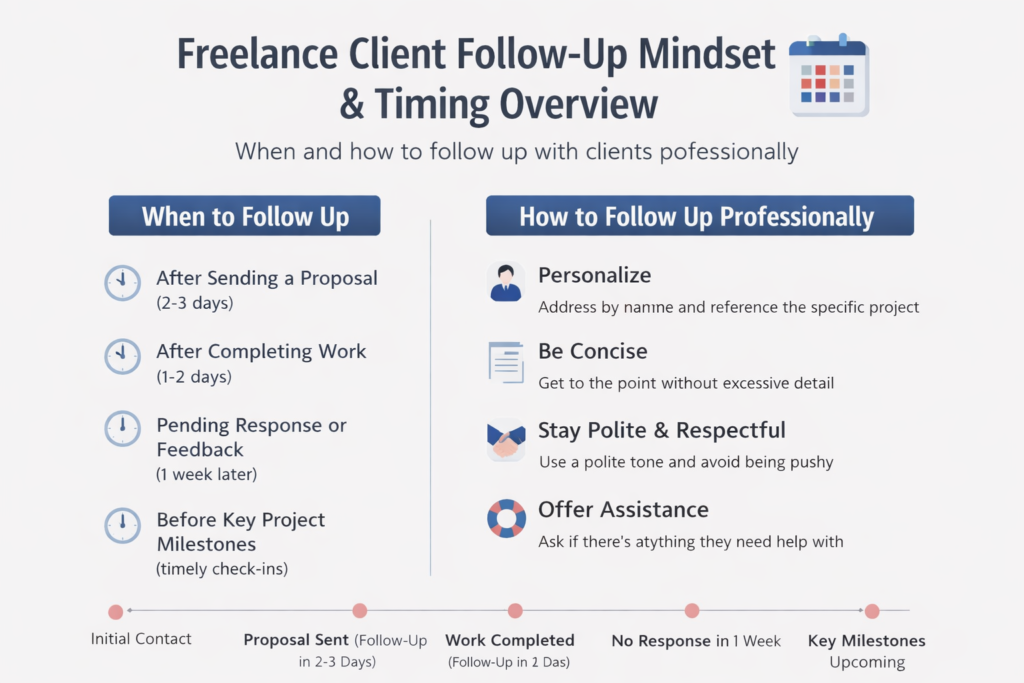
Timing is the most important variable in freelance client follow up. The same message sent at the wrong interval can feel either neglectful (too long) or harassing (too short). These timing guidelines cover the most common follow-up scenarios in a freelance workflow.
After Sending a Proposal
Wait three to five business days before your first follow-up on a submitted proposal. This gives the client enough time to review your submission, possibly share it with others involved in the decision, and form an initial reaction — without sitting so long that your proposal has drifted far down their inbox. If the client specifically told you they would respond by a certain date and that date has passed, follow up the next business day.
Sending your follow-up on a Tuesday, Wednesday, or Thursday tends to produce better results than Monday or Friday — clients are catching up at the start of the week and winding down at the end, making mid-week the sweet spot for a response.
After Delivering a Project
If a client has received your deliverable and has not acknowledged it within two business days, a brief check-in is appropriate: confirm they received it, ask if they have any questions, and keep the message short. This is a low-stakes freelance client follow up that almost always produces a response — the client simply forgot to confirm receipt, and your message gives them an easy way to close the loop.
After a Discovery Call or Interview
Follow up within 24 hours of a discovery call or client interview with a brief thank-you and summary of next steps discussed. This follow-up is not about pushing for a decision — it is about demonstrating organization and keeping the conversation momentum alive while your call is still fresh in both parties’ minds.
On a Late Invoice
For freelance client follow up on unpaid invoices, the timing sequence is: a gentle reminder on the due date itself, a firmer follow-up at five to seven days overdue, and a formal payment request at two weeks overdue. At thirty days overdue, escalation beyond email is appropriate depending on the amount and relationship.
| Scenario | First Follow-Up | Second Follow-Up | Third Follow-Up |
|---|---|---|---|
| Proposal sent | 3–5 business days | 5–7 days after first | 7–10 days after second |
| Project delivered | 2 business days | 3 days after first | Close the loop / invoice |
| Discovery call | Within 24 hours | 5 days if no response | 7–10 days after second |
| Invoice due | Due date (reminder) | 5–7 days overdue | 14 days overdue |
| Past client re-engagement | 3–6 months after last project | 3 months later | Seasonal or event-triggered |
Section 3: How to Follow Up After Sending a Proposal
The post-proposal freelance client follow up is one of the highest-value communications in a freelancer’s workflow because the client is still actively evaluating their options — your follow-up can be the message that tips the decision in your favor. The key is to add something to the conversation rather than simply asking “did you see my proposal?”
Make the First Follow-Up Easy to Respond To
Your first proposal follow-up should do three things: remind the client of the proposal, invite any questions they might have, and make it easy for them to move forward. Keep it to three to four sentences. Do not re-pitch everything in the proposal — assume they read it, or at minimum saw it. A message that implies “I know you are busy and just want to make sure this is easy to move on when you are ready” generates far more responses than one that re-argues the case for hiring you.
Many freelancers do not send a second email at all — doing so automatically makes you stand out as someone who genuinely wants to work with the client, rather than someone running a mass-submission process and moving on regardless of who responds.
Add Value in the Second Follow-Up
If the first proposal follow-up does not produce a response after five to seven days, the second freelance client follow up should offer a new angle: a relevant observation about their project, a specific example from your portfolio that addresses a concern they might have, or a brief note about something you noticed in their brief that you would approach in a particular way. This message demonstrates that you are still thinking about their project and invested in it — not just checking a box.
Close the Loop on the Third
If two follow-ups have produced no response, a third and final message should close the loop gracefully: acknowledge that timing may not be right, leave the door open for future work, and remove any pressure. This message often generates responses precisely because it removes the implicit ask — the client who felt avoiding the thread was easier suddenly feels comfortable re-engaging when the pressure is off. If there is still no response after the third message, stop and move on. A fourth and fifth message begin to damage the relationship rather than protect it.
Section 4: How to Follow Up During an Active Project
Freelance client follow up does not only happen at proposal and invoice stages — it is also a critical practice during active projects, and this version of follow-up is where many freelancers fall short. Proactive check-ins during a project prevent the end-of-project misalignments that generate revision demands, disputes, and below-five-star reviews.
Milestone Check-Ins
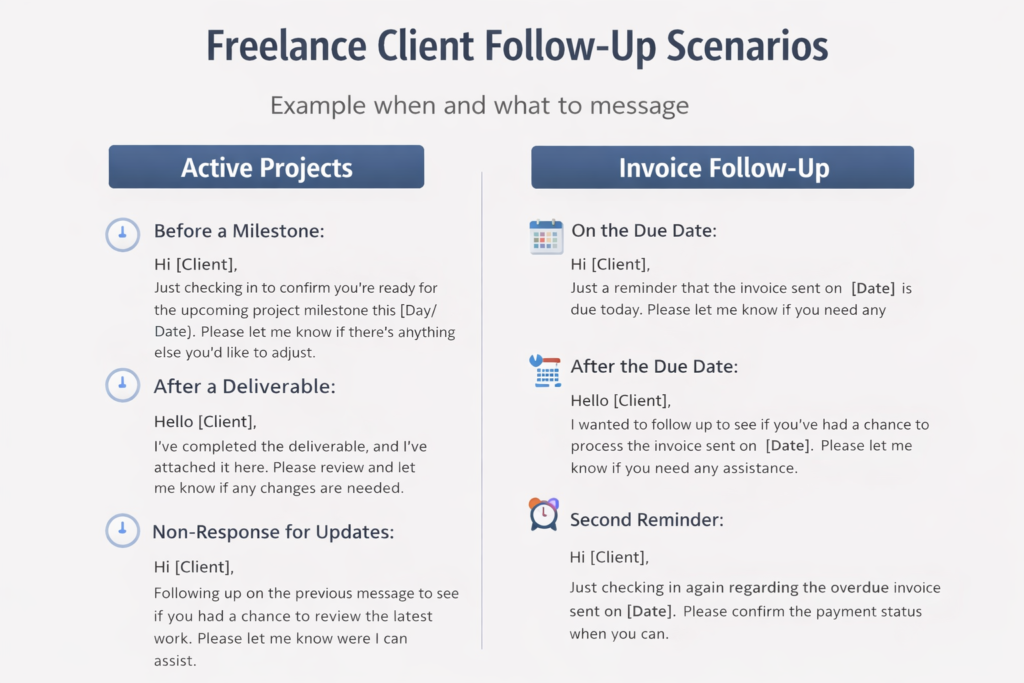
For any project lasting more than one week, plan a brief freelance client follow up at each natural milestone: before you begin the next phase, after delivering each discrete piece, and at any point where you need information or approval to continue. These are not optional communications — they are the mechanism by which you keep the client informed, prevent scope creep from developing silently, and create a documented trail of approval that protects you if disputes arise later.
A milestone check-in does not need to be a long update. Two to three sentences confirming what was completed, what is next, and whether you need anything from the client is entirely sufficient. The goal is to keep the client engaged and informed so that the final delivery is never a surprise.
The Unblocking Follow-Up
If the client owes you something — feedback, assets, access credentials, a decision — and has not delivered it, the unblocking freelance client follow up is one of the most important messages you will send. Frame it as a project management communication, not a demand: “I want to keep your project on track — I am currently waiting on [specific item] to move forward with [specific phase]. Could you share that by [date]?” This is direct, non-accusatory, and gives the client a specific, easy action to take.
Section 5: How to Follow Up on an Unpaid Invoice
The invoice freelance client follow up is the scenario most freelancers dread and delay the longest — which, ironically, makes the problem worse. An invoice that has been ignored for two weeks is harder to collect on than one followed up promptly at three days overdue. Timely, professional invoice follow-up is part of running a freelance business, and treating it as a routine communication rather than a confrontation makes it significantly easier.
The Due-Date Reminder
Send a brief, friendly reminder on the invoice due date if payment has not yet been received. This message is not accusatory — many clients simply have payment on their to-do list and a gentle nudge on the due date is often all that is needed. Include the invoice number, amount, and a direct payment link if applicable. Keep the tone warm and matter-of-fact: this is a routine part of the business relationship, not a problem.
The Overdue Follow-Up (5–7 Days)
If payment has not arrived within five to seven days of the due date, the freelance client follow up escalates slightly in directness — though not in hostility. State that the invoice is now past due, repeat the invoice details, and give a specific date by which you would like to receive payment. Do not apologize for asking. Late payment follow-up is a normal part of business communication — simply state your requirements clearly and professionally without over-explaining.
The Final Notice (14 Days Overdue)
At two weeks past due, your freelance client follow up should be direct and specific about consequences: you are pausing any active work until the invoice is settled, or you will be initiating your dispute process if payment is not received by a specified date. This message should be brief, completely professional, and contain no anger or emotional language — but it should be unambiguous. On platforms like Upwork, this is also the stage at which you would formally raise a dispute through Upwork’s resolution center rather than continuing to follow up through messages alone.
Section 6: How to Follow Up With a Ghosted Client
Being ghosted is one of the most common and most frustrating experiences in a freelance career. A client who seemed enthusiastic goes silent after a proposal, after a discovery call, or — worse — partway through a project. The freelance client follow up for a ghosted client requires a particular approach because the dynamic is different from a simple delayed response.
Assume a Practical Reason, Not a Rejection
Before concluding that a client has made a deliberate decision to ignore you, consider the most likely practical explanations: their project budget was cut, a competing priority took over, the decision-maker changed, your email went to spam, or they are simply having an unusually busy week. The four most common reasons a potential client does not respond are: they are too busy, the timing is not right, your email landed in spam, or you contacted the wrong decision-maker — none of which are a deliberate decision to reject your work. A ghosted client freelance client follow up should be written assuming a practical reason and offering them an easy way back into the conversation without pressure.
The “Closing the Loop” Message
The most effective freelance client follow up message for a persistently unresponsive client is the one that signals you are stepping back. A message along the lines of: “I wanted to send one final note — I understand that priorities change, and if now is not the right time to move forward, that is completely fine. If you have future projects where I can help, I would love to reconnect.” This message consistently generates responses from clients who felt uncomfortable re-engaging once they had gone quiet, because it removes the social awkwardness of the situation. By explicitly releasing the pressure, you paradoxically make it easier for the client to come back.
The Re-Engagement Follow-Up (Months Later)
A client who went quiet three to six months ago is worth a light-touch freelance client follow up when the timing might be more favorable. Business cycles change, budgets reset, projects that were paused get revived. A brief, no-pressure check-in every few months — ideally tied to something relevant to their business rather than just “checking in” — keeps you in their consideration set without feeling persistent or intrusive.
Section 7: How to Follow Up for Repeat Business and Referrals
The most underused freelance client follow up scenario is the one that generates the easiest and most profitable work: following up with past clients for repeat business and referrals. A client who already knows your work, has seen your quality, and has trusted you with a project is the warmest possible lead — and yet most freelancers never systematically follow up with their completed-project client list.
The Post-Project Check-In
Two to four weeks after a project is successfully completed and closed, send a brief freelance client follow up to check on how the deliverable is performing. “I wanted to follow up to see how the website redesign has been going since launch — hoping it has been generating the traffic improvements we aimed for.” This message does two things: it shows genuine investment in the client’s success beyond the transaction, and it naturally opens the door for a follow-up project if they have new needs that have emerged.
The Seasonal or Contextual Re-Engagement
For past clients you have not heard from in three to six months, a contextual freelance client follow up is far more effective than a generic “just checking in.” Tie your message to something relevant to their industry or business: a platform update they should be aware of, a trend that affects their market, or simply an acknowledgment of a business milestone you noticed. This kind of tailored outreach signals that you have been paying attention to their world — which is the behavior of a trusted partner, not a vendor fishing for work.
Asking for Referrals
The referral request is one of the highest-return freelance client follow up actions and one of the least frequently taken. After a successful project, ask directly: “If you know anyone else who might need [your service], I would genuinely appreciate an introduction.” Most satisfied clients are happy to refer if asked — they simply never think to do it unprompted. A direct, brief, non-pressured ask removes that friction entirely.
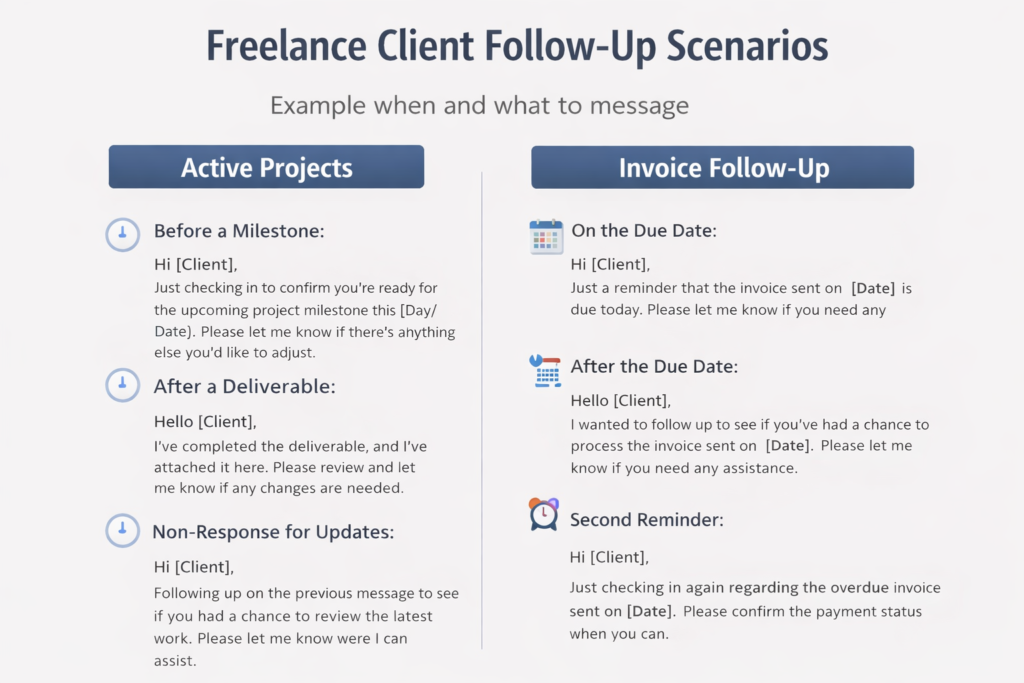
Section 8: Freelance Client Follow Up Templates You Can Use Today
These templates cover the most common freelance client follow up scenarios. Each is written to be copied, lightly personalized, and sent — not as a starting point for a five-paragraph explanation, but as a complete, professional communication that gets the job done in the fewest words necessary.
Template 1: Proposal Follow-Up (3–5 Days After Sending)
Subject: Following up on my proposal for [Project Name]
Hi [Client Name],
I wanted to follow up on the proposal I sent on [date] for [brief project description]. I know you have a lot going on, so just wanted to make sure it came through and offer to answer any questions that might help you move forward.
If timing has shifted on your end, no problem at all — just let me know and we can adjust. Happy to jump on a quick call if that would be easier.
[Your Name]
Template 2: Proposal Follow-Up (Second Touchpoint — Adding Value)
Subject: One more thought on [Project Name]
Hi [Client Name],
I have been thinking more about [specific aspect of their project] and wanted to share a quick note: [one-sentence relevant observation or example]. I think this approach would work particularly well given [specific context from their brief].
Still very interested in working on this — let me know if you have questions or want to discuss further.
[Your Name]
Template 3: Proposal Follow-Up (Final Message)
Subject: Closing the loop on [Project Name]
Hi [Client Name],
I understand priorities change, and wanted to send one final note before stepping back. If now is not the right time for this project, no problem at all — I would be glad to reconnect whenever the timing works for you.
Wishing you and the team all the best.
[Your Name]
Template 4: Delivered Project Check-In (2 Days After Delivery)
Subject: Checking in on [Deliverable]
Hi [Client Name],
Just checking in to make sure you received [deliverable] and that everything looks good. Let me know if you have any questions or would like to discuss any part of it — I am happy to jump on a call.
Once you have had a chance to review, just let me know and I will send over the invoice.
[Your Name]
Template 5: Invoice Reminder (Due Date)
Subject: Invoice [#XXX] — Payment Due Today
Hi [Client Name],
A quick reminder that Invoice [#XXX] for [amount] is due today. You can pay via [payment method / link].
Please let me know if you have any questions or if there is anything you need from me on this.
[Your Name]
Template 6: Overdue Invoice (5–7 Days)
Subject: Invoice [#XXX] — Now Past Due
Hi [Client Name],
I wanted to follow up on Invoice [#XXX] for [amount], which was due on [date] and is now [X] days past due. If there has been an issue with the payment or you need anything further from me, please let me know.
Could you confirm when I can expect payment? I would appreciate settlement by [specific date].
[Your Name]
Template 7: Ghosted Client Re-Engagement
Subject: Checking in
Hi [Client Name],
I know things get busy — just wanted to send a quick note in case our earlier conversation got buried. If the project is still on your radar, I would love to help make it happen. And if timing has changed, completely understood — I am here if you need support down the road.
[Your Name]
Template 8: Past Client Repeat Business
Subject: Checking in — [Project Name] from [Month]
Hi [Client Name],
I hope things have been going well since we wrapped up [project]. I was thinking about your business recently and wanted to check in — if you have any upcoming projects I can help with, I would love to hear about them.
No pressure at all, just wanted to stay in touch.
[Your Name]
Section 9: Building a Freelance Client Follow Up System
One of the most common reasons freelancers execute poor freelance client follow up is not a lack of willingness — it is a lack of a system. When follow-ups are handled reactively and from memory, they happen inconsistently, get sent at the wrong time, or get forgotten entirely. A simple, repeatable system removes the cognitive load and ensures every follow-up happens at the right moment.
Track Every Open Loop
For every proposal submitted, every delivered project awaiting approval, every sent invoice, and every past client worth re-engaging, there should be a logged entry in your tracking system with a specific follow-up date attached to it. The format does not matter — a spreadsheet, a CRM, a task manager — as long as every open freelance client follow up has a named date it will be acted on. Without this structure, follow-ups happen when you happen to remember them, which is not a system.
Use Your Preferred Channel — And Know Theirs
Not all clients respond equally across channels. Some clients who ignore emails are responsive on LinkedIn. Clients on Upwork or Fiverr may be easier to reach through platform messages than through external email. Before defaulting to email for every freelance client follow up, consider which channel you have seen them be most responsive on — and use that. A brief LinkedIn message referencing your email — “I also sent you an email, but thought I would follow up here in case this is easier” — is often the message that finally produces a response from a client who had buried your original outreach.
Batch Your Follow-Ups
Rather than reacting to follow-up needs as they arise throughout the day, batch your freelance client follow up activity into a specific weekly slot — for example, every Tuesday morning. Review your open loop list, identify which follow-ups are due this week, write them all in one focused session, and send. This approach reduces the friction and anxiety of individual follow-up decisions, keeps your cadence consistent, and prevents the mental overhead of wondering “should I follow up yet?” from consuming your workday.
Log Every Interaction
Every freelance client follow up you send should be logged with the date, content summary, and response received (if any). Over time, this log tells you which follow-up approaches generate responses, which clients respond at which cadences, and what language tends to produce action versus silence. This data allows you to continuously refine your freelance client follow up approach based on actual evidence rather than intuition.
Common Freelance Client Follow Up Mistakes to Avoid
These are the errors that undermine even well-intentioned freelance client follow up efforts — each one is preventable and each one costs freelancers real income.
1. Waiting too long to send the first follow-up. The most common mistake in freelance client follow up is giving the client “space” for so long that the opportunity cools entirely. A proposal or delivered project that goes unacknowledged for ten or fourteen days is not showing respect for the client’s time — it is passively allowing the relationship to go cold. Three to five business days is the right interval for a first follow-up in most scenarios. Shorter than that can feel rushed; longer than that loses momentum.
2. Opening with “Just checking in.” “Just checking in” is the most common freelance client follow up opener and the least effective. It signals that you have nothing new to add and are only reaching out to satisfy your own anxiety about the silence. Every freelance client follow up should open with something specific: a reference to the project, a relevant observation, a direct question, or a clear next step. Replace “just checking in” with “I wanted to follow up on [specific thing] and make sure [specific outcome].”
3. Sending too many follow-ups too quickly. The counterpart to waiting too long is following up too aggressively. A client who receives three follow-up messages in the same week is not being well-served — they are being pressured, and they will experience your follow-up as an intrusion rather than a service. Space your freelance client follow up messages by at least three to five business days and limit most sequences to three messages total before stepping back.
4. Making the follow-up about your needs instead of theirs. “I need to know your decision soon because I am planning my schedule” is a freelance client follow up that is entirely about your situation and asks the client to accommodate your anxiety. “I wanted to follow up and make sure you have everything you need from me to move forward” is a freelance client follow up that frames the communication around the client’s readiness and needs. The second message is far more effective — and more honest about what a good follow-up is actually for.
5. Not following up on invoices out of discomfort. Invoice discomfort is one of the most financially damaging patterns in freelancing. Every day an overdue invoice is not followed up is a day the payment does not arrive. A professional, matter-of-fact freelance client follow up on an unpaid invoice is not confrontational — it is a routine part of running a business. The client who needs to be reminded is usually not trying to avoid paying — they are busy, and your message gives them the prompt to act.
6. Using identical messages for every follow-up in a sequence. Sending the same template as both your first and second freelance client follow up signals that you are not paying attention and have nothing new to offer. Each message in a follow-up sequence should add something: a new angle on the project, a relevant portfolio piece, a slight shift in the ask. Even a small change to the opening or the content signals that you are actively engaged rather than running a mechanical reminder process.
7. Following up without a clear call to action. Every freelance client follow up should end with one clear, low-friction next step: “Let me know if you have any questions,” “Could you confirm receipt?”, “When would be a good time for a quick call?” A message that ends without a specific ask creates decision paralysis — the client has no obvious action to take in response. Make it easy for them to engage by giving them one specific thing to do.
8. Never following up with past clients for repeat work. The highest-conversion, lowest-cost freelance client follow up is the one most freelancers never send: the past client re-engagement. A client who was satisfied with your work is far more likely to hire you again than a cold prospect — they simply need to be reminded you exist and that you are available. A brief, warm message every three to six months maintains the relationship and consistently generates repeat business for freelancers who make it a habit.
Freelance Client Follow Up Checklist
- ☐ Every open proposal has a scheduled follow-up date in your tracking system
- ☐ First follow-up on a proposal is scheduled 3–5 business days after sending
- ☐ Follow-up messages open with something specific — not “Just checking in”
- ☐ Each message in a sequence adds something new (angle, example, observation)
- ☐ Every follow-up ends with one clear, low-friction call to action
- ☐ Invoice reminders are scheduled on the due date and at 5–7 days overdue
- ☐ Delivered projects are followed up within 2 business days if unacknowledged
- ☐ Discovery call follow-ups are sent within 24 hours
- ☐ Ghosted client sequences are limited to 3 messages before stepping back
- ☐ Past client re-engagement is scheduled every 3–6 months
- ☐ Referral requests are sent after every successful project completion
- ☐ All follow-up interactions are logged with date and outcome
- ☐ Follow-up channel matches the client’s most responsive channel
- ☐ Follow-up messages do not send on Mondays or Fridays when avoidable
- ☐ Maximum 3 follow-ups per sequence without a response before pausing
Frequently Asked Questions About Freelance Client Follow Up
How many follow-up messages should I send before giving up?
For most freelance client follow up scenarios — proposal follow-ups, ghosted clients, post-interview check-ins — three messages sent over two to three weeks is the appropriate limit before stepping back. Three attempts across a reasonable timeline signals genuine interest without tipping into harassment. The exception is invoice follow-up, where persistence is more warranted given that you have already delivered work: four or more follow-ups over a month, escalating to formal dispute processes if necessary, is appropriate for overdue payments.
What is the best day and time to send a freelance client follow up?
Tuesday, Wednesday, and Thursday are consistently the most effective days for freelance client follow up emails. Monday is typically spent catching up from the weekend; Friday is winding down. Within the day, late morning (9–11 AM in the client’s time zone) and early evening (around 5–6 PM, when people clear their inboxes before closing) tend to produce higher response rates. Avoid sending follow-ups on public holidays or during obvious industry event periods when clients’ attention is directed elsewhere.
Should I follow up by email, phone, or through the platform?
For most freelance client follow up situations, email or platform messages (Upwork, Fiverr) are the appropriate channel — calls are generally too high-friction for a first or second follow-up unless the client specifically prefers them. LinkedIn is an effective secondary channel if email follow-ups are going unread: a brief note on LinkedIn referencing your email (“I also emailed you, but thought I would follow up here in case it is easier”) consistently produces responses from clients who had buried the email. Use the channel where you have seen the client be most responsive.
What should I do if a client has not paid and is also not responding to my messages?
If an invoice is more than 14–21 days overdue and your freelance client follow up messages have been unanswered, escalate beyond the standard sequence. For platform-based contracts on Upwork, use the formal dispute resolution system. For off-platform freelance contracts, reference the payment terms in your contract, send a formal notice, and if necessary seek legal or collections assistance for larger amounts. Document every follow-up attempt including dates and content — this documentation matters if the situation escalates further.
Is it okay to follow up on the same day I sent the original message?
No — same-day or next-day freelance client follow up on a proposal or casual inquiry is almost universally perceived as pressure and can damage the client relationship before it has properly started. Give clients a minimum of two to three business days before any first follow-up, and three to five for proposals where a decision or review process is involved. The only exception is a message explicitly tied to an urgent or time-sensitive project, where you can note the deadline context in the follow-up.
How do I ask a past client for repeat work without feeling awkward?
The most effective freelance client follow up for a past client re-engagement is one that is genuinely brief, specific, and no-pressure: reference a project you worked on together, ask how it is going, and mention you are available if they have upcoming work. Do not launch into a sales pitch and do not make the message about your availability or income needs. The message that generates the most repeat business is the one that sounds like it came from someone who was actually thinking about the client’s business — because it should. If you cannot think of something genuine to say about their business, that is a signal to spend a minute reviewing their situation before reaching out.
How Zenlance Helps You Build a Consistent Freelance Client Follow Up System
The biggest obstacle to an effective freelance client follow up practice is not knowing what to say — it is keeping track of what needs to be followed up on, when, and what was said last time. When you are managing multiple clients and active projects simultaneously, open proposal loops, overdue invoices, and past client re-engagements all compete for mental bandwidth. Without a system, the highest-value follow-ups get forgotten while low-priority tasks take up the space they should occupy.
Zenlance is a free AI-powered CRM built specifically for Upwork and Fiverr freelancers. It gives you a centralized dashboard to track every active client relationship, log communications, set follow-up reminders, and manage proposals from first contact through to completed contract and review request. Instead of maintaining a mental list of who needs a follow-up and when, Zenlance surfaces those reminders for you — so your freelance client follow up practice becomes systematic and consistent rather than reactive and forgettable. Start free at zenlance.net.
Recommended Reading
- Upwork Profile Optimization: The Complete Guide to Winning More Clients in 2026
- Upwork Proposal Examples That Win Jobs: Templates and Tips for 2026
- How to Write a Winning Upwork Cover Letter in 2026
- How to Get Your First Client on Upwork With Zero Reviews (2026)
- Upwork Job Success Score: How It Works and How to Improve It in 2026
- Free AI CRM for Freelancers: Manage Clients, Tasks, and Projects in 2026
- Fiverr vs Upwork: Which Platform Is Better for Freelancers in 2026?