How to Build a Freelance Portfolio That Wins Clients in 2026
Your freelance portfolio is the single most powerful sales tool you have as a freelancer — more persuasive than your bio, more convincing than your rates, and more decisive than any proposal you will ever write. It is the place where a potential client goes from curious to convinced, from browsing to reaching out.
Research consistently shows that freelancers who have published a portfolio are hired up to nine times more often than those who have not. In 2026, with more independent professionals entering the market every month and clients making hiring decisions in minutes rather than hours, a weak or nonexistent freelance portfolio is not just a gap in your profile — it is the reason you are losing work to people who may be less skilled than you.
The challenge most freelancers face when building their freelance portfolio is not a lack of skill. It is a lack of clarity about what the portfolio is actually for. A freelance portfolio is not a gallery of everything you have ever done — it is a curated argument for why a specific type of client should hire you for a specific type of work.
The freelancers with the most effective portfolios are not necessarily the most experienced. They are the ones who have most clearly answered the question a client silently asks when browsing: “Can this person solve exactly the problem I have?” Every decision in a great freelance portfolio — what to include, how to present it, what to say about each piece, where to host it — is an answer to that question.
This guide gives you the complete freelance portfolio blueprint for 2026: what makes a portfolio convert browsers into buyers, how to structure case studies that demonstrate outcomes not just output, how to build a compelling portfolio even if you have no client work yet, where to host it for maximum professional impact, and the specific elements that separate a forgettable portfolio from one that wins consistent work. Whether you are building your first freelance portfolio from scratch or overhauling one that is not performing, this is the framework that works.
Table of Contents
- What Makes a Freelance Portfolio Actually Win Clients?
- Section 1: Choosing What to Include in Your Freelance Portfolio
- Section 2: How to Build a Freelance Portfolio With No Client Work Yet
- Section 3: The Case Study Format — Turning Projects Into Proof
- Section 4: The Essential Pages Every Freelance Portfolio Needs
- Section 5: Social Proof — Testimonials and Client Results
- Section 6: Where to Host Your Freelance Portfolio in 2026
- Section 7: How to Use Your Freelance Portfolio on Upwork and Fiverr
- Section 8: Tailoring Your Freelance Portfolio for Different Clients
- Section 9: Keeping Your Freelance Portfolio Updated and Active
- Common Freelance Portfolio Mistakes That Cost You Clients
- Freelance Portfolio Checklist
- Frequently Asked Questions About Freelance Portfolio Building
What Makes a Freelance Portfolio Actually Win Clients?
Most freelance portfolios fail not because the work they contain is bad, but because they are organized around the wrong goal. A portfolio built to impress — to show range, volume, and the breadth of everything a freelancer can do — is a different thing from a portfolio built to convert. Converting a visitor into a client requires answering three questions in the first thirty seconds of someone landing on your page: What do you do? Who do you do it for? Can you prove it?
A freelance portfolio that answers all three questions immediately — with a clear headline, a focused set of work samples, and tangible evidence of outcomes — will consistently outperform a longer, more impressive portfolio that takes time and effort to decode. Clients are not studying your portfolio like a gallery visitor. They are making a fast, pattern-matching judgment: “Is this person the right fit for the project I have in mind?” Everything in your freelance portfolio should be optimized for that moment of recognition — the instant when a potential client sees a piece of your work and thinks, “This is exactly what I need.”
The second thing that makes a freelance portfolio win clients is specificity. A portfolio that shows you can do everything for everyone convinces no one of anything. A portfolio that shows you have specifically solved the problem a particular type of client has — in their industry, at their scale, with their constraints — makes you the obvious choice rather than one option among many. Specialization in a freelance portfolio is not a limitation. It is a conversion mechanism.
The best freelance portfolio is not the most impressive one — it is the most relevant one. A client deciding whether to hire you is not asking “is this person talented?” They are asking “is this person right for my project?” Your portfolio wins when the answer to that question is an immediate, obvious yes.
Section 1: Choosing What to Include in Your Freelance Portfolio
The most common freelance portfolio mistake is inclusion rather than curation. The instinct — especially for newer freelancers — is to include everything: every project completed, every skill demonstrated, every client served. The result is a portfolio that feels unfocused and unconvincing, because it asks the visitor to do the work of finding the relevant pieces rather than presenting them front and center.
Quality Always Beats Quantity
Three to five exceptional, well-presented portfolio pieces will consistently outperform a freelance portfolio of twenty mediocre ones. Clients are not looking for evidence that you are prolific — they are looking for evidence that you can deliver the specific type of work they need at a quality level they can trust. A single case study that demonstrates a clear problem, a specific approach, and a measurable outcome communicates more about your capability than a grid of twenty project thumbnails with no context.
Start by identifying the three to five pieces of work you are most proud of — pieces that represent the type of work you want to do more of, delivered at the quality level you are confident you can sustain. Those are the foundation of your freelance portfolio. Everything else is optional.
Show the Work You Want to Do, Not Everything You Have Done
This principle is one of the most strategically important in freelance portfolio construction: your portfolio should be a signal of the work you want to attract, not an archive of everything you have ever delivered. If you spent two years writing email newsletters but now want to focus on landing pages, your freelance portfolio should lead with landing page work — even if that means featuring fewer pieces overall. The portfolio that shows a potential client exactly what they need communicates intent and focus. The portfolio that shows everything you have ever done communicates ambiguity.
What to Include Across Skill Types
The right portfolio content varies by discipline, but the underlying principle is consistent: show the problem, the process, and the proof.
For writers and content creators, the strongest freelance portfolio pieces combine the actual work sample with a brief annotation: what was the goal, who was the audience, what was the result. A single annotated piece is more persuasive than five unannotated samples.
For designers and visual creatives, context is everything. A logo without any explanation of the brand brief and strategic thinking behind it is just an image. A logo presented with the client’s challenge, your approach, and the final outcome is a case study that demonstrates both craft and thinking.
For developers and technical freelancers, live links and GitHub repositories are the gold standard portfolio evidence — but they must be accompanied by plain-English descriptions of what was built, why specific technical decisions were made, and what the client or end user gained from the work.
For consultants and strategists, results-focused case studies — with specific metrics, timelines, and outcomes described — are the most compelling freelance portfolio format available.

Section 2: How to Build a Freelance Portfolio With No Client Work Yet
The cold-start problem in freelance portfolio building is real: you need a portfolio to get clients, but you need clients to build a portfolio. Every established freelancer once faced this same paradox, and the solution is the same across every discipline — you do not need paid client work to build a compelling freelance portfolio. You need relevant, high-quality samples of the work you can deliver.
Spec Work and Concept Projects
Spec work — short for speculative work — is project work you create to demonstrate your skills without a client commission. For designers, this means conceiving a brand identity or redesigning an existing company’s website as a personal exercise. For writers, it means writing a sample article, landing page, or email sequence in the style and format of the clients you want to work with. For developers, it means building a side project, a useful tool, or a demo application that showcases your technical skills in a specific context.
Spec work is entirely legitimate in a freelance portfolio, and clients evaluating new freelancers regularly respond positively to well-executed concept work. The key is to present it honestly — label it as a personal or concept project — and to make it as polished and professional as any paid commission would be. A sloppily executed spec piece hurts your portfolio more than an empty slot. A beautifully crafted concept piece can be indistinguishable in persuasive power from a paid commission.
Volunteer and Pro Bono Work
Offering your services to a nonprofit, a community organization, a friend’s small business, or a local cause is an effective and ethically straightforward path to real portfolio content. The work is real, the outcome is real, and the client relationship — including the ability to request a testimonial — is real. Volunteer work in your freelance portfolio is not a concession; it is a legitimate demonstration of applied skill with genuine stakes.
Personal Projects and Self-Initiated Work
If you designed your own logo, built your own website, wrote your own blog, or developed a personal application, all of it is fair game for your freelance portfolio. Work you did for yourself demonstrates taste, initiative, and the ability to define and execute a project without external direction — all qualities that translate directly to client value. Your own personal projects in your freelance portfolio often spark more interesting client conversations than commissioned work precisely because they reveal your own voice and perspective.
Reframe Off-Platform Experience
Many freelancers underestimate how much portfolio-relevant material they have from previous employment, academic work, or informal projects. A presentation you built for a previous employer, a marketing campaign you contributed to, a software feature you developed as part of a team — all of these can be presented in your freelance portfolio with appropriate context about your specific contribution. Frame the piece around your role, your specific deliverable, and the outcome, and it becomes valid portfolio evidence regardless of where the work was originally produced.
Section 3: The Case Study Format — Turning Projects Into Proof
The case study is the highest-converting format in a freelance portfolio. Where a simple work sample shows what you produced, a case study shows how you think, how you work, and what your clients actually gained from the engagement. Clients reading a well-written case study do not just see the output — they experience what it would be like to hire you. That experiential dimension is what separates a persuasive freelance portfolio from a passive one.
The Three-Part Case Study Structure
Every strong case study in a freelance portfolio follows a version of the same structure: the problem, the approach, and the result.
The problem section establishes context — who the client was (without necessarily naming them), what challenge they faced, and why it mattered. This is the section that makes a potential client recognize their own situation in your portfolio piece. If a buyer sees their own problem described in your case study, they have already half-decided to contact you before reading the rest.
The approach section is where you demonstrate your thinking and process. What specific methods did you apply? What decisions did you make and why? What obstacles arose and how did you navigate them? This section proves that your work is not accidental — it is the product of a deliberate methodology that you can replicate for the next client.
The result section is the most persuasive part of the case study and the most commonly underdeveloped section in a freelance portfolio. Specific, quantified outcomes — a 40% increase in conversion rate, a 15-day reduction in development time, a 62% improvement in organic traffic, a client’s first $10,000 product launch — are far more compelling than vague success descriptions. If you have metrics, use them. If you do not have exact figures, describe the qualitative outcome as specifically as you can: “The client reported a significant improvement in inbound lead quality within the first month of the new site launch.”
Keep Case Studies Focused and Readable
A freelance portfolio case study does not need to be long. Three to five paragraphs covering problem, approach, and result — supported by one or two visuals of the actual work — is the right length for most disciplines. Longer case studies are appropriate for highly complex projects, but the default should be concise and scannable: a potential client should be able to read your entire case study in under three minutes and come away with a clear, confident impression of what you delivered and why it mattered.
Section 4: The Essential Pages Every Freelance Portfolio Needs
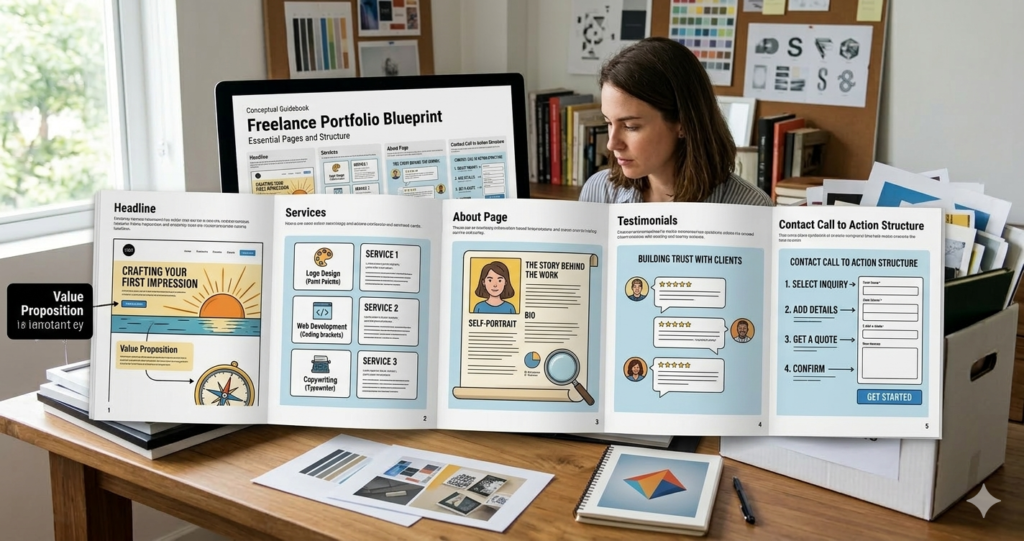
A professional freelance portfolio website is more than a gallery of work samples. The pages and elements that surround your work samples determine how much of that work actually converts visitors into clients. These are the essential components every freelance portfolio needs.
A Clear, Specific Headline
The first thing a visitor sees on your freelance portfolio should tell them exactly who you are, what you do, and who you do it for — in a single sentence. “Freelance Designer” is not a headline. “Brand Identity Designer for DTC Consumer Startups” is a headline. The specificity of your headline determines whether a potential client in your target market immediately recognizes you as relevant or scrolls past. Every word of your headline is doing conversion work. Vague headlines cost you the clients who would have hired you if they had known you were exactly what they needed.
Work Samples or Case Studies
This is the core of your freelance portfolio and should be given the most visual weight on the page. Three to five featured pieces, each presented with enough context for a visitor to understand what the work was, who it was for, and what it achieved. Include a thumbnail or preview for each piece that makes someone want to click and read more. The work samples section of your freelance portfolio should be the first thing visitors see below your headline — not buried below a lengthy bio or a list of services.
Services Page
A dedicated services section tells potential clients exactly how they can engage with you and what they will receive. Be specific: name each service, describe what is included, and if possible note what type of client or project is the right fit. Vague services descriptions — “I offer a range of creative solutions” — create friction. Specific ones — “Brand identity packages including logo, color system, typography guide, and brand usage guidelines” — remove it. Your services page is where curiosity converts to inquiry.
About Page
The about page of your freelance portfolio is not primarily about your personal story — it is a professional pitch that explains why a client should choose you over other alternatives. Lead with your area of expertise and your professional background, describe the type of clients you serve and the outcomes you help them achieve, and include a professional headshot. Keep it focused: the goal of the about page is to give a visitor enough credibility and personality to feel confident reaching out, not to tell your entire life story.
Testimonials and Social Proof
Client testimonials are covered in detail in the next section, but their placement matters for freelance portfolio conversion. Do not bury testimonials on a separate page. Weave them throughout your portfolio — one after your headline, one after your featured work, one on your services page. Social proof distributed across your freelance portfolio creates a consistent confidence signal rather than a single concentrated endorsement section that visitors might skip.
Contact and Call to Action
Every page of your freelance portfolio should make it easy for a client to reach out. A simple, low-friction contact form — or a clear email link — paired with a direct call to action (“Get in touch to discuss your project” or “Book a free discovery call”) removes the final barrier between interest and action. Do not make a potential client hunt for a way to contact you after your work has already convinced them.
Section 5: Social Proof — Testimonials and Client Results
Social proof is the most persuasive category of content in a freelance portfolio. A potential client reading your own description of your work is evaluating your self-assessment. A potential client reading a satisfied client’s description of working with you is reading third-party validation — which is categorically more persuasive than anything you can say about yourself.
Getting Testimonials
The most reliable way to collect testimonials for your freelance portfolio is to ask for them directly at the end of every successful project. A simple, direct request — “If you were happy with the work, a brief testimonial would mean a lot to me and help me grow my portfolio” — generates testimonials at a much higher rate than leaving it to chance. Most satisfied clients are happy to oblige when asked directly and given clear context about where the testimonial will be used.
The best testimonials for a freelance portfolio are specific. “Working with [Name] was a pleasure” is weak social proof. “Within two weeks of launching the new landing page [Name] designed, our conversion rate increased from 1.8% to 4.2% — significantly above our target” is powerful social proof. When requesting a testimonial, consider guiding the client with a specific question: “Could you briefly describe the problem you were facing before we worked together, what we delivered, and the impact it had on your business?” This prompt reliably produces the type of specific, outcome-focused testimonials that actually convert visitors.
Video Testimonials
Video testimonials are the gold standard of freelance portfolio social proof and the least commonly included element — precisely because they require more effort to collect. A brief, candid thirty-second video of a satisfied client describing their experience is worth more than five written testimonials because it is significantly harder to fake and significantly more emotionally resonant. If you complete a project with a client who communicates well and seems enthusiastic about the outcome, ask if they would be willing to record a short video testimonial over a Zoom call or on their phone. Even a handful of video testimonials in your freelance portfolio will distinguish it from almost every competitor you face.
Quantified Results
Wherever you have specific metrics from completed projects — traffic growth, revenue generated, time saved, error rates reduced, conversion improvements — include them in your freelance portfolio case studies and testimonials. Numbers convert better than adjectives. A potential client reading “increased organic traffic by 40% in three months” is making a direct mental calculation about ROI. A potential client reading “excellent SEO results” is receiving an unverifiable claim. The difference in persuasive power is significant.
Section 6: Where to Host Your Freelance Portfolio in 2026
The platform you choose to host your freelance portfolio affects how it is found, how it presents your work, and how much control you have over the client experience. Each hosting approach has trade-offs worth understanding before committing to one.
Personal Portfolio Website
A dedicated personal website is the most professional and most flexible freelance portfolio option available. It gives you complete control over design, structure, and SEO, allows you to present your work exactly as you intend, and builds a permanent home for your professional identity online. A personal freelance portfolio website built on WordPress, Webflow, or Squarespace can be indexed by search engines, which means potential clients can find you organically — without you spending Connects or paying for visibility on a third-party platform.
The trade-off is setup time and maintenance. A well-designed portfolio website requires more effort to build than a profile on a platform like Behance or Contently — but it pays dividends in professional credibility that no third-party-hosted portfolio can fully replicate.
Platform-Specific Portfolio Options
Depending on your discipline, purpose-built portfolio platforms can be effective supplements to a personal website. Behance and Dribbble are the dominant freelance portfolio platforms for designers, with large audiences of potential clients who actively browse for creative talent. GitHub is the standard technical freelance portfolio platform for developers. Contently and Clippings.me are strong options for writers who want a clean, professional display of published or unpublished writing samples.
These platforms work best as supplements to a personal website, not replacements. They extend your reach into platform-specific audiences while your personal site maintains your primary professional identity and remains fully under your control.
Upwork and Fiverr Profiles
On platforms like Upwork and Fiverr, your platform profile functions as an embedded freelance portfolio — and it is often the first (and sometimes only) portfolio representation a client sees before making a hiring decision. The next section covers this in detail, but the key principle is that your platform profile portfolio section and your standalone portfolio website should work in harmony, with the platform profile driving traffic to your full portfolio for clients who want to see more.
Section 7: How to Use Your Freelance Portfolio on Upwork and Fiverr
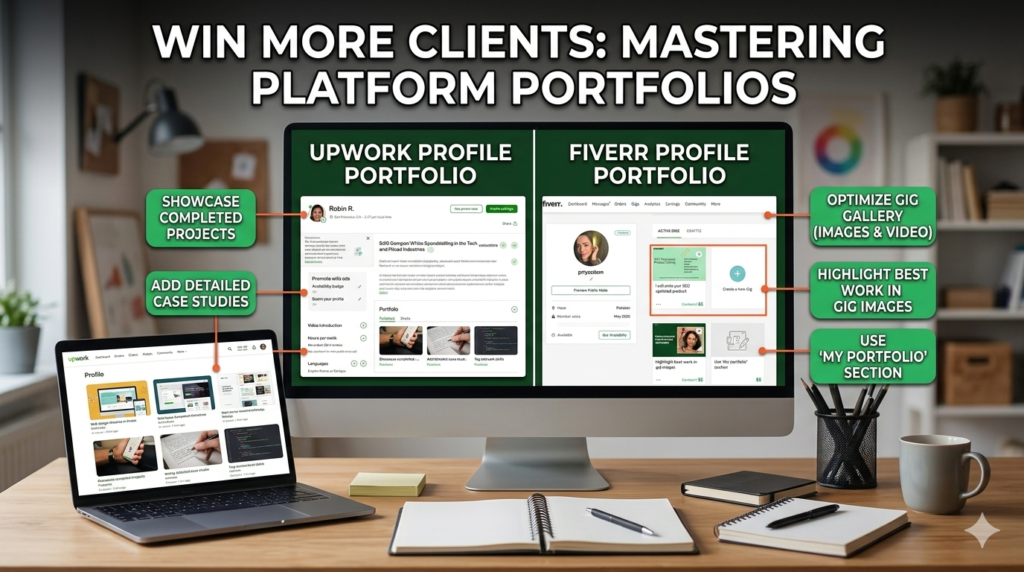
On Upwork and Fiverr, your freelance portfolio lives inside your profile and gig pages — and it operates under different constraints than a standalone website. Understanding how to use your on-platform portfolio effectively is critical for converting profile views into orders.
Upwork Portfolio
Upwork allows you to add portfolio items directly to your profile, each with a title, image or document, a description, and skills tagged. These items appear prominently on your profile and are often the first thing a client reviews after your headline and overview. For your Upwork freelance portfolio, apply the same principles as a standalone site: include only your strongest three to five pieces, describe each with a problem-approach-result narrative rather than a simple caption, and make sure the visual thumbnails are high-quality and immediately communicate the type of work you are offering.
You can also link your Upwork portfolio items to an external URL — use this to connect to your full standalone portfolio or to a specific case study page that gives the client more detail than the Upwork interface allows.
Fiverr Portfolio
On Fiverr, your freelance portfolio is embedded directly in your gig pages. Each gig can include images, PDFs, and videos that function as work samples. According to Fiverr’s official gig best practices documentation, gigs with high-quality images and sample work consistently outperform those with placeholder visuals or no samples at all. Treat each gig’s portfolio images as a mini freelance portfolio in their own right: present your actual work, use real samples not stock imagery, and include at least one image that shows a before-and-after or a visible outcome where the format of your work allows it.
At higher Fiverr seller levels, you also have access to a standalone portfolio section on your profile page — use it to display your three to five best pieces with full case study descriptions, linking through to your standalone freelance portfolio for clients who want the full picture.
Section 8: Tailoring Your Freelance Portfolio for Different Clients
One of the most powerful and underused techniques in professional freelance portfolio strategy is tailoring — adapting which pieces you feature prominently depending on the specific client or opportunity you are pursuing. A single static freelance portfolio performs adequately for all clients. A tailored presentation performs exceptionally for specific ones.
Custom Portfolio Links for High-Value Opportunities
When pursuing a high-value contract — a large Upwork project, a significant new client approached through direct outreach, or a referral from an existing client — consider creating a brief, targeted version of your freelance portfolio that leads with the two or three pieces most relevant to that client’s specific context. This can be as simple as a single page on your portfolio website with a custom URL, or a curated PDF featuring selected case studies.
A potential client who lands on a portfolio page that features work remarkably similar to their own project requirements is experiencing a level of personalization that the vast majority of freelancers never provide. The implicit message — “I have already thought about what is relevant to you” — communicates both attentiveness and professionalism.
Industry and Niche Alignment
When possible, organize your freelance portfolio around industries or client types rather than just work categories. A developer whose portfolio shows work for e-commerce brands will convert better with e-commerce clients than a developer whose portfolio shows the same technical work presented generically. A writer whose portfolio is organized around healthcare content will win healthcare clients faster than one whose writing portfolio is unsorted by industry.
This does not require multiple separate portfolio websites — a single well-structured site with a clear organization or filter system achieves the same effect. The goal is to give any potential client a path through your freelance portfolio that leads directly to the evidence most relevant to their situation.
Section 9: Keeping Your Freelance Portfolio Updated and Active
A freelance portfolio is not a one-time build — it is a living professional document that needs regular attention to remain effective. An outdated portfolio that features your oldest and least representative work is not just unhelpful — it actively undermines the impression you are trying to create.
Quarterly Review Habit
Build a quarterly review of your freelance portfolio into your professional calendar. Every three months, ask: does this portfolio still reflect the work I want to be hired for? Are there completed projects from the past quarter that are stronger than the weakest piece currently featured? Is there a piece I am keeping for volume but would be better served removing? A quarterly audit keeps your freelance portfolio current without requiring constant maintenance.
Add Case Studies Immediately After Completion
The best time to write a portfolio case study for a completed project is immediately after the project closes — when your memory of the problem, process, and result is fresh and when the client is most likely to respond positively to a testimonial request. Waiting until a quarterly review means important details get lost and clients become harder to reach. Build the habit of drafting a brief case study within the first week after every significant project closes.
Remove What No Longer Represents You
One of the most valuable portfolio maintenance activities is removal. Work that you produced two or three years ago, at an earlier skill level or in a category you no longer serve, should be removed when newer and stronger work is available. A freelance portfolio that contains your oldest pieces alongside your newest creates a confusing and inconsistent impression. Ruthless curation — keeping only what you would be proud to have a potential client see today — is one of the most important ongoing portfolio management practices.
Common Freelance Portfolio Mistakes That Cost You Clients
These are the most frequent and most damaging errors in freelance portfolio construction — each one is preventable and each one costs the freelancers who make it real income.
1. Including everything instead of curating ruthlessly. The freelance portfolio with 25 work samples and no editorial judgment communicates a failure to distinguish your best work from your average work. Clients do not have time to find the good pieces buried in a long portfolio. Feature only the work you would be proud to have a sophisticated potential client evaluate as representative of your typical output — three to five exceptional pieces, not a comprehensive archive.
2. No context or narrative around work samples. A freelance portfolio full of images, files, and links with no explanation of what the work is, who it was for, or what it achieved is a passive display of output, not a persuasive demonstration of value. Every portfolio piece needs at minimum a one-paragraph description that names the client context, your approach, and the outcome. Without this context, even exceptional work fails to convert.
3. A headline that is too broad or too vague. “Creative Professional” or “Experienced Developer” are headlines that tell a potential client nothing differentiating. A specific, targeted headline — “UX Designer for B2B SaaS Products” or “WordPress Developer for WooCommerce Speed and Conversions” — immediately qualifies you as relevant to the right client and irrelevant to the wrong one. Vague headlines maximize your theoretical audience and minimize your actual conversion rate.
4. No testimonials or social proof. A freelance portfolio with no client testimonials asks potential clients to rely entirely on your own self-description. In a marketplace where most established competitors have multiple reviews and testimonials, the absence of social proof creates a trust gap that even excellent work samples may not bridge. Ask for a testimonial after every satisfied client engagement and include them throughout your portfolio, not just on a dedicated testimonials page.
5. Showing work you no longer want to do. A portfolio that features your older, less representative, or off-niche work in order to appear more comprehensive is signaling the wrong message to the clients you actually want to attract. If you want to work on landing pages, your freelance portfolio should feature landing pages. If you want to work with SaaS companies, your portfolio should feature SaaS-context work. Showing everything you have ever done attracts the wrong clients as often as the right ones.
6. No clear call to action. A freelance portfolio without a visible, easy call to action makes a client who is already interested do additional work to reach you. Every page of your portfolio — and certainly your work samples and about page — should include a direct invitation to get in touch, with a frictionless way to do so. “Interested in working together? Send me a message” with a linked email address or contact form is all that is needed. Without it, potential clients who liked your work close the tab and do not come back.
7. Outdated work that no longer represents your skill level. A freelance portfolio that has not been updated in twelve months is silently communicating that you are either inactive or satisfied with work that predates your current skill level. Regular portfolio maintenance — removing old pieces, adding new ones, updating case studies with current metrics — is not optional upkeep. It is a direct reflection of how you approach your professional development and your commitment to your craft.
8. Not having a freelance portfolio at all. This remains the most expensive mistake in freelancing. Research suggests freelancers with a published portfolio are hired up to nine times more often than those without one. Waiting until your portfolio is “ready” — until you have more work, more polish, more content — is a form of self-sabotage. A freelance portfolio with three good pieces and honest presentation of your skills is infinitely more effective than no portfolio. Start with what you have, and improve it over time.
Freelance Portfolio Checklist
- ☐ Portfolio leads with a specific, targeted headline (who you are, what you do, who you do it for)
- ☐ 3–5 curated work samples or case studies featured — quality over quantity
- ☐ Each piece has a context description: problem, approach, and result
- ☐ All work samples represent the type of work you want to be hired for going forward
- ☐ At least one piece includes specific, quantified results (metrics, percentages, outcomes)
- ☐ Spec work, personal projects, or pro bono work included if paid client work is limited
- ☐ At least 2–3 client testimonials present, distributed throughout the portfolio (not only on one page)
- ☐ Services section clearly names what you offer and who it is for
- ☐ About page focuses on professional background and client outcomes, not personal biography
- ☐ Professional headshot included on profile or about page
- ☐ Clear call to action on every page with easy contact mechanism
- ☐ Portfolio hosted on a personal website (standalone domain preferred)
- ☐ Platform portfolio (Upwork, Fiverr) aligned with and linked to standalone site
- ☐ Portfolio reviewed and updated quarterly
- ☐ Outdated or off-niche pieces removed
- ☐ Case study drafted within one week of every significant project closing
Frequently Asked Questions About Freelance Portfolio Building
How many pieces should a freelance portfolio include?
Three to five strong, well-presented case studies or work samples is the recommended starting point for a freelance portfolio in most disciplines. Quality always outperforms quantity in portfolio conversion — a potential client who sees five exceptional pieces leaves with more confidence than one who has browsed twenty mediocre ones. As your career grows, you may expand to eight or ten pieces in your full portfolio, but your featured or highlighted pieces should remain tightly curated to your best and most relevant work.
Can I build a freelance portfolio with no paid client work?
Absolutely. Spec work, personal projects, volunteer projects, and previous employment work presented with appropriate framing are all legitimate and effective freelance portfolio content. The goal of a freelance portfolio is to demonstrate that you can deliver the type of work a client needs — and that demonstration does not require a commercial transaction to be valid. Many of the most effective early-stage portfolios are built entirely from self-initiated and pro bono projects, and clients regularly respond well to them when the work quality is high and the context is clearly explained.
Do I need a personal website for my freelance portfolio, or can I use a platform like Behance or Upwork?
A personal website is the gold standard for a freelance portfolio because it gives you full control over design, presentation, SEO, and the client experience — and it builds a professional identity that is not dependent on any third-party platform’s policies or algorithms. That said, platform profiles on Upwork, Fiverr, Behance, or GitHub are effective supplements, particularly for reaching audiences who browse those platforms. The ideal setup is a personal website as your primary freelance portfolio, with platform profiles that link to it and drive interested clients through to the full picture.
How often should I update my freelance portfolio?
A quarterly review is the minimum recommended cadence for most active freelancers. In each review, assess which pieces are still your strongest and most representative, add recent projects that demonstrate current skill and direction, and remove older pieces that no longer reflect your standards or desired niche. Additionally, draft case studies for completed projects immediately after closing — within the first week, while the details are fresh and the client is easy to reach for a testimonial.
Should my freelance portfolio show my rates?
This is a personal preference, but most freelancers choose not to publish rates directly on their portfolio, for two reasons. First, rates for bespoke freelance work typically depend on project scope, which varies significantly between clients. Publishing a rate that is appropriate for one project type may deter a client with a larger, higher-value project or attract clients whose budget is misaligned with your minimum. Second, portfolio visitors who are genuinely interested in working with you will reach out regardless of whether rates are listed — and the discovery conversation is an opportunity to understand their needs before quoting. A services page that describes what is included in an engagement, without specific pricing, strikes the best balance.
How do I get testimonials for my freelance portfolio if I am just starting out?
Ask directly and ask immediately after every completed project — including spec work, volunteer work, and work done for friends or previous employers. Most clients who were satisfied with your work are happy to provide a brief written testimonial when asked directly and given a specific prompt (“Could you describe what we worked on together and what the outcome was for you?”). For freelancers without any client history, a brief endorsement from a former manager, colleague, or professor about your relevant skills and work ethic can serve as early social proof in your portfolio until client testimonials are available.
How Zenlance Helps You Build and Sustain a Winning Freelance Portfolio
Building a strong freelance portfolio is the foundation — but sustaining the client relationships and project track record that keep it growing requires consistent organization and follow-through. The testimonials, case study details, and outcome metrics that make a portfolio compelling come from how well you manage your active client relationships: following up after delivery, requesting feedback at the right moment, and keeping a clear record of each project’s scope, process, and results.
Zenlance is a free AI-powered CRM built specifically for Upwork and Fiverr freelancers. It gives you a centralized dashboard to track active projects, log client communications, and set follow-up reminders — so you never miss the right moment to request a testimonial, document an outcome, or add a completed project to your freelance portfolio. Start free at zenlance.net.
Recommended Reading
- How to Get Your First Client on Upwork With Zero Reviews (2026)
- Upwork Profile Optimization: The Complete Guide to Winning More Clients in 2026
- How to Create a Fiverr Seller Profile That Gets Clicks in 2026
- Upwork Proposal Examples That Win Jobs: Templates and Tips for 2026
- Fiverr Seller Levels Explained: Requirements & How to Level Up (2026)
- How to Follow Up With Freelance Clients Without Being Annoying (2026)
- Free AI CRM for Freelancers: Manage Clients, Tasks, and Projects in 2026