How to Get Upwork Clients Fast: A Proven Step-by-Step System
If you are applying on Upwork and not getting replies, the issue is rarely “not enough proposals.” In most cases, the problem is mismatch: your profile does not signal a clear specialty, your proposals do not quickly demonstrate relevance, or you are applying to jobs that are unlikely to convert.
This guide explains how to get Upwork clients fast using a structured approach you can repeat every week. You will learn how to position your services, optimize your profile for conversion, target the right jobs, write proposals that get interviews, and turn first contracts into repeat work so results accelerate over time.
Table of Contents
- Step 1: Understand how Upwork surfaces freelancers
- Step 2: Choose a clear market position
- Step 3: Optimize your profile like a landing page
- Step 4: Build a job targeting filter
- Step 5: Write proposals that earn replies
- Step 6: Handle interviews strategically
- Step 7: Deliver for reviews and repeat work
- Step 8: Systemize and optimize weekly
- Zenlance workflow tie-in
- Frequently Asked Questions
Quick Summary
| Key Insight | Explanation |
|---|---|
| Marketplace visibility is not random | Relevance, recent activity, and performance signals influence where you appear and how clients engage. |
| Specialists convert faster than generalists | A narrow, outcome-focused offer reduces competition and makes your proposals feel more “obvious” to hire. |
| Profile = landing page | Clients decide quickly; clarity, proof, and structure matter more than long introductions. |
| Targeting beats volume | Applying to fewer, better-fit jobs increases your interview rate and protects your Connects budget. |
| Retention compounds speed | Repeat clients and referrals reduce your need to bid, making growth faster and more predictable. |
| Systems create consistency | Templates, tracking, and a weekly review loop outperform motivation and “proposal sprints.” |
Step 1: Understand how Upwork surfaces freelancers
Upwork is a marketplace that relies on relevance and signals. Clients either post a job and review proposals, or they search and invite freelancers. Your goal is to show up where clients are looking and to earn action once they see you.
Visibility and response rates are affected by a few practical realities:
- First impressions happen quickly: clients often scan only a portion of proposals before shortlisting.
- Relevance wins: your title, overview, skills, and proposal language should match what the client asked for.
- Performance signals matter: strong outcomes and positive feedback help clients trust you faster.
- Connects and boosting exist: Upwork offers proposal boosting features, but they work best when your positioning and message are already strong (see Upwork’s guidance on boosted proposals).
- Client intent varies: some posts are exploratory, some are urgent, and some are unrealistic.
If you treat Upwork like a conversion funnel (impression → click → reply → interview → contract), it becomes easier to identify exactly where you are losing clients and fix the right step.
Practical takeaway: before you change your pricing or send more proposals, identify your bottleneck. Are clients not viewing your proposals? Not clicking your profile? Not replying? Or are you losing deals after an interview? Each problem has a different solution.
Helpful external resources:
Step 2: Choose a clear market position
One of the fastest ways to improve your Upwork results is to stop presenting yourself as “available for anything.” Clients hire faster when you look like the obvious fit for a specific problem. This is not a branding exercise; it is a conversion strategy.
A strong market position includes three parts:
- Niche: who you help (industry, business type, or role)
- Offer: what you deliver (service, scope, format)
- Outcome: why it matters (result the client cares about)
Examples of clear positioning:
- “Shopify product page optimization for higher conversion rates”
- “B2B SaaS blog writing focused on search traffic and lead quality”
- “Short-form video editing for creators who publish daily”
- “Bookkeeping cleanup for small e-commerce stores”
Pro tip: Pick a position you can prove. If you are new, your proof can be personal projects, internships, volunteer work, or detailed process demonstrations. The key is to show relevant work, not necessarily big brand names.
Specialist vs. generalist: why specialists get hired faster
| Factor | Generalist Profile | Specialist Profile |
|---|---|---|
| Client confidence | Lower (needs more explanation) | Higher (feels like a direct fit) |
| Proposal personalization | Harder to sound specific | Easier to reference similar work |
| Competition set | Very broad | Narrower and more relevant |
| Pricing leverage | Often pressured downward | More room to price for value |
| Repeat work likelihood | Lower (one-off tasks) | Higher (ongoing needs) |
Specialization is also consistent with broader guidance on creating helpful, people-first content and clear value communication, which improves trust and reduces ambiguity in decision-making.
Helpful external resources:
- Ahrefs Blog (marketing and positioning principles)
- Google Search Central: Creating helpful, reliable, people-first content
Step 3: Optimize your profile like a landing page
Your profile is where many proposals win or lose. A client may like your opening message, click your profile, and decide within seconds whether you appear credible and relevant. Treat your profile like a landing page: clear headline, clear offer, proof, and a simple next step.
Profile elements that most impact conversion
- Title: include niche + outcome (not just your role)
- First 2–3 lines of overview: state who you help and what result you deliver
- Proof: portfolio items with context, results, and process
- Credibility signals: testimonials, certifications (where relevant), tools, and clear working process
- Call to action: invite the client to share specifics so you can confirm scope
Clients do not need your full biography. They need to quickly understand what you do, who it is for, and why you are likely to succeed for them.
A practical overview structure you can copy
- Line 1: “I help [type of client] achieve [result] by [service].”
- Lines 2–4: your process in 3–5 bullets (fast to scan)
- Proof: 1–2 short mini case studies (challenge → approach → outcome)
- Close: “If you share X and Y, I can recommend a plan and timeline.”
Pro tip: Avoid listing every service you can do. A tighter offer increases conversion even if it reduces the number of total inquiries. The goal is not maximum inquiries; it is maximum hires.
Portfolio upgrades that increase interviews
- Add “before/after” screenshots or summaries when possible.
- Write 3–5 sentences describing the client’s goal and your role.
- Include constraints you solved (time, budget, legacy systems).
- Use consistent formatting so scanning is easy.
- Align your top portfolio items with the jobs you are applying to this week.

Step 4: Build a job targeting filter that protects your time
If you apply to the wrong jobs, speed becomes impossible. You can write excellent proposals and still lose because the client is not ready to hire, the budget is unrealistic, or the scope is unclear. A targeting filter helps you focus on opportunities that convert.
Use a two-layer targeting approach
Layer A: quality filter (should be true most of the time)
- Verified payment method
- Clear deliverables (or at least clear goals)
- Budget range that matches your positioning
- Reasonable timeline
- Client has prior hires or strong account signals (when available)
Layer B: fit filter (must be true)
- The job matches your niche and offer
- You can show a similar portfolio example or credible process
- You can complete the work without stretching beyond your skills
Job targeting checklist (copy/paste into your workflow)
| Question | Yes / No |
|---|---|
| Is this job inside my niche and offer? | |
| Can I show proof relevant to this exact task? | |
| Is the scope clear enough to price responsibly? | |
| Is the budget realistic for the deliverables? | |
| Does the client sound ready to act (not just researching)? |
If you have fewer than three “Yes” answers, skip the job. This discipline is a major part of how to get Upwork clients fast without burning time and Connects.
When proposal boosting makes sense (and when it does not)
- Consider boosting when the job is an excellent fit, the budget is attractive, and you can respond quickly if the client replies.
- Avoid boosting when the job is vague, the budget is low, or you lack strong proof. Boosting can improve visibility, but it does not fix weak positioning.
- Test, do not assume: run small experiments and track interview rate differences on boosted vs unboosted submissions.
Boosting is a visibility tool, not a persuasion tool. Use it to amplify already-strong applications.
Helpful external resources:
Step 5: Write proposals that earn clicks and replies
Many freelancers lose clients because their proposals look like everyone else’s. Clients skim. If your first two lines do not signal relevance, your message becomes noise. The goal is not to be the most enthusiastic applicant; it is to be the clearest problem-solver.
A proposal framework that converts
- Line 1 (relevance): reference the client’s goal and show you understood the job.
- Line 2 (direction): propose a practical approach or diagnostic insight.
- Proof: mention one similar result, example, or process artifact.
- Plan: outline 2–4 steps and a realistic timeline.
- Close: ask one clarifying question and suggest a next step.
Pro tip: Use personalization as structure, not decoration. Avoid “I read your post and I’m excited.” Instead personalize by referencing a specific detail and connecting it to your approach.
Proposal openers (examples you can adapt)
- Design: “Your landing page goal is clearer sign-ups, but the current layout likely hides the primary CTA on mobile. I would start by auditing the above-the-fold section and simplifying the decision path.”
- Writing: “You want blog posts that attract qualified traffic, not just views. I would map the article to search intent, build an outline that answers common questions, and then optimize headings and internal links for readability.”
- Development: “Based on your description, the issue sounds like a checkout flow break on a specific device. I would reproduce the error, review logs, and then implement a patch with a rollback plan.”
What to include (and what to avoid)
| Include | Avoid |
|---|---|
| One relevant proof point or example | Long lists of unrelated skills |
| Specific plan in 2–4 steps | Generic promises (“high quality, fast delivery”) |
| One clarifying question | Many questions that overwhelm the client |
| Short, scannable paragraphs | Dense blocks of text |
| Professional tone | Overly casual language |
Personalization that scales without copy-paste spam
- Create a “proof library” (short snippets describing outcomes, case studies, or relevant tasks).
- Create 3–5 modular proposal sections (audit approach, implementation steps, timeline, deliverables).
- Customize only the opening, the proof line, and one sentence in the plan.
- Track which opener patterns lead to replies and repeat what works.
Personalization is showing the client you can think inside their context. One sharp insight beats five paragraphs of self-description.
Helpful external resource:
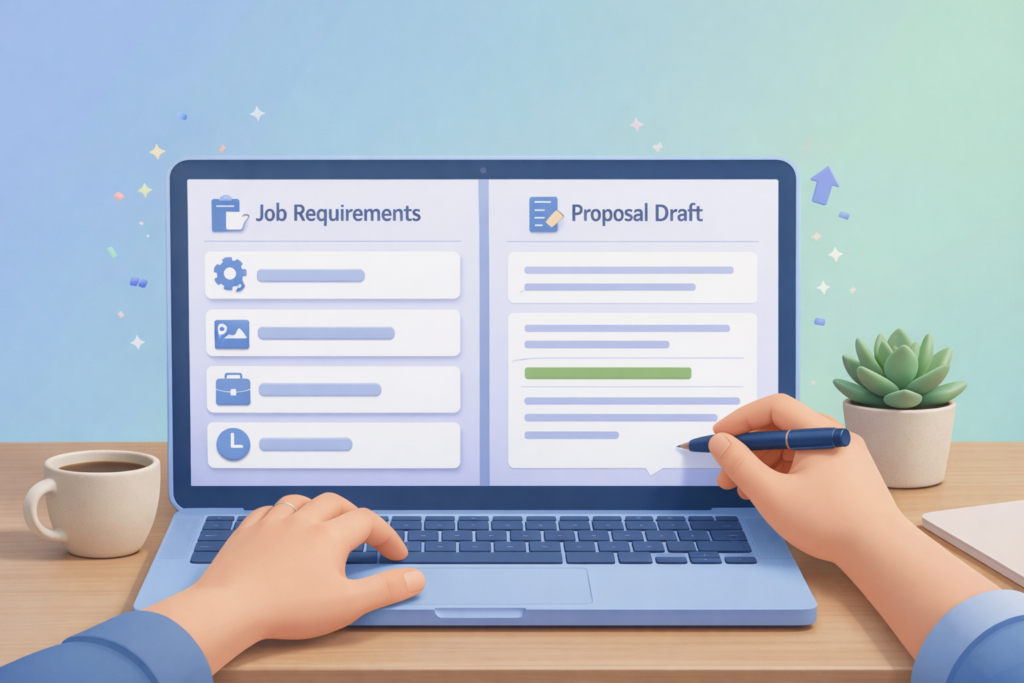
Step 6: Handle interviews like a scope and trust process
Winning an interview is progress, not success. Many freelancers lose after the interview because they overexplain, underscope, or fail to make the next step easy. Treat interviews as a structured scope and trust process.
Response speed and professionalism
- Reply quickly when possible (within a few hours if you can).
- Keep your answers concise and directly tied to outcomes.
- Confirm you understand the goal in one sentence.
- Ask only the questions you need to deliver accurately.
- Offer a short next step (call, milestones, or a 1-page plan).
Pro tip: Instead of arguing about price, reduce scope. Offer a smaller first milestone that proves value quickly. This approach lowers client risk and gets you to a review faster.
Interview checklist (use this to avoid scope confusion)
- Goal: What does success look like in measurable terms?
- Deliverables: What exactly will be delivered and in what format?
- Timeline: When does the client need it and what constraints exist?
- Dependencies: What access, assets, or inputs are required?
- Communication: Where will updates happen and how often?
Clients choose freelancers who reduce uncertainty. Clear milestones and next steps feel safer than vague reassurance.
Step 7: Deliver for reviews, repeat work, and referrals
Fast client acquisition improves dramatically once you have momentum. A strong first contract creates a review, builds trust signals, and makes your next applications easier. This is why delivery is part of how to get Upwork clients fast long term.
Deliver in a way that makes feedback easy
- Confirm scope in writing before you start.
- Send one early progress update to reduce anxiety.
- Deliver with a short summary: what you did, how to use it, and what to expect.
- Include a “next improvements” section (1–3 ideas).
- Close with a polite feedback request after successful completion.
Pro tip: Add one small “above and beyond” improvement that is relevant and low-risk (a checklist, a short Loom summary, a quick QA pass). This often increases review quality and repeat work.
Turn one contract into ongoing work
- Suggest a maintenance or iteration plan (weekly or monthly).
- Offer a second-phase milestone tied to a clear outcome.
- Ask what else is on their roadmap that you could support.
- Document what you learned so follow-up work is faster.
- Build a simple client folder: scope, assets, decisions, and results.
Repeat clients are the fastest clients. When you reduce the need to bid, you accelerate income and stability at the same time.
Step 8: Systemize your outreach and improve weekly
Freelancers who “try harder” for a week and then burn out rarely see consistent results. Consistency comes from systems. Create a repeatable weekly routine that protects your time, improves your assets, and tracks the data that matters.
A simple weekly acquisition workflow (example)
- Daily (30–45 minutes): filter jobs, apply to best-fit posts, update tracking.
- Twice per week: refresh your “proof library” (add a new snippet, improve one case study).
- Weekly (30 minutes): review metrics and adjust targeting or proposal openers.
- Biweekly: update your profile based on the jobs you want more of.
- Monthly: raise rates or tighten scope based on outcomes and demand.
Track metrics that directly improve speed
| Metric | What it tells you | What to improve if it is low |
|---|---|---|
| Proposal views → replies | Message relevance and clarity | Opening lines, proof, scannability |
| Replies → interviews | Client confidence and next step | Ask one clear question, propose a short plan |
| Interviews → contracts | Scope control and trust | Milestones, clearer deliverables, smaller first step |
| Contracts → repeat work | Delivery quality and relationship | Summary, improvements list, retention offer |
Do not optimize everything at once. Pick the bottleneck metric and improve only that for the next 7–14 days.
How Zenlance supports faster Upwork client acquisition
Most freelancers lose time in the same places: rewriting proposals from scratch, searching for past examples to prove credibility, and forgetting to follow up because everything is scattered across notes, drafts, and inbox threads. These small frictions slow your cycle time and reduce consistency.
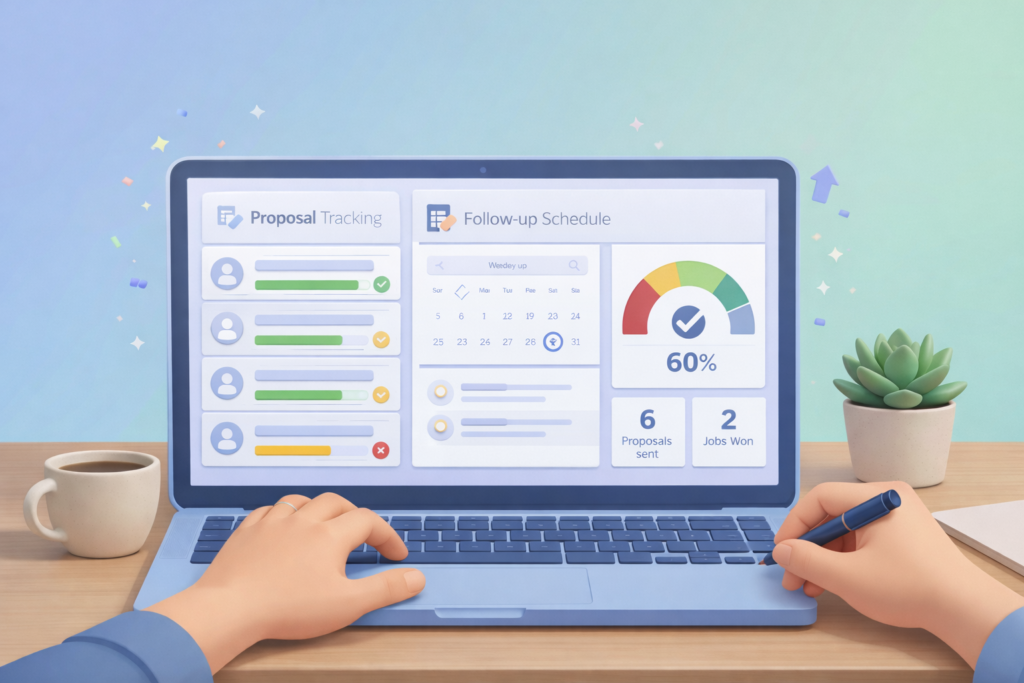
Zenlance is designed to reduce those bottlenecks by supporting a structured workflow:
- Proposal drafting support: generate a strong first draft quickly so you can focus on personalization and proof.
- Template organization: maintain niche-specific templates and modular sections (openers, proof snippets, deliverables).
- Client pipeline visibility: track where each opportunity sits (applied, replied, interview, won, follow-up).
- Follow-up reminders: reduce missed opportunities by prompting timely check-ins.
- Process consistency: standardize what “good” looks like so your results are repeatable.
The goal is not automation for its own sake. The goal is faster execution without losing relevance. When you can submit higher-quality proposals consistently, you increase the chances of winning the right jobs quickly.
Frequently Asked Questions
How long does it take to get the first client on Upwork?
Timelines vary by niche, proof, and consistency. Many new freelancers see interviews within a few weeks when they specialize, apply to strong-fit jobs, and improve proposals based on feedback. Faster results typically come from narrowing scope and emphasizing proof.
Is boosting proposals a reliable way to get hired faster?
Boosting can improve visibility for a strong-fit job, but it does not replace positioning and a clear proposal. Use boosting selectively for opportunities where you can demonstrate direct relevance and respond quickly if the client replies.
How many proposals should I send each day?
A small number of highly targeted proposals often outperforms high volume. If you consistently apply to the best-fit jobs with a tailored opening and proof, 5–10 proposals per day can be enough to build momentum.
What should I do if clients view my proposal but do not reply?
This usually indicates that your opening is not specific enough, your proof is not strong, or your next step is unclear. Tighten the first two lines, include one relevant example, and end with one concise question that moves toward a call or milestone.
Does niche specialization matter for how to get Upwork clients fast?
Yes. Specialization reduces the client’s uncertainty and makes your offer easier to compare. A specialist profile and proposal typically match more closely to a job post, improving reply rates and shortening the decision cycle.
Should I lower my rates to get hired quickly?
Lower rates can help you earn early reviews in some situations, but it is often better to reduce scope instead. A smaller first milestone protects quality, improves client confidence, and helps you build proof without committing to undervalued work.
What is the fastest way to turn one client into multiple projects?
Deliver with a clear summary, propose 1–3 next improvements, and offer an optional second phase with a defined outcome. Many clients have ongoing needs; they simply want a freelancer who makes the next step easy.
Recommended
Backlink outreach opportunities
- Upwork Resources / Upwork Help Center ecosystem: This guide complements official guidance by turning platform features into a step-by-step workflow (include the relevant Upwork Help Center links).
- Semrush: The proposal personalization and conversion tracking sections align with broader content and conversion principles.
- Ahrefs: The positioning and specialization sections align with competitive differentiation and marketing fundamentals.
External links used in this article: