
Upwork Fixed Price vs Hourly: Which Contract Type Should You Choose? (2026)
Every job you accept on Upwork falls into one of two contract structures, and the upwork fixed price vs hourly decision between upwork fixed price vs hourly affects more than just how you get paid — it affects how protected you are, how you manage scope, how clients perceive your work, and ultimately how much you earn per hour of effort invested. Most freelancers default to whichever contract type the client offers without thinking strategically about which actually serves them better. That passive approach costs money, creates avoidable disputes, and leaves protection mechanisms unused.
The upwork fixed price vs hourly question does not have a single correct answer. It depends on your skill category, your relationship with the client, how clearly the project scope is defined, how long the engagement will run, and your own preference for income predictability vs. time flexibility. A developer working on a two-week feature build has different contract needs than a writer producing weekly blog posts. A consultant doing discovery work has different needs than a designer delivering a logo with two revision rounds. Getting this decision right — consistently — is one of the distinguishing habits of freelancers who earn well and encounter fewer payment disputes.
This guide walks through everything you need to know about upwork fixed price vs hourly in 2026: how each contract type works mechanically, what payment protection applies to each, the earning implications for different skill categories, the risks each type carries and how to mitigate them, and the clear decision framework that tells you which to choose for each type of project you encounter in 2026.
Table of Contents
- Upwork Fixed Price vs Hourly: How Each Contract Works
- Section 1: How Billing and Payment Work — Upwork Fixed Price vs Hourly
- Section 2: Payment Protection — Upwork Fixed Price vs Hourly
- Section 3: Upwork Fixed Price vs Hourly — Scope, Flexibility, and Risk
- Section 4: Earnings and Rate Strategy for Each Contract Type
- Section 5: Upwork Fixed Price vs Hourly by Skill Category
- Section 6: Milestones — How to Structure Fixed-Price Contracts Safely
- Section 7: Hourly Contracts — The Work Diary, Time Tracking, and Rate Increases
- Section 8: Upwork Fixed Price vs Hourly for New Freelancers
- Section 9: Switching Contract Types and When It Makes Sense
- Common Upwork Fixed Price vs Hourly Mistakes to Avoid
- Upwork Fixed Price vs Hourly Decision Checklist
- Frequently Asked Questions About Upwork Fixed Price vs Hourly
Upwork Fixed Price vs Hourly: How Each Contract Works
Understanding the upwork fixed price vs hourly distinction starts with the fundamental mechanical differences in how each contract is structured, because these mechanics determine everything downstream — payment timing, dispute options, scope management, and income predictability.
A fixed-price contract is an agreement where the client and freelancer agree on a defined deliverable and a set payment amount before work begins. The contract is structured around milestones — discrete checkpoints where a defined piece of work is delivered and a pre-agreed payment is released.
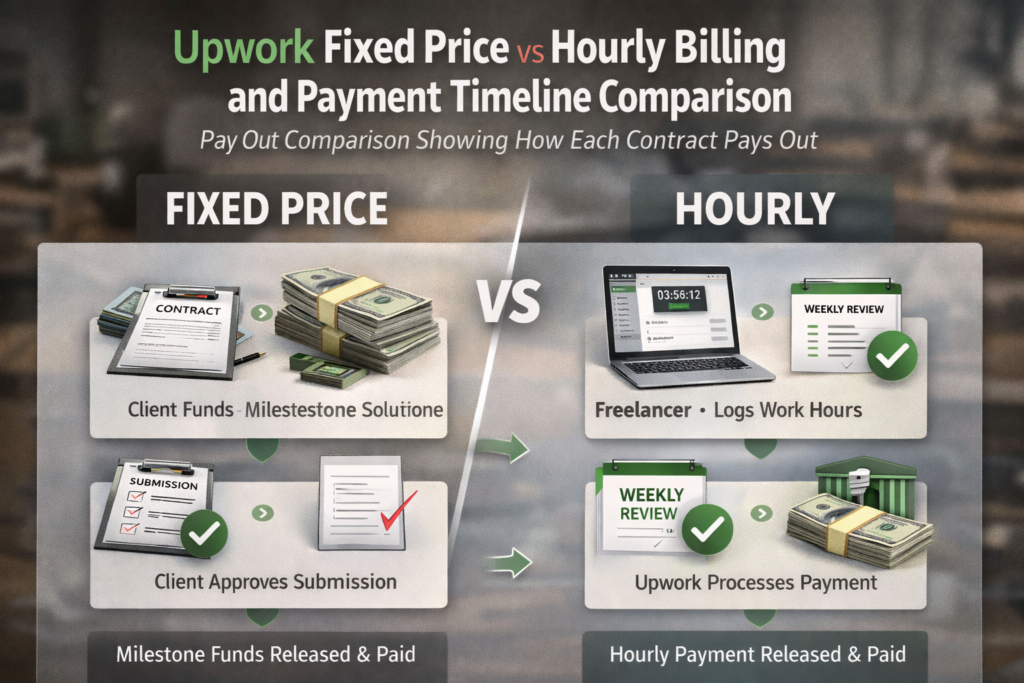
According to Upwork’s official contract comparison documentation, fixed-price contracts require clients to deposit milestone funds into a secure escrow account before work begins, and payment is released once the freelancer submits work and the client approves it — or after a 14-day review window passes without action. The minimum fixed-price project rate is $5.00 USD. Fixed-price contracts do not involve time tracking for billing purposes — you are paid for the deliverable, not the hours spent producing it.
An hourly contract is an arrangement where the freelancer is paid for every hour worked at an agreed rate, logged through Upwork’s time tracking system. The minimum hourly rate is $3.00 USD. Freelancers log time throughout the week using the Upwork Desktop App, which captures screenshots and activity levels as a work record. Hours are billed automatically every Monday for the prior week, and funds are released to the freelancer the following Wednesday if no dispute is filed. Hourly contracts are ongoing by nature — they have no built-in end date and no pre-agreed deliverable scope.
The upwork fixed price vs hourly decision is fundamentally a question of what you are selling: a result or a process. Fixed-price contracts sell outcomes — a deliverable with defined scope at a set price. Hourly contracts sell time — your availability, effort, and expertise applied to an evolving need. Neither is inherently superior. The right choice depends on whether the project has a clear, bounded scope or an open-ended, evolving one.
| Feature | Fixed-Price Contract | Hourly Contract |
|---|---|---|
| Payment basis | Defined deliverable / milestone | Hours worked and logged |
| Minimum rate | $5.00 USD per project | $3.00 USD per hour |
| Billing schedule | On milestone approval or after 14 days | Weekly (billed Monday, released Wednesday) |
| Scope definition required | Yes — defined upfront | No — can evolve over time |
| Time tracking required | No (optional for own records) | Yes — via Upwork Desktop App |
| Payment protection type | Fixed-Price Payment Protection (escrow) | Hourly Payment Protection |
| Best for | Defined deliverables, one-off projects | Ongoing work, evolving scope, long-term engagements |
Section 1: How Billing and Payment Work — Upwork Fixed Price vs Hourly
The billing mechanics of upwork fixed price vs hourly contracts differ significantly, and understanding them prevents the payment delays and surprises that catch many freelancers off guard.
Fixed-Price Billing
On a fixed-price contract, the client must fund each milestone into escrow before you begin working on it. This is a critical protection point: according to Upwork’s Fixed-Price Payment Protection documentation, only funds that are held in escrow at the time of your work submission are covered by protection. Any amount promised verbally or discussed outside of funded milestones is not protected — Upwork cannot help you recover it.
Once you complete a milestone and submit your work using the “Submit Work for Payment” button, the client has 14 days to review the submission. They can approve the work, request changes, or raise a dispute. If the 14-day window passes without any action from the client, the funds are automatically released to you. After release, the funds move to a five-day security hold before becoming available for withdrawal — so the total timeline from submission to withdrawable funds is typically 14–19 days for fixed-price contracts.
Hourly Billing
On an hourly contract, freelancers log time using the Upwork Desktop App throughout the week (Monday through Sunday, UTC time). Logged hours are automatically billed to the client every Monday. Clients have until Friday of that same week to review the Work Diary and file a dispute on any hours they believe are not related to the project. If no dispute is filed, funds are released to the freelancer the following Wednesday — meaning the standard payment cycle for hourly contracts is approximately 10–12 days from when hours are logged.
Clients on hourly contracts can set a weekly hour limit to cap their exposure. Freelancers should be aware of this limit before logging hours, as hours logged above the cap may not be covered by Hourly Payment Protection. The upwork fixed price vs hourly billing comparison generally favors hourly for cash flow regularity — the weekly billing cycle creates a more predictable income stream than waiting for milestone approvals on fixed-price work.
Section 2: Payment Protection — Upwork Fixed Price vs Hourly
Payment protection is one of the most important and most misunderstood dimensions of the upwork fixed price vs hourly comparison. Both contract types include Upwork Payment Protection, but the mechanics of each are different — and the conditions under which your pay is guaranteed vary significantly.
Hourly Payment Protection
For hourly contracts, Upwork’s Hourly Payment Protection guarantees that you will be paid for all time tracked through the Desktop App, as long as the hours meet the protection criteria: time must be logged via the app (not entered manually), screenshots must be captured, and the activity must be visibly related to the project. Hours that meet these criteria are protected even if the client disputes them — Upwork will investigate and protect qualifying hours regardless of the client’s position.
Critically, Hourly Payment Protection does not apply to manually entered time, bonus payments, or any hours logged above the client’s set weekly limit. This means that if you log 50 hours in a week but the client’s limit is 40, only 40 hours are protected. Know your weekly limit before you begin logging.
Fixed-Price Payment Protection
For fixed-price contracts, protection is tied exclusively to what has been funded into escrow. If a milestone is funded and you submit work through the official Upwork workflow, you are protected. If a client promises additional payment outside of a funded milestone — via message, email, or verbal agreement — that amount is entirely unprotected. Upwork’s documentation is explicit: only money held in escrow at the time of submission is covered.
The most important rule for protecting yourself on fixed-price work: never begin working on a milestone until the client has funded it. The “Funded” label must appear next to your milestone before you start. In the upwork fixed price vs hourly protection comparison, hourly contracts are generally considered more straightforward — if you track time correctly, you get paid. Fixed-price protection is equally strong when followed properly, but it requires more active management of milestones and escrow status.
| Protection Factor | Fixed-Price | Hourly |
|---|---|---|
| What is protected | Funded milestone amounts only | All tracked hours meeting criteria |
| Manual time included | N/A (no time tracking) | No — manual time not protected |
| Client can dispute | Yes — within 14-day review window | Yes — within the week’s billing cycle (by Friday) |
| Auto-release trigger | 14 days after submission with no action | Wednesday following the billing Monday |
| Unfunded promises protected | No | N/A |
| Over-limit hours protected | N/A | No — hours above weekly limit unprotected |
Section 3: Upwork Fixed Price vs Hourly — Scope, Flexibility, and Risk
The scope dynamics of upwork fixed price vs hourly contracts represent one of the most practically significant differences in day-to-day freelance work. How a project’s scope is defined — or not defined — at the start should be one of the primary inputs into your contract type decision.
Scope in Fixed-Price Contracts
Fixed-price contracts live or die by scope clarity. When you agree to deliver a defined outcome for a set price, the entire economics of the contract depend on your estimate of how long it will take being accurate. If the scope is clear and your estimate is right, fixed-price contracts can be extremely lucrative — skilled freelancers who work efficiently earn significantly more per actual hour on fixed-price work than they would on an equivalent hourly contract. If the scope is vague, poorly defined, or subject to change, fixed-price contracts expose you to scope creep: a phenomenon where the client gradually requests more work than was originally agreed, eroding your effective hourly rate with every additional revision or add-on.
Scope creep is the most common source of income loss in the upwork fixed price vs hourly fixed-price side. The antidote is meticulous upfront documentation: a written project brief that specifies exactly what is included, what constitutes a completed milestone, how many rounds of revisions are included, and what falls outside the agreed scope. Every addition beyond the documented scope should trigger a new milestone or a scope change discussion — never absorbed silently.
Scope in Hourly Contracts
Hourly contracts are purpose-built for open-ended or evolving scope. Since the client pays for time rather than a result, there is no built-in conflict between changing requirements and your compensation — you simply log the additional hours and they are billed accordingly. This makes hourly contracts naturally suitable for projects in the research or discovery phase, ongoing operational work, long-term consulting relationships, and any situation where neither party can accurately predict how much work will be required.
When considering upwork fixed price vs hourly, the risk in hourly contracts is not scope creep — it is the absence of any natural endpoint. Without milestones or defined deliverables, hourly contracts can extend indefinitely, and clients may gradually reduce scope or end the contract abruptly without warning. The upwork fixed price vs hourly risk profile flips depending on which type of uncertainty concerns you more: the risk of underpricing a complex deliverable (fixed-price risk) or the risk of an indefinite engagement that ends unpredictably (hourly risk).
Section 4: Earnings and Rate Strategy for Each Contract Type
The upwork fixed price vs hourly choice has significant implications for your actual earnings per hour, even when the headline rate looks equivalent. Smart freelancers think about effective hourly rate — total payment divided by total time invested — rather than just the posted rate or project amount.
Earning Potential on Fixed-Price Contracts
On the upwork fixed price vs hourly fixed-price side, fixed-price contracts reward speed and experience. If you can complete a $500 project in four hours because you have done similar work dozens of times, your effective rate is $125/hour. On an hourly contract, a client would only pay you for those four hours — and most clients would balk at a $125 hourly rate. Fixed-price packaging allows experienced freelancers to capture the value of their efficiency rather than being penalized for it. This is one of the strongest arguments for fixed-price contracts in the upwork fixed price vs hourly debate for freelancers whose skills are well-developed and whose project scope estimates are accurate.
The flip side: if your estimate is off — the project takes twelve hours instead of four — your effective rate drops to $41.67/hour. Accurate scoping is therefore an essential skill for fixed-price work. Freelancers who consistently underestimate complexity systematically undercharge themselves, and the solution is either better upfront scoping, smaller milestones that limit exposure, or a shift toward hourly contracts until scoping confidence improves.
Earning Potential on Hourly Contracts
Hourly contracts protect you against underestimation risk but cap your earnings at your agreed rate multiplied by hours worked. They also come with a significant advantage that fixed-price contracts lack: scheduled rate increases. According to Upwork’s official contract documentation, you can include a Scheduled Rate Increase directly in your initial proposal for a long-term hourly contract — specifying the date and amount of future rate adjustments upfront, so the client agrees to them before the contract starts. This eliminates the awkward negotiation of asking for a raise mid-contract and ensures your compensation grows with your value over time.
For long-term engagements on Upwork, hourly contracts with scheduled rate increases can produce compound income growth that fixed-price project-by-project work simply cannot replicate. A freelancer who secures a $75/hour retainer with a 10% annual rate increase built in starts at $150,000 in potential annual billing at 40 hours per week — and that rate rises automatically without renegotiation.

Section 5: Upwork Fixed Price vs Hourly by Skill Category
The upwork fixed price vs hourly preference varies significantly by skill category. Understanding the conventions in your field — and the reasoning behind them — helps you propose the right contract type in proposals and respond confidently when clients suggest a different structure.
Software and Web Development
Development work divides naturally along project phase lines. Discovery, architecture planning, and research phases suit hourly contracts — scope is inherently unclear during exploration, and charging fixed-price for an unknown quantity exposes you to significant underestimation risk. Build phases with clearly defined features and acceptance criteria can work as fixed-price milestones when scope is tightly documented. Long-term maintenance, support, and retainer arrangements almost universally suit hourly. In the upwork fixed price vs hourly calculation for developers, the rule of thumb is: hourly for complexity, fixed-price for clarity.
Writing and Content Creation
Writing lends itself to fixed-price contracts more than most categories because deliverables are well-defined (word count, format, number of pieces) and the scope is easily documented. A 1,000-word blog post is a 1,000-word blog post. Fixed-price per article or per content bundle is the standard in this category and generally produces a higher effective hourly rate for experienced writers who work efficiently. Ongoing content retainers — a set number of pieces per month — can work as either contract type, but recurring fixed-price agreements are common and easy to manage.
Design
Design projects mirror development in their scope-dependence. Logo creation with defined deliverables (three initial concepts, two revision rounds, final files) suits fixed-price well. UX/UI projects for complex applications — where iteration is continuous and requirements evolve with testing — often suit hourly better. Brand identity projects with clearly documented phase deliverables can be broken into fixed-price milestones (discovery, concepts, refinements, delivery). In the upwork fixed price vs hourly comparison for designers, the decision hinges almost entirely on how clearly the client can define “done.”
Virtual Assistance and Administrative Work
VA and admin work is the clearest hourly-wins case in the upwork fixed price vs hourly landscape. The work is ongoing, the scope changes daily, and there is no natural “deliverable” to define. Clients in this category expect to pay for time spent, and hourly contracts with scheduled rate increases are the standard — and most protective — arrangement for long-term VA relationships.
Consulting and Strategy
Consulting engagements can go either way depending on the engagement structure. One-time audits, assessments, or strategy documents suit fixed-price well — the deliverable is clear and bounded. Ongoing advisory relationships, fractional roles, and iterative consulting work suit hourly better. The upwork fixed price vs hourly decision for consultants often comes down to client preference and relationship stage: new clients may prefer the predictability of fixed-price; established relationships with a track record may naturally migrate to hourly retainers.
Section 6: Milestones — How to Structure Fixed-Price Contracts Safely
Milestone structure is the most important tactical skill in the upwork fixed price vs hourly fixed-price side. A well-structured milestone plan is the most important safety tool on the fixed-price side of upwork fixed price vs hourly. It protects your income, limits scope creep, and makes disputes easier to resolve. A poorly structured plan — one large milestone covering the entire project — concentrates all your risk into a single payment event and leaves you vulnerable if the client disputes at the end of a long engagement.
The Core Rule: Break Large Projects Into Small Milestones
Upwork’s own Fixed-Price Payment Protection documentation explicitly recommends breaking large projects into smaller milestones. The logic is straightforward: each funded milestone is a protected payment checkpoint. If you complete a $5,000 project as a single milestone and the client disputes at delivery, your entire $5,000 is in jeopardy. If you structure it as five $1,000 milestones — each covering a defined phase — a dispute at the final milestone only puts $1,000 at risk, and the four previously approved milestones are already paid and in your account.
Milestone Best Practices for Fixed-Price Work
- Fund before you start: Look for the “Funded” label next to each milestone before beginning any work. An unfunded milestone is an unprotected milestone — do not start work until the money is in escrow.
- Submit work formally: Always use the “Submit Work for Payment” button in Upwork’s interface rather than just delivering files via message. Formal submission triggers the 14-day review window and automatic payment countdown. Delivery outside the official workflow forfeits protection.
- Document scope per milestone: Write a clear description for each milestone that specifies exactly what will be delivered, what constitutes approval criteria, and how many revisions are included. This becomes the reference point if a dispute arises.
- Keep Upwork as the paper trail: All project communication, file delivery, and work discussion should remain on Upwork’s platform. Agreements made or evidence of work delivered outside the platform cannot be referenced in a dispute.
- Add milestones for scope changes: If the client requests work beyond the originally defined scope, create a new funded milestone before beginning that additional work — do not absorb it into an existing milestone.
The upwork fixed price vs hourly milestone strategy effectively turns fixed-price contracts into a series of small, protected transactions rather than one large, high-stakes payment event. This approach mirrors the cash flow regularity of hourly contracts while preserving the earning potential advantages of fixed-price.
Section 7: Hourly Contracts — The Work Diary, Time Tracking, and Rate Increases
Succeeding on the hourly side of upwork fixed price vs hourly requires understanding how the Work Diary functions and how to use it to protect your pay and build trust with clients.
The Upwork Work Diary
The Work Diary is Upwork’s record of your tracked time on hourly contracts. The Desktop App takes screenshots at random intervals within each 10-minute billing segment, captures your activity level (keystrokes and mouse movements as a percentage), and records a memo field where you can describe what you are working on. This diary is visible to your client in real time and serves as the primary evidence in any payment dispute.
To maximize your protection and your client’s confidence, write meaningful memos that clearly describe the work being done during each time segment: “Drafting homepage copy for Section 3,” “Debugging user authentication API,” or “Researching competitor pricing for strategy document” are all clear, project-relevant descriptions. Vague memos like “working” or blank memo fields are harder to defend in disputes and reduce client trust.
Setting and Protecting Your Hourly Rate
Your hourly rate on Upwork is negotiated with each client at the start of the contract and can only be changed by starting a new contract — mid-contract rate adjustments require creating a new agreement. The exception is the Scheduled Rate Increase feature, which allows you to build future rate adjustments into the original contract. According to Upwork’s documentation, you can propose a rate increase schedule — specifying the frequency and percentage increase — in your initial proposal, and the client can approve, decline, or edit it before the contract starts. This is one of the most underused features in the upwork fixed price vs hourly toolkit for hourly freelancers building long-term relationships.
If a client proposes an hourly contract at a rate below what you need, negotiate before accepting — rate discussions are expected and accepted during the proposal stage. Once a contract starts, your leverage to negotiate is significantly reduced.

Section 8: Upwork Fixed Price vs Hourly for New Freelancers
The upwork fixed price vs hourly question is particularly consequential for new freelancers who are still calibrating their value, building their first reviews, and learning how Upwork’s payment and protection systems work.
The Case for Starting with Hourly
When new freelancers consider upwork fixed price vs hourly, hourly contracts offer several structural advantages. The weekly billing cycle provides faster cash flow than waiting for milestone approvals. Hourly Payment Protection is more straightforward to qualify for — as long as you track time correctly with the Desktop App, you will be paid. There is no risk of underscoping a project and effectively working for pennies per hour because your estimate was off. And hourly contracts with good reviews are a reliable way to build a track record on the platform before taking on higher-value, higher-stakes fixed-price work.
The Case for Fixed-Price Early On
Fixed-price contracts can work well for new freelancers in categories where deliverables are crystal clear: a blog post, a logo, a landing page. Clients in these categories are comfortable with fixed-price structures, the scope is easy to define, and the per-project review cycle generates individual reviews that build your profile faster than one long hourly contract. New freelancers who price fixed-price work competitively to win those first reviews can establish a strong foundation quickly.
The caution for new freelancers approaching upwork fixed price vs hourly on the fixed-price side: avoid large, complex, single-milestone projects until you have experience scoping similar work. The risk of a poorly scoped $2,000 project running to 40 hours of work instead of 10 is not worth the early income — start with smaller, well-defined milestones and build your scoping confidence incrementally.
Section 9: Switching Contract Types and When It Makes Sense
Sometimes the upwork fixed price vs hourly decision you made at the start of a client relationship needs to change. A fixed-price project can evolve into an ongoing engagement that would suit hourly better. An hourly arrangement can mature into a scope-clear phase that would benefit from fixed-price milestones. Upwork allows you to switch contract types, but it requires starting a new contract — you cannot convert an existing hourly contract to fixed-price or vice versa in place.
According to Upwork’s official guidance on switching contract types, if you have not yet activated the original contract with any payment, you can cancel and restart without incurring an additional Contract Initiation Fee. If the original contract has already been activated — hours logged or milestones funded — a new Contract Initiation Fee will apply to the new contract. Factor this cost into your decision when considering whether to renegotiate contract structure mid-relationship.
The most common upwork fixed price vs hourly switch scenario is a fixed-price project that completes successfully and the client wants to continue with ongoing work. When a project evolves into an ongoing relationship, proposing a new hourly contract — with a rate that reflects the successful delivery and established trust — is a natural transition. This switch often comes with a rate increase, since the relationship risk for the client is now lower and your value is demonstrated.
Common Upwork Fixed Price vs Hourly Mistakes to Avoid
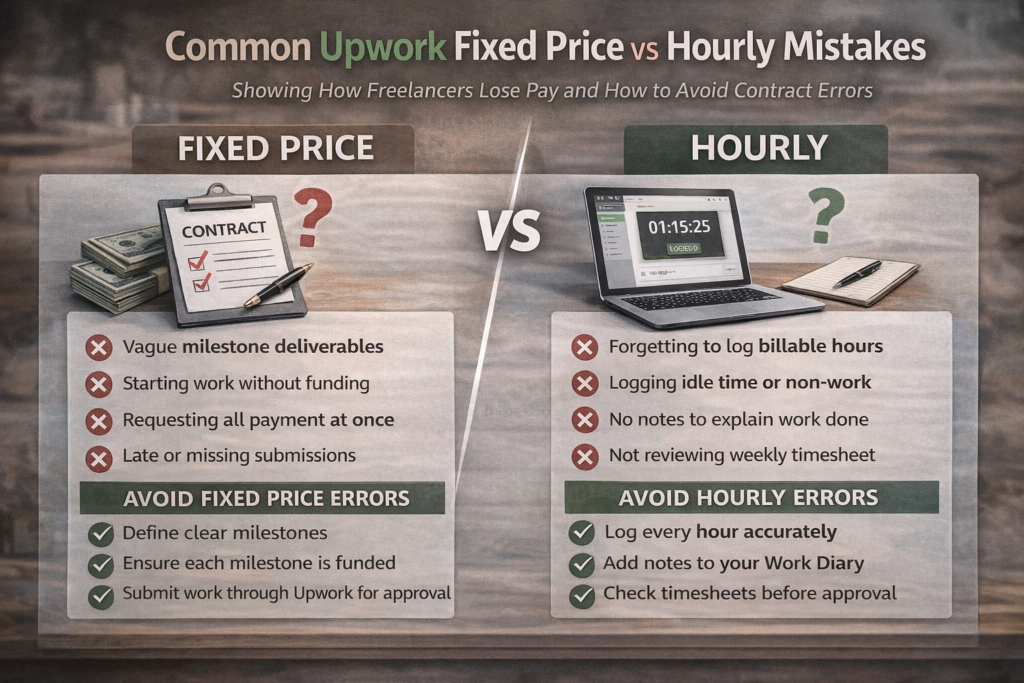
These errors appear consistently across both sides of the upwork fixed price vs hourly decision and cause the most common payment disputes, scope conflicts, and earnings shortfalls on Upwork.
1. Starting work on a fixed-price milestone before it is funded. This is the most costly mistake on the fixed-price side of the upwork fixed price vs hourly equation. An unfunded milestone is an unprotected milestone. Any work done before the client deposits funds is not covered by Fixed-Price Payment Protection. Always confirm the “Funded” label before starting any phase of work — no exceptions, regardless of how much you trust the client or how urgently they need the work.
2. Using manual time entry on hourly contracts and expecting protection. Manual time on hourly contracts is not covered by Hourly Payment Protection. If you log hours manually rather than through the Desktop App — even for time genuinely spent on the project — those hours are unprotected and the client can dispute them without Upwork’s protection applying. Use the Desktop App for all billable time on hourly contracts.
3. Structuring a large fixed-price project as a single milestone. A $3,000 single-milestone contract is a $3,000 single point of failure. If the client disputes at the end of a long engagement, the entire amount is at risk. Breaking the same project into six $500 milestones limits your maximum exposure at any point to $500 and creates six separate approval checkpoints that build shared understanding and reduce end-of-project surprises.
4. Accepting fixed-price work without documenting scope in writing. Verbal scope agreements — even in Upwork messages — are less defensible than a clearly written milestone description that specifies deliverables, revision rounds, and acceptance criteria. Before starting any fixed-price milestone, ensure the scope is explicitly written into the milestone description or the initial message thread. This documentation becomes your evidence if a dispute arises.
5. Choosing contract type based on client preference alone. The upwork fixed price vs hourly decision should be driven by project characteristics, not just what the client initially proposes. Clients often default to fixed-price because they want budget certainty — but for complex, evolving work, that structure protects the client at your expense. It is entirely professional to explain why hourly is the better fit for a given project type and to propose a weekly cap if the client needs budget protection.
6. Failing to build scheduled rate increases into long-term hourly contracts. Hourly contracts that run for months or years without rate adjustments quietly erode your real compensation as your skills, speed, and value increase. The Scheduled Rate Increase feature eliminates this problem — proposing one at contract start is professional, expected, and protects your long-term income without awkward mid-contract negotiations. Not using it on long-term upwork fixed price vs hourly hourly contracts is leaving compound income growth on the table.
7. Delivering work outside the formal Upwork submission workflow. On fixed-price contracts, files and work sent via message or shared through external links do not trigger the 14-day payment review window or the automatic payment release. Always use the “Submit Work for Payment” button. Work delivered informally is not formally submitted — meaning the payment countdown never starts and the client has no platform obligation to approve it.
8. Ignoring the client’s weekly hour limit on hourly contracts. If a client sets a weekly hour limit of 20 hours and you log 30, the extra 10 hours are not covered by Hourly Payment Protection. Know your contracted weekly limit before logging each week, and either stay within it or discuss adjusting it with the client before logging above it. This is a common and avoidable source of disputed hours in the upwork fixed price vs hourly hourly context.
Upwork Fixed Price vs Hourly Decision Checklist
- ☐ Is the project scope clearly defined with specific, verifiable deliverables? → Lean fixed-price
- ☐ Is the project scope open-ended, evolving, or hard to define upfront? → Lean hourly
- ☐ Is this a long-term ongoing engagement (weeks or months)? → Lean hourly
- ☐ Is this a one-off project with a clear end state? → Lean fixed-price
- ☐ If choosing fixed-price: is the first milestone funded before you start?
- ☐ If choosing fixed-price: is the project broken into multiple milestones (not one large payment)?
- ☐ If choosing fixed-price: is the scope written explicitly in the milestone description?
- ☐ If choosing hourly: is the Desktop App installed and ready to track all billable time?
- ☐ If choosing hourly: do you know the client’s weekly hour limit before starting?
- ☐ If choosing hourly for a long engagement: did you propose a Scheduled Rate Increase?
- ☐ Have you kept all project communication, file delivery, and scope discussions on Upwork?
- ☐ Does your contract type match the conventions in your skill category?
Frequently Asked Questions About Upwork Fixed Price vs Hourly
Which is safer — Upwork fixed price or hourly?
Both contract types include payment protection, but they protect different things. In the upwork fixed price vs hourly safety comparison, hourly contracts are generally considered easier to protect — as long as you track time through the Desktop App, you will be paid for qualifying hours regardless of client disputes. Fixed-price protection is equally strong but requires more active management: every milestone must be funded before you start, and all work must be submitted through the formal submission workflow. For freelancers new to Upwork, hourly contracts tend to produce fewer payment complications because the protection mechanism is more automatic.
Can I switch from a fixed-price to an hourly contract mid-project?
Yes, but not by converting the existing contract — you need to close the current contract and open a new one with the different structure. According to Upwork’s official guidance, if the original contract has already been activated with a payment, a new Contract Initiation Fee will apply when the replacement contract is funded. If no payment has been made yet, you can cancel and restart without the additional fee. Both parties must agree to the switch, and both have 14 days after the contract closes to leave mutual feedback.
Is fixed-price or hourly better for getting more work on Upwork?
In the upwork fixed price vs hourly comparison for winning proposals, neither contract type is definitively better — what matters more is matching your proposed structure to the client’s project type. Clients with clear, bounded deliverables often prefer fixed-price for budget predictability. Clients with ongoing or evolving needs often prefer hourly for flexibility. Proposing the wrong contract type for a client’s project can hurt your proposal’s appeal. Read the job post carefully and propose the contract type that genuinely fits the work — clients notice when a freelancer understands their project well enough to suggest the right structure.
Does Upwork take a different fee on fixed-price vs hourly contracts?
No — Upwork’s service fee structure applies equally to both contract types. As of 2025, Upwork charges freelancers a variable fee of 0–15% on earnings from both hourly and fixed-price contracts, with the specific rate determined at proposal submission based on market conditions. The upwork fixed price vs hourly fee structure is the same; the difference in take-home pay comes from effective rate management (accurate scoping on fixed-price, rate increase planning on hourly), not from the fee applied.
What happens if a fixed-price client doesn’t approve my milestone?
If you submit a milestone for payment and the client takes no action within 14 days, the funds are automatically released to you — you do not need their explicit approval for payment to proceed. If the client actively refuses to release payment for a completed milestone, you can file a dispute. Upwork will review the dispute using the evidence in your milestone description, the work submitted, and the message thread. This is why keeping all communication on Upwork and documenting scope clearly in the milestone are essential in the upwork fixed price vs hourly fixed-price context.
How many milestones should a fixed-price contract have?
The right number depends on project size and complexity, but the general principle in the upwork fixed price vs hourly milestone strategy is: more milestones are almost always safer than fewer. For a project over $500, three or more milestones is standard. For projects over $2,000, five or more is recommended. Each milestone should represent a distinct, verifiable phase of work with its own funded amount. Breaking work into smaller milestones limits your payment exposure at any point, builds client trust through incremental deliveries, and creates a clearer record of approved work if a dispute ever arises at the end.
How Zenlance Helps You Manage Upwork Fixed Price and Hourly Contracts
Navigating the upwork fixed price vs hourly decision is only the beginning. Once contracts are active — whether you are tracking milestone approvals on fixed-price work or managing weekly hour logs on hourly engagements — the operational side of freelancing can quickly overwhelm a scattered inbox and a spreadsheet. Missing a milestone funding confirmation, forgetting to follow up after a submission, or losing track of which client is on which contract type are exactly the kinds of errors that cause avoidable disputes and delayed payments.
Zenlance is a free AI-powered CRM built specifically for freelancers on Upwork and Fiverr. It gives you a unified dashboard to track every active contract, monitor project deadlines, manage client communication history, and ensure nothing falls through the cracks — regardless of whether your contracts are fixed-price, hourly, or a mix of both. The platform also includes an AI proposal generator to help you craft faster, more targeted proposals when you are deciding how to pitch your next upwork fixed price vs hourly contract type. Start free at zenlance.net.
Recommended Reading
- Upwork Profile Optimization: The Complete Guide to Winning More Clients in 2026
- Upwork Job Success Score: How It Works and How to Improve It in 2026
- How to Write a Winning Upwork Cover Letter in 2026
- Upwork Connects: How Many Do You Need and How to Save Them (2026)
- How Many Proposals Should You Send on Upwork Per Day? (2026 Guide)
- Fiverr vs Upwork: Which Platform Is Better for Freelancers in 2026?
- Free AI CRM for Freelancers: Manage Clients, Tasks, and Projects in 2026